
Finfluencers, trust and a $350B buying question
SEBI's finfluencer warning collides with a $350 billion creator economy. Inside the debate on whether credibility can be monetised without being spent.
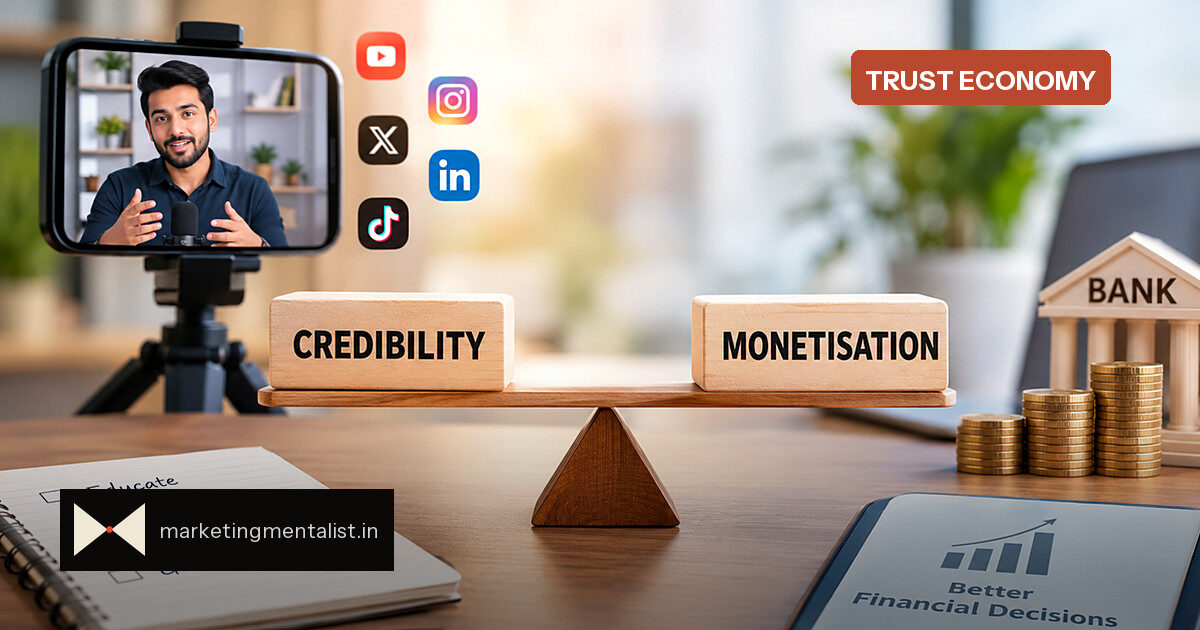
The Indian markets regulator has turned the creator economy’s trust question into a public warning. Earlier this month, SEBI chairman Tuhin Kanta Pandey cautioned investors against relying on finfluencers, anonymous tips and exaggerated return claims as household participation in capital markets grows. The timing matters: creators are pulling financial products into the awareness funnel faster than most brands can, but credibility is becoming the scarce input.
The scale is no longer niche. A May 2025 Boston Consulting Group estimate puts India’s active digital creator base at 2–2.5 million people, shaping more than $350 billion in annual consumer spending. That number is projected to cross $1 trillion by 2030. Yet only around 8–10% of creators are estimated to monetise their content effectively, and financial creators face a sharper version of the problem: one misleading call can cost an audience real savings and a creator their licence to influence.
The gap between followers and influence
At the afaqs! BankFin 360 conference, a fireside chat on finfluencers and the trust economy brought together Abhishek Garg, a business mentor and financial content creator since 2018, and Prashant Chaudhari, head of marketing at Fino Payments Bank. Garg’s core point was that the post-Covid surge in financial content made information more accessible, but also let unqualified voices make quick-return promises. As audiences mature, they increasingly sort informed creators from aspirational noise.
He drew the line simply: “Ultimately, there’s a difference between having followers and having influence.” For him, reporting a Reserve Bank of India policy change is not enough; the useful creator explains what it means for loan EMIs and household spending power.
Chaudhari added a caution. Consumers are not uniformly shifting trust from institutions to personalities. Some do their own research; others lean on creators. The danger sits in the middle, where an easy-money promise is hard to tell apart from sound guidance.
The family test before the brand deal
Before promoting anything, Garg runs a three-question screen:
- Would I use this myself or recommend it to my family?
- Could it harm someone’s financial well-being?
- Does it genuinely add value?
He also avoids unregulated offerings such as unauthorised forex trading platforms. That screen is the mechanism behind his distinction between reach and influence, and it is easy for any marketer to borrow when auditing creator partnerships.
Chaudhari’s trust architecture is different. Fino Payments Bank follows a merchant-led rather than branch-led model, with around 20 lakh merchants across India. These neighbourhood bankers often know customers and their families personally. “Trust is built not just through the brand, but through the people who deliver our services to customers,” he said. The insight for brands: trust can be local and human even when the product is digital.
On responsibility, Chaudhari suggested platforms could introduce a verification badge for registered financial professionals. It would not guarantee trustworthiness, but it would help audiences separate qualified voices from unqualified ones.
What monetisation without self-destruction looks like
Garg’s economics are small but telling. Instead of ten brand deals at Rs 100 each, a credible creator might take three at Rs 350 each. The math is nearly identical, but the trust cost is much lower. A recommendation that feels curated builds recall long after the post is gone, and can influence a purchase decision months later.
Creators also need to treat influence as a business. That means managing their own money conservatively and preparing for regulatory and market cycles. Garg’s warning is blunt: “Money doesn’t necessarily change your character; it amplifies it.” Audiences, he says, eventually see through people who trade credibility for short-term income.
For brands, the selection shift is already visible. Fino evaluates creators on three parameters: values and ethics, qualifications and expertise, and storytelling ability. That is the useful sequence—character first, competence second, craft third. Reach and engagement are distribution, not proof of influence.
The strategic takeaway is that trust is not the enemy of monetisation; it is the pricing mechanism. Brands that screen for it and creators who protect it can charge a premium. Everyone else competes on volume.
Source: Afaqs!