What Somany’s Brand Refresh Teaches About Durable Positioning
Somany's shift from a celebrity tagline to an architect-focused identity shows how brands stretch across emotional and technical buying jobs.
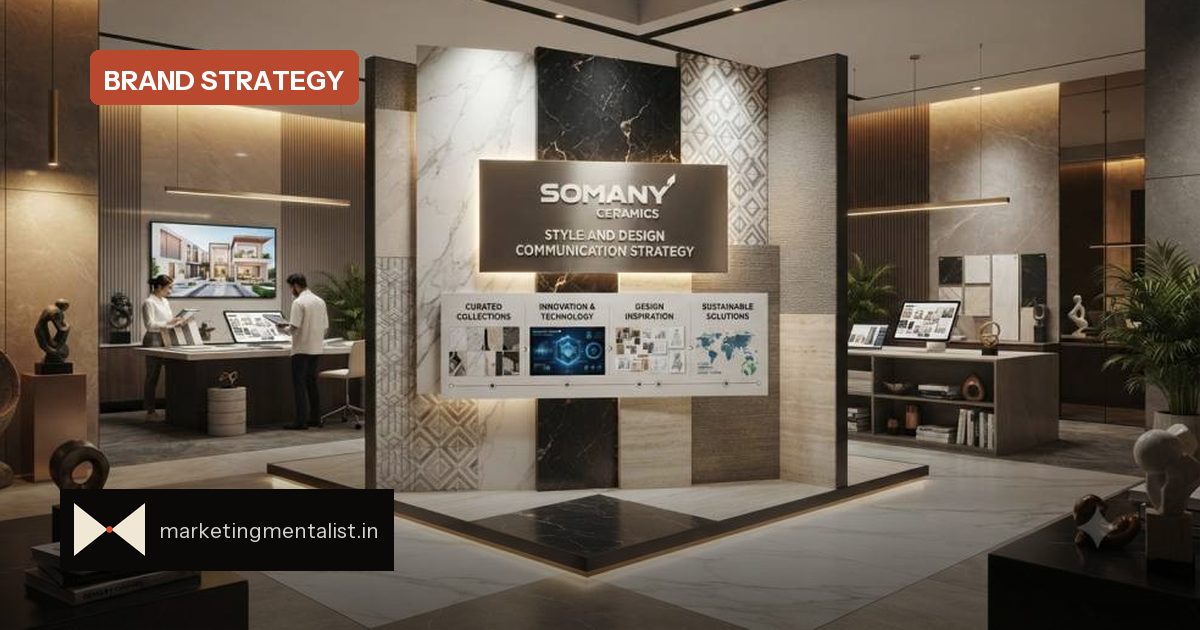
Somany Ceramics has just given brand managers a live case in stretching one brand across two very different buying minds. For years, its consumer-facing story was built around the Hindi tagline “Zameen Se Judey” — translated in company material as “Rooted in the Ground” — anchored by Salman Khan from around 2019 and extended in 2024 with Varun Sharma to balance strength and approachability. In April 2026, the company shifted emphasis with a corporate identity refresh aimed at architects, designers, retailers and consumers.
The new identity, according to the company release, introduces softer curves that mirror modern spaces, a stronger red for energy and scale, and a blue arrowhead for forward momentum. It also turns SOMANY into an acronym for Scale, Originality, Momentum, Assurance, New Horizons and Young.
Why the shift makes competitive sense
India’s tiles market is structurally split. The organised segment held about 46% share in FY25 and is projected to reach 55% by FY29, yet Morbi in Gujarat still accounts for an estimated 80–90% of production across the wider industry. In that price-led unorganised base, established brands compete less on cost and more on trust, design credibility, showroom experience and perceived durability.
Inside the organised tier, Kajaria Ceramics leads with roughly 17% volume share, while Somany and Prism Johnson sit at about 9% each. That runner-up position raises the stakes for branding: Somany cannot win on raw price against Morbi, and it cannot simply outspend the leader.
- 11 manufacturing units, more than 15,000 retail points and 500-plus exclusive showrooms.
- FY24 revenue of ₹2,577.32 crore; net profit up 33.63% to ₹96.88 crore.
- FY25 turnover of INR 26.43 billion, up 2.6%, with 70.85 million square metres sold.
- A mission statement that frames the category around “pursuing the latest fashion trends,” not price or distribution alone.
Two buying jobs, two brand assets
The “Zameen Se Judey” campaign was a memory play: use a familiar face, a simple value and a consistent tagline to make durability and rootedness feel tangible. The 2026 identity refresh is a specification play. It explicitly names architects and designers as a distinct audience and carries the new system across retail, packaging, digital and communication platforms.
This is not abandoning the emotional platform. It is layering a technical, future-facing identity on top of it. In considered-purchase categories such as tiles, the person who falls in love with the brand and the person who specifies it are often different.
What marketers should do
A useful rule from the case is to separate the memory asset from the specification asset. Keep the memory asset—tagline, colour, ambassador, rootedness—alive for consumer recall. Refresh the specification asset—design language, trade credibility, architectural identity—when influence in the purchase chain shifts.
Somany kept visual continuity while signalling momentum. That reduces recognition cost and gives architects a reason to re-evaluate the brand. For brand managers, the action is to map the purchase chain first. If installers, architects or contractors hold disproportionate influence, invest in a separate credibility system for them—and then watch whether that influence actually moves share, not just awareness. The source notes that public brand-tracking and campaign-attribution data are thin, so financial results here should be read as context, not proof of campaign effectiveness.
Source: MarkHub24