The Psychology of an Ad: Whisper India’s Touch the Pickle
A 2014 Whisper India film made a jar of pickle a symbol of defiance. Here are the behavioural levers that made the taboo work for the brand.
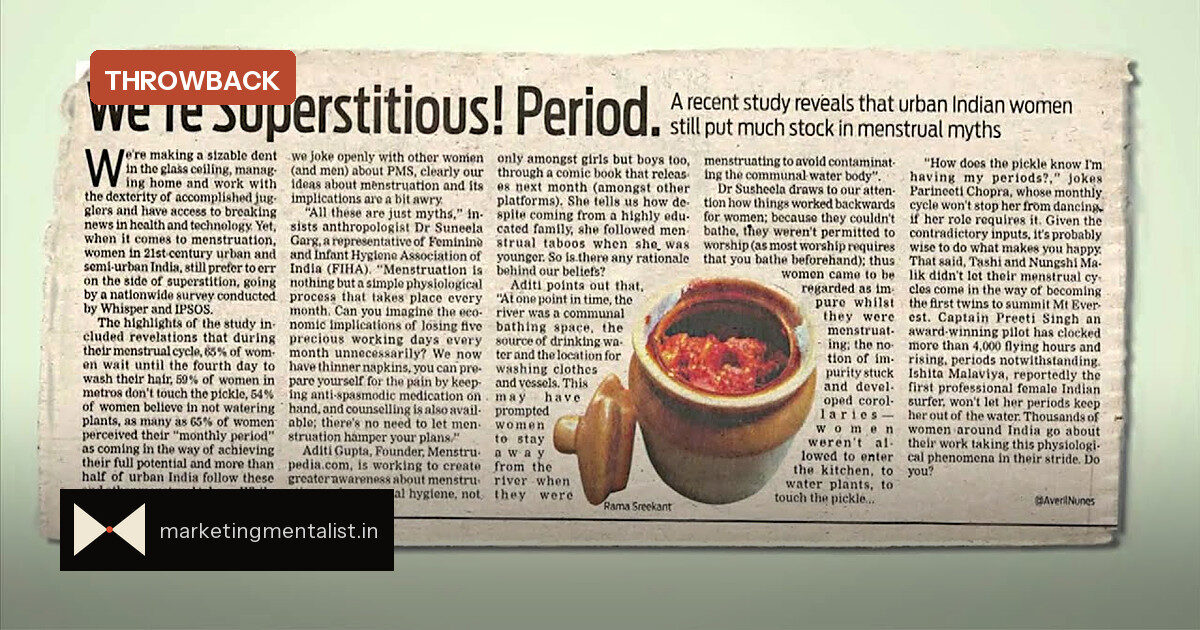
The ad and when it ran
Whisper India’s “Touch the Pickle” launched in 2014, created by BBDO India. It is a small-scale film built around one of India’s strangest period rules: a woman who is menstruating should not touch the pickle jar, or she will spoil it. The film treats this not as a superstition to be debunked quietly, but as a social dare.
The brand did not lead with absorbency or freshness. It led with a question most people had stopped asking: why does this rule exist? The tagline, “Touch the Pickle,” turned a prohibition into an instruction.
The levers it pulled
The film works as a compact lesson in behavioural science.
- Reactance. When people are told they cannot do something, especially for no good reason, they often want to do it more. The pickle rule is exactly that: a restriction with no logic left. By naming it, the ad triggers a small rebellion in the viewer.
- Social proof. The rebellion matters because it spreads. One woman touches the pickle, then others follow. The audience sees the new behaviour becoming normal, which reduces the social risk of joining in.
- Norm shifting. The ad reframes Whisper from a hygiene product into a badge of equality. It suggests that choosing the brand means choosing a new social norm, not just better protection.
Each principle does a different job: reactance creates the spark, social proof lowers the fear, and norm shifting gives the brand a lasting meaning.
What it did for the brand and the culture around it
The campaign turned a feminine-care brand into a participant in India’s gender conversation. Instead of a whispered problem, it treated menstruation as a public confidence issue. That was a departure from the category’s usual blue-liquid demonstrations and quiet, clinical reassurance.
The work became a reference point in Indian advertising. It proved a brand could take one specific ritual, challenge it directly, and make the challenge feel liberating rather than angry. Whisper earned attention as a brand with a point of view, and the campaign is still cited by marketers as an early example of Indian purpose advertising that did not feel imported.
What still works today and what would not
The core mechanic still works: pick a small, concrete rule; expose its absurdity; show people breaking it together. That is a durable template for brands that want to stand for something.
What would be trickier today is the execution’s narrow frame. The film centres a fairly privileged, urban, English-speaking setting. Modern audiences expect a sharper intersectional lens—caste, class, region and religion shape how taboos are enforced. A remake would need more diverse voices and a clearer follow-up: a campaign that challenges a norm without a long-term programme behind it can feel like cultural tourism.
Period taboos have not disappeared; they have moved online and into wellness language. The insight that shame hides in tiny everyday rules remains sharp. But audiences now also ask whether the brand’s own behaviour matches the message. If a feminine-care brand speaks about equality but does not invest in access or education, the gap becomes the story.
Watch the original: Whisper India on YouTube