KFC bets on store design to win back the chicken wars
KFC lost its top-three U.S. chicken spot in 2025. Now a store-first redesign, refreshed menu and Colonel Sanders aim to turn latent love into visits.
The modern chicken fight has a new shape. Tender-focused challengers such as Raising Cane’s, Dave’s Hot Chicken and Hangry Joe’s Hot Chicken & Wings are pulling in younger customers with sauce-forward menus and thick-cut pickles. At the same time, KFC—the legacy name in the category—has faded from the front edge. In 2025, Raising Cane’s pushed KFC out of the top three U.S. chicken restaurants by sales, behind Chick-fil-A and Popeyes.
Remembered, but not always chosen
KFC U.S. president Catherine Tan-Gillespie, who took the role in April 2025, sees both sides of the problem. The brand still carries, in her words, “huge latent love for the brand.” But affection is not the same as action. Losing its top-three position became what she called “the catalyst” for urgent work on making KFC more relevant, easier and more distinctive.
That distinction matters for any marketer. A brand can stay warm in memory while its salience decays: people recognise it, remember it fondly, and still choose something else when hunger hits.
From a Dubai preview to the store of the future
KFC has spent several years testing new chicken concepts, beverages and brand approaches. Now it is scaling a bigger transformation: a refreshed menu, a new brand platform, a campaign that brings back Colonel Sanders, and a ground-up restaurant redesign created with global agency JKR.
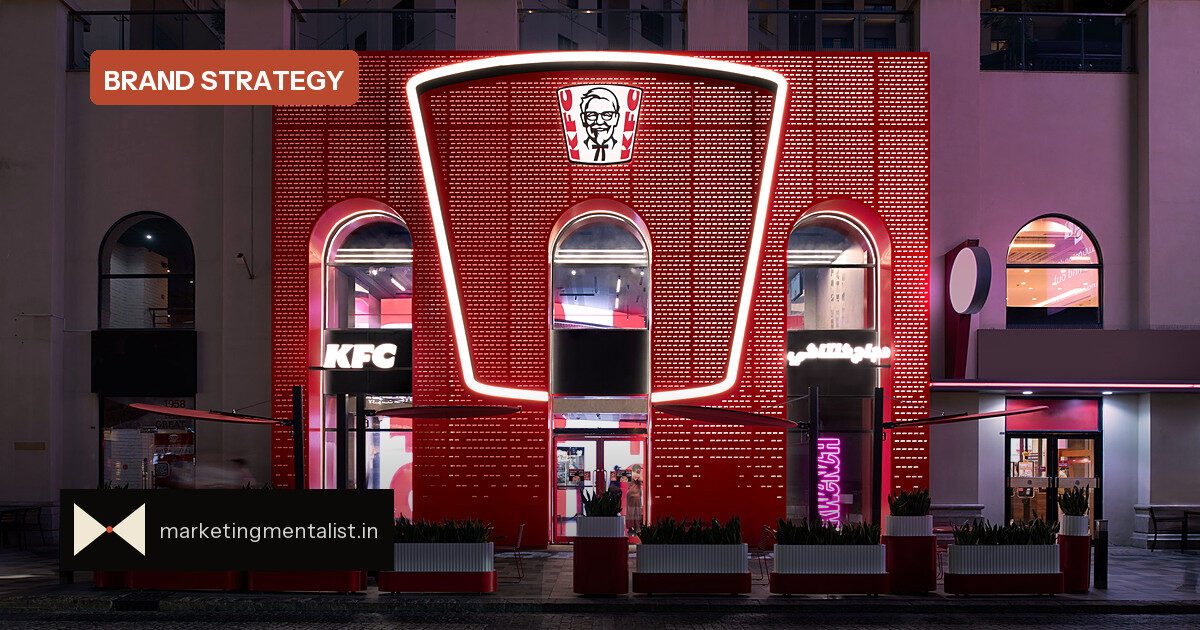
A Dubai unit already suggests where the design language is heading—a glowing red facade, giant archways, long-form content on a two-storey screen, a deliberately stark interior with two-tone red furniture and a neon wall mural. From October 31, KFC began testing what it calls a restaurant concept of the future.
Memory versus salience
The behavioural challenge here is not awareness but mental availability: how automatically KFC comes to mind in the buying moment, rather than how warmly it is remembered. The redesign is a bid to rebuild that cue at street level, before a single ad is seen.
What marketers can take from the move
This is not decoration dressed up as strategy. It is an attempt to turn latent affection into active preference by making the brand physically impossible to miss again. Legacy brands often have more permission to reinvent than they use—but reinvention has to be visible before it can change behaviour.
- Name the gap between memory and relevance before changing the logo.
- Treat store design as brand media, not just operations.
- Use a market share shock as a licence to move faster.
- Reintroduce familiar brand codes—like Colonel Sanders—inside a contemporary frame.
For KFC, the test is whether a bolder physical presence and a sharper platform can close the distance between “we love KFC” and “let’s go there tonight.”
Source: Fast Company