
The Psychology of the Ad: Asian Paints’ Har Ghar Kuch Kehta Hai
How Asian Paints turned a paint ad into an emotional story about home and belonging—and why Har Ghar Kuch Kehta Hai still resonates.
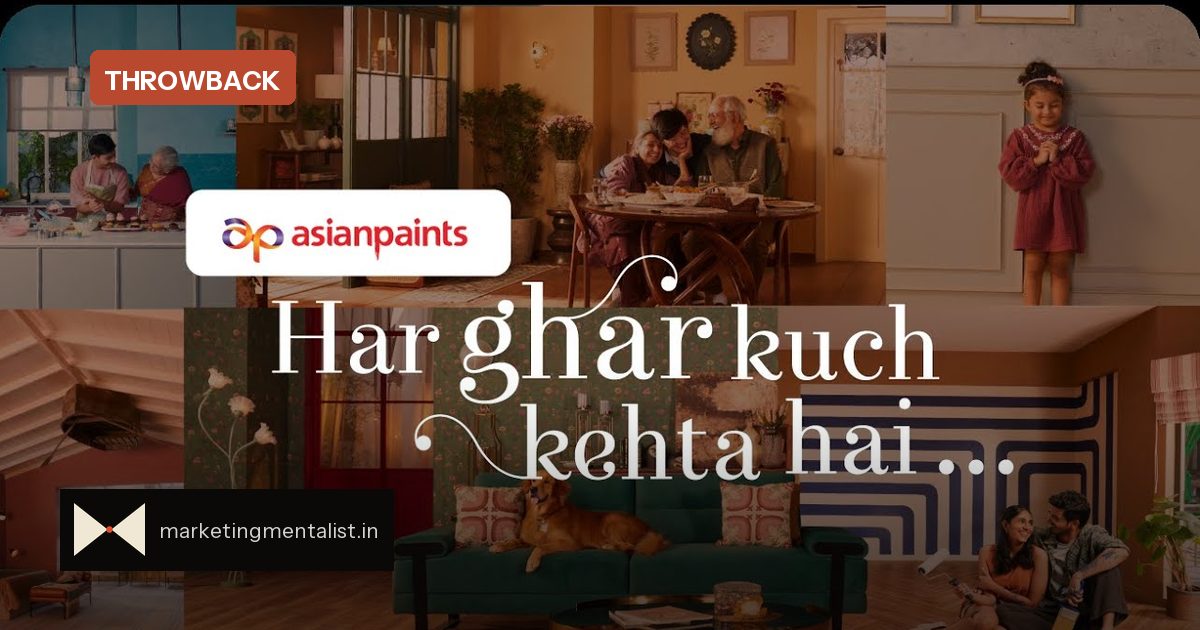
The ad and when it ran
The film is part of a long-running Asian Paints platform created with Ogilvy. It was made for Indian television in the 2000s—an era when a single national spot could still hold together a country as varied as this one. The tagline, Har Ghar Kuch Kehta Hai, gives away the proposition before a single scene lands: every home has something to say.
You can watch the film above. It does not lecture about emulsion or durability. Instead, it moves through real-feeling homes, each with its own emotional register. The paint is present, but the life inside the walls is the actual subject.
The levers it pulled
Three behavioural principles do the heavy lifting.
- Affect heuristic. Viewers feel first and rationalise later. The film bathes the product in warmth, pride, longing and belonging, so the brand inherits those feelings. Paint is no longer a cost; it is a carrier of emotion.
- Self-congruity theory. People lean toward brands that match their actual or ideal self. By showing homes across regions, faiths and budgets, the ad lets different viewers see a version of their own life. That recognition turns a mass brand into a personal one.
- Symbolic consumption. The campaign reframes paint as a language. A wall is not a surface to maintain; it is a statement about who lives there. The purchase becomes identity work, not upkeep.
Together, the levers move the brand from functional memory to emotional memory—a far stickier place to live.
What it did for the brand and the culture around it
The campaign gave Asian Paints an emotional moat in a category that had long competed on shade cards, prices and dealer networks. It made the market leader feel less like a coatings company and more like a keeper of Indian stories.
Culturally, the line entered everyday Indian speech. It offered a gentle, confident idea for a rapidly urbanising country: your home can change, grow and modernise, and still remain unmistakably yours. That theme—space as identity—has since become standard in home and interiors advertising.
What still works today and what would not
The insight still works because it is built on durable psychology. Show the customer a version of themselves, attach product to feeling, and let the brand be the medium rather than the hero. Those fundamentals travel well across media.
What would not transfer as easily is the format. A broad national montage assumes a shared idea of home. Today’s audiences reward the specific—a Kolkata apartment, a Kochi kitchen, a Jaipur courtyard—not the universal. The original’s patient pacing would also struggle in short-form feeds. The emotional strategy is timeless; the delivery would need to be rebuilt for hyper-local, algorithm-led media.
Watch the original: Asian Paints on YouTube