
Build Brands, Not Restaurants: Speciality’s Scaling Playbook
Speciality Restaurants runs 118 outlets and 20 brands. CEO Avik Chatterjee's approach shows why distinct brand identity beats outlet count in scaling.
There is a quiet but important distinction hiding inside most expansion announcements in Indian retail and food service: are you adding outlets, or are you building brands? Speciality Restaurants Limited, the company behind Mainland China, Oh! Calcutta and Sigree Global Grill, has picked a side.
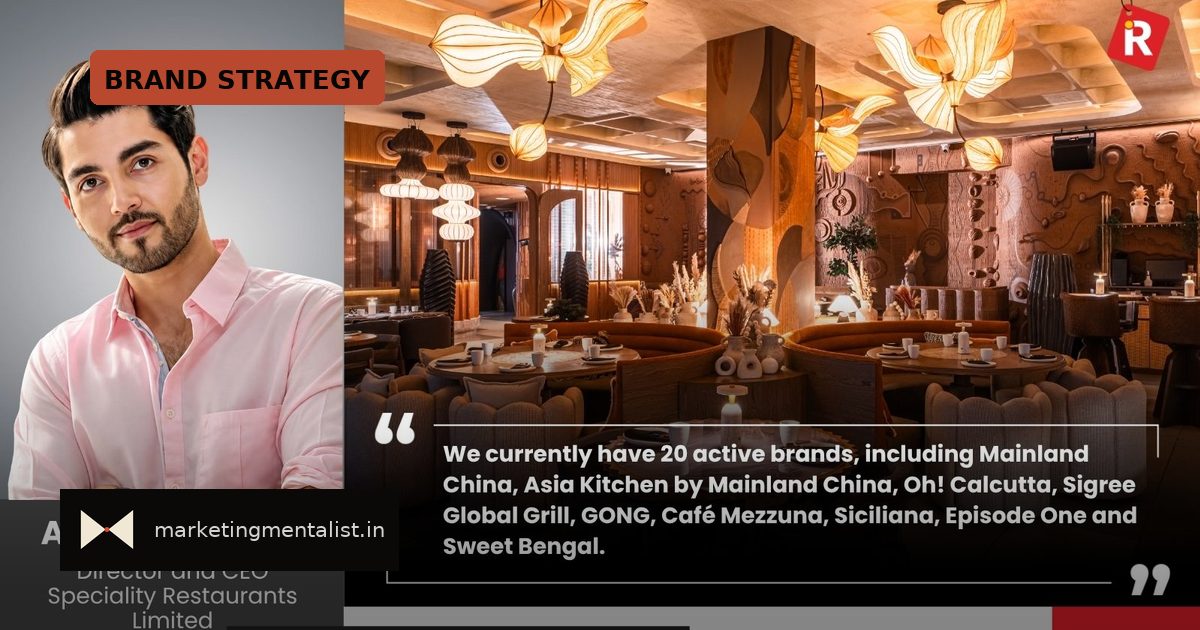
In an interview with IndianRetailer.com, Director and CEO Avik Chatterjee summed up the company’s operating philosophy as building brands rather than simply restaurants, adding that every brand needs a clear identity, a strong consumer proposition and the ability to deliver consistently as it grows. The company currently runs a network of 118 outlets across 20 active brands.
The numbers behind the philosophy
Speciality’s portfolio spans Mainland China, Asia Kitchen by Mainland China, Oh! Calcutta, Sigree Global Grill, GONG, Café Mezzuna, Siciliana, Episode One and Sweet Bengal. Of the 118 outlets, 110 are company-operated and eight are franchise-led. The business currently spans nine cities and seven states, concentrated in Western and Eastern India, with the North identified as the next opportunity.
Between August and November 2026, nine openings are scheduled across Mumbai, Pune and Delhi, with four more planned in Bengaluru and Kolkata. The stated ambition is a run rate of eight to ten restaurants a year, taking the company to around 150 restaurants, and closer to 250 units once WALTERS — its new QSR format — and Sweet Bengal confectionery outlets are counted.
Franchise formats require roughly Rs 75 lakh to Rs 1.25 crore depending on brand and city, with an indicative payback of four to five years.
Why brand architecture matters more than outlet count
For marketers, the interesting bit is not the expansion arithmetic. It is the discipline of the portfolio. Twenty brands could easily become twenty versions of the same thing — the classic cannibalisation trap, where a house of brands quietly collapses into a house of near-identical menus with different fonts.
The defence against that is what Chatterjee calls a clear reason for the consumer to come back. In positioning language: each brand must own a distinct occasion in the consumer’s head. Asian fine dining, Bengali comfort food, grill buffets, Italian, QSR, sweets. These are not menu categories; they are consumption occasions, and occasions are how people actually make eating-out decisions.
Consumers, he noted, now want experience, discovery and value rather than only a meal. That is a meaningful shift for anyone building a consumer brand in India: the product is table stakes, the context is the differentiator.
Consistency is a psychological asset, not an ops line item
Speciality’s franchise approach leans on SOPs, training and regular audits. That reads like operations. It is actually branding.
Every brand promise is a prediction the customer makes before they spend. If the Mainland China in one city delivers differently from another, the prediction breaks — and broken predictions are expensive, because customers do not downgrade their expectation, they abandon the brand. Chatterjee’s point that franchising only works when both sides agree on how the brand should feel to the customer is really a statement about protecting that prediction.
The test-learn-scale framework worth stealing
The company’s approach to launching new concepts follows a sequence any brand team can apply:
- Start with the consumer need — what problem or occasion is unaddressed?
- Define the proposition — is there a clear reason to choose this over alternatives?
- Pressure-test pricing, menu and format before committing capital.
- Validate unit economics — same-store growth, revenue per outlet, store-level EBITDA, occupancy and labour costs, customer frequency, payback period.
- Scale only if repeatable — a format that works in one location but cannot be replicated without hurting economics or experience is not truly scalable.
On location, the evaluation covers catchment, demographics, visibility, accessibility and rental economics — with a caution that Tier II markets hold potential but demand the right format, because what works in one market may not travel.
The takeaway
Chatterjee expects the next phase of the industry to reward quality growth over adding outlets, as real estate costs, manpower, inflation and competition squeeze operators. That is a useful reframe well beyond restaurants: scale without a differentiated proposition is just expensive distribution. Build the reason to return first.
Source: IndianRetailer.com