SBI Life’s Para-Sport Bet: Meaning Over Media Metrics
SBI Life is deepening its para-sport association and refusing to judge it on reach or ROI. Here's the brand psychology behind that decision.
Most sponsorships are bought like media. SBI Life is treating one like a belief system.
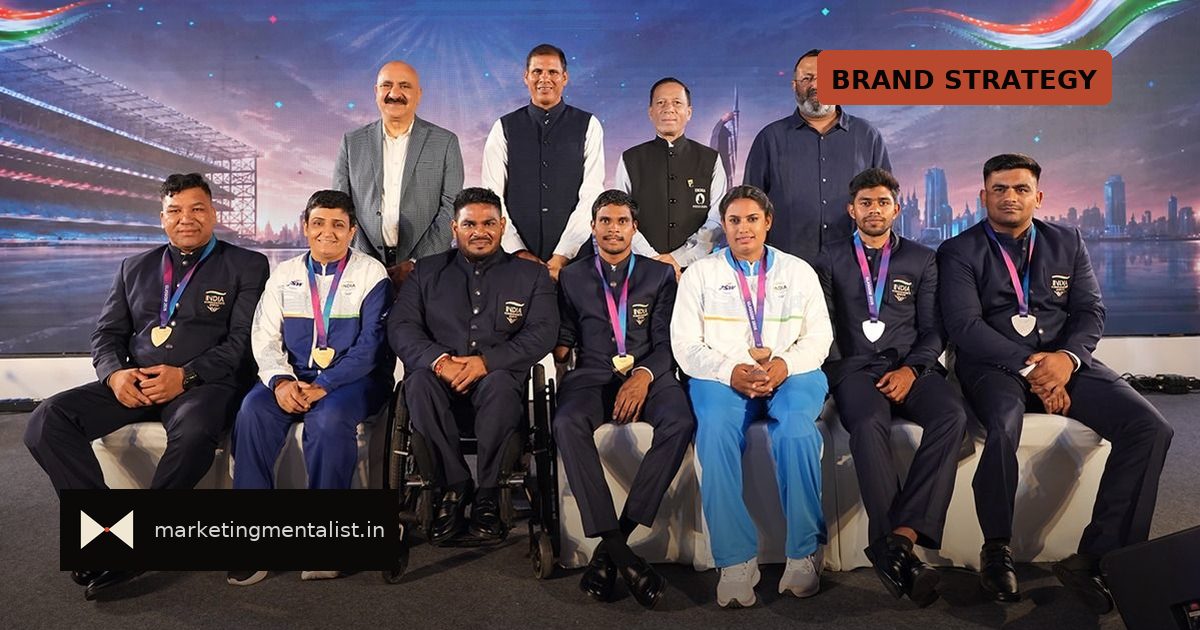
The insurer has been steadily deepening its association with Indian para-sport — a relationship that began around the Paris 2024 Paralympic Games, continued through the Glasgow 2026 Commonwealth Games, and will extend to the Aichi-Nagoya 2026 Asian Para Games. On September 7, 2026, at an event in New Delhi, the company felicitated seven Indian para-athletes who returned from Glasgow with three gold, two silver and two bronze medals.
Why para-sport, and why now
Amit Jhingran, MD and CEO of SBI Life Insurance, told BestMediaInfo.com that the athletes’ own stories drove the decision to go deeper, describing para-sport as an area that needed more support.
The strategic logic is cleaner than it first appears. Ravindra Sharma, EVP and Chief of Brand, Corporate Communications and CSR, framed it as a narrative fit: para-sport demonstrates that a challenge in life can be overcome, and that support helps you overcome it. That is, almost word for word, the job description of life insurance.
This is what strong brand-property matching looks like. Not audience overlap. Meaning overlap. Cricket buys SBI Life reach; para-sport buys it a metaphor. The category sells protection against an unforeseen setback, and para-athletes embody the lived proof that setbacks are survivable when a support system exists.
The deliberate refusal to measure it
The most interesting line in the story is what SBI Life says it will not do. Sharma said the association is kept outside commercial consideration or visibility, and that whatever visibility the brand earns should be seen as a by-product of bringing athletes’ stories to a wider audience.
Marketers will instinctively read that as soft. It isn’t. There is a well-documented psychological penalty for visibly self-interested generosity — audiences discount goodwill the moment they can attribute it to a commercial motive. Behavioural researchers call this the attribution discount. The brand that shouts about its cause is credited with marketing; the brand that shows up for years without shouting is credited with character.
The commitment signal matters too. SBI Life said it is working with the Paralympic Committee of India on talent identification, training resources, kits, coaches and longer-term athlete development. Funding the unglamorous middle of the pipeline — not just the medal photo-op — is a costly signal, and costly signals are the only ones consumers reliably believe.
PCI President Devendra Jhajharia captured the point at the event: a medal is a moment of recognition, but behind it sits a lifetime of work.
The real category problem: awareness, not price
Jhingran was blunt about what actually blocks insurance penetration in India. Affordability exists. Access exists. Awareness doesn’t. Insurance is intangible with no visible immediate return — a product the brain struggles to value because the benefit is invisible and delayed.
That is a classic present-bias problem. Young Indians happily buy mutual funds and SIPs, where returns are trackable and gratifying, while insurance arrives late in the financial journey. Jhingran’s counter-argument is both emotional and economic: insurance protects family and, bought earlier in life and career, costs less.
Three things marketers can borrow
- Match on meaning, not just eyeballs. Ask what your category emotionally promises, then find the property that dramatises it. SBI Life found resilience-plus-support.
- Engage instead of educating. Its IdeationX property takes the brand into colleges and asks students to build ideas around insurance. Self-generated conclusions stick harder than delivered ones — the generation effect at work.
- Stop siloing screens. Sharma said linear TV and connected TV are planned together as one audio-visual medium, with the mix set by campaign objective rather than channel fashion.
Asked what he would optimise for over the next three to five years — share, first-time policyholders, persistency or trust — Jhingran chose trust, and the wish to serve more customers in their hour of need.
For a category whose product only proves itself on the worst day of a customer’s life, that is not a soft metric. It’s the only one that compounds.
Source: BMI Group of Publications