
Rediffusion-Bharat Lab Report Maps India’s Relational Buying
A new Rediffusion-Bharat Lab report turns everyday Indian rituals into marketing signals: family decisions, muhurat timing, social proof.
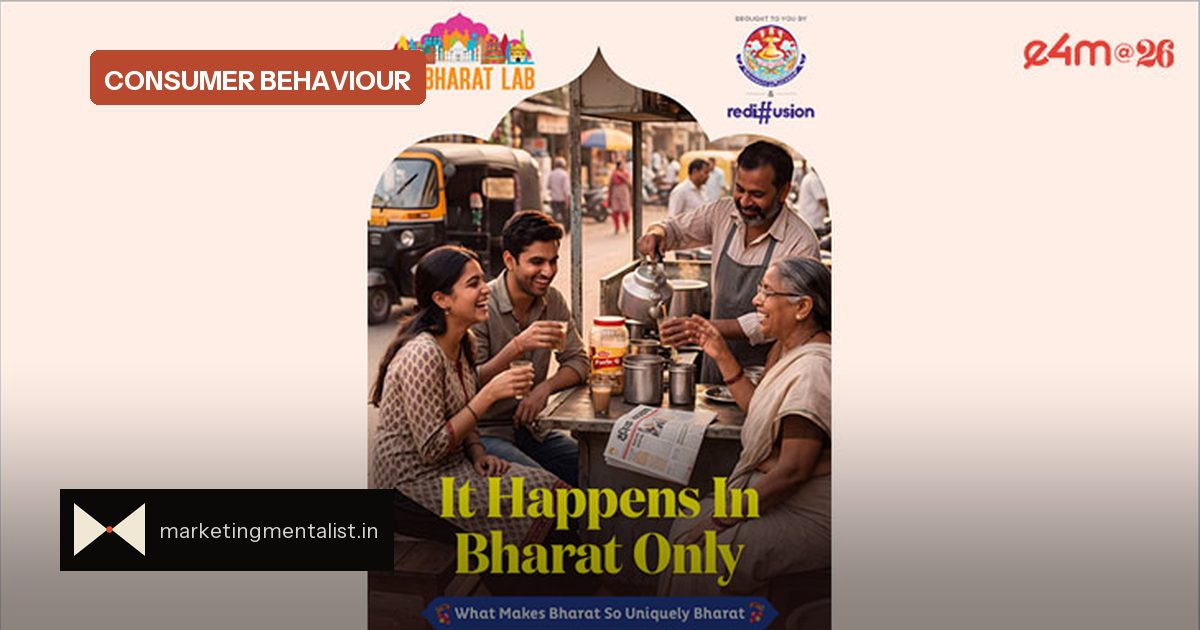
A new report from Rediffusion and Bharat Lab argues that many purchasing decisions in India are not individual choices at all—they are family decisions, community signals and ritual responses. Titled It Happens In Bharat Only: What Makes Bharat So Uniquely Bharat, the study draws on “hundreds of chats and conversations” across the country to map the behavioural side of consumption.
The report’s central lens is relational. Indian consumers often see themselves as extensions of family and social networks, so brand managers who plan for isolated individuals may miss the real approval chain behind a purchase.
Scarcity, jugaad and the optimisation instinct
Rediffusion and Bharat Lab connect everyday habits—bargaining, preserving household items, stretching limited resources—to India’s historical experience of scarcity. This is an important nuance: behaviour that can look like frugality is often an optimisation reflex that continues even as incomes rise.
For marketers, the implication is not to “premiumise away” value cues. Instead, products that respect resourcefulness can feel culturally fluent.
The ‘Bharat Specials’ marketers can use
The report identifies several consumer-behaviour patterns. These are not just labels; they describe how social validation, relationships and ritual affect brand interactions.
- Jamai Premium, Shagun Pricing Effect and Muhurat Tax show how cultural rituals and auspiciousness shift purchase timing and pricing expectations.
- Kitty Party Economy, Bhai Discount and Tiffin Box Test reveal how informal networks and visible social context shape acceptance.
- Badaam Effect, Sharma Ji Ka Beta Effect and First Salary Syndrome describe how effort, comparison and emotional milestones create meaning.
Why the Muhurat Tax deserves a place in your calendar
The Muhurat Tax refers to buying around auspicious dates and festivals. The report’s own observations cite that 40% of annual auto sales occur during the 22 days around Dussehra-Dhanteras, and 30% of gold sales take place over three days.
That is a practical planning signal: inventory, media weight and service capacity need to follow the cultural calendar, not just the financial quarter.
Social proof from kitty parties to WhatsApp
The report describes kitty parties as an early form of peer-to-peer influence, sampling and social proof—networks that have since extended to platforms like WhatsApp. The Tiffin Box Test captures a similar truth: a product may be judged not only by the buyer but by family members and colleagues who encounter it.
This means brand adoption often depends on dual approval: the direct buyer and the visible audience around them.
Frame Bharat, don’t fix it
The report also documents everyday cultural practices—the head wobble, nimbu-mirchi charms, dahi-cheeni before important occasions, plastic-covered household items, repurposed biscuit tins, dipping biscuits into tea, eating with hands, folding banana leaves and adding chaat masala to fruit.
Its conclusion is simple: these are not quirks to be corrected. They are cultural patterns that offer a window into how Indian consumers relate to products, communities and each other. The study positions itself as an attempt to “frame Bharat” rather than “fix Bharat”.
Source: Indian Advertising Media & Marketing News – exchange4media