Liberty’s Multi-Brand Bet: A House of Brands in Footwear
Liberty built 10+ sub-brands to match India’s occasion-driven footwear market. Here’s the psychology and trade-off behind a house of brands.
When a brand tries to stand for every occasion at once, it usually stands out in none. Liberty Shoes has spent three decades trying to avoid that trap by building more than ten proprietary sub-brands under one corporate umbrella.
One master brand, many incompatible jobs
Liberty’s roots go back to 1954 in Karnal, Haryana; the Liberty brand itself dates to 1964. Into the 1990s, the company sold formal, school, casual and industrial footwear under a single Liberty name. That made the brand easy to recognise, but difficult to position.
Indian footwear buying is highly occasion- and identity-specific. A school shoe buyer, a value-seeking small-town shopper, a formal office worker, an industrial safety buyer and an urban millennial looking for athleisure all retrieve brands through different mental shortcuts. One name cannot credibly hold all those slots at the right price point.
The house-of-brands response
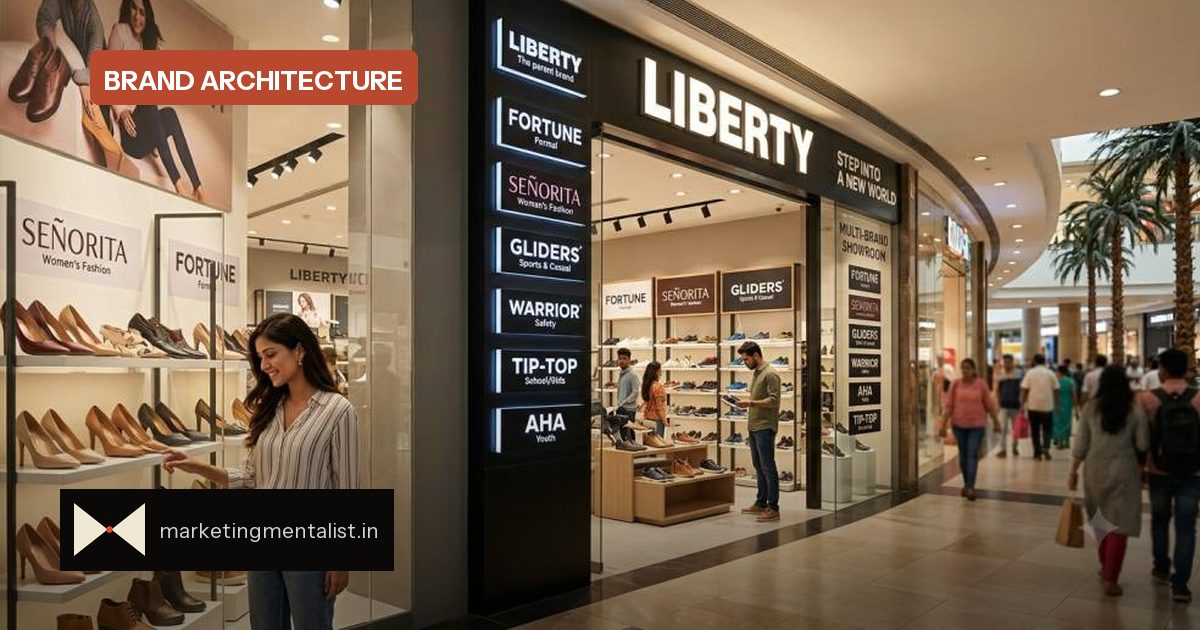
Liberty’s alternative was to build a portfolio: Force 10 and Fortune from the 1990s, followed by Gliders, Prefect, Windsor, Coolers, Footfun, Warrior, Tiptop, women-focused Senorita, comfort-focused Healers, and Leap7X, introduced in 2022–23 as a premium casual and athleisure line. Newer names include AHA, Lucy & Luke and Freedom.
In the case, the company describes these sub-brands as “independently positioned with unique identities, target audiences, and design philosophies.” That is the crucial difference between a real brand portfolio and a set of private labels wearing different badges.
Here is the psychological logic in practice:
- Occasion-based retrieval: Force 10 can be remembered for broad everyday wear; Healers for comfort; Leap7X for premium athleisure.
- Price-tier separation: value, mass and premium offers can coexist without pulling the corporate name upmarket or downmarket.
- Demographic fit: Senorita speaks to women, Lucy & Luke to children, and AHA or Freedom to younger and value segments.
- Basket adjacency: bags, wallets, the Shoe Smile care range, perfumed socks and fragrances under Liberty Lifestyle extend into related purchase moments.
Why more brands is not automatically more mental availability
The financial picture from the source shows the hidden cost. In FY2023-24, Liberty reported revenue of about ₹637 crore—down roughly 2.6% year on year—and a net margin of about 1.8%. The next year, revenue reached a record ₹675 crore. Later trade coverage cited revenue around ₹800 crore, with management targeting double-digit growth.
But portfolio breadth alone has not produced consistently strong margins. Each sub-brand needs its own assortment, shelf presence, retail format and memory refresh. If two names solve the same job, they quietly cannibalise each other and duplicate marketing overhead.
A practical filter for brand managers
Before adding another brand, ask a simple question: would the customer be confused if this product carried the parent name instead? If not, the new brand may be a private label in disguise. Liberty’s current premiumisation bet is that Healers and Leap7X can contribute 30–50% of revenue within two to three years—an outcome that only works if those names earn their own credibility, not borrowed credibility from the parent.
Liberty’s architecture sits somewhere between Bata’s single-master-brand model and the retailer-led multi-brand model of Metro Brands. The takeaway is not that portfolios are good or bad. It is that a brand architecture is a positioning decision, not just a naming decision. Each name must own a distinct retrieval cue or it becomes margin drag.
Source: MarkHub24