Why ‘Independent’ Is Campaigning’s Hottest Brand Asset
Independent candidates are turning the word itself into a logo and biography. Here’s what their negative positioning teaches brand managers.
The most valuable word in some 2026 U.S. Senate races is not a policy promise. It is “independent.”
The word becomes the visual identity
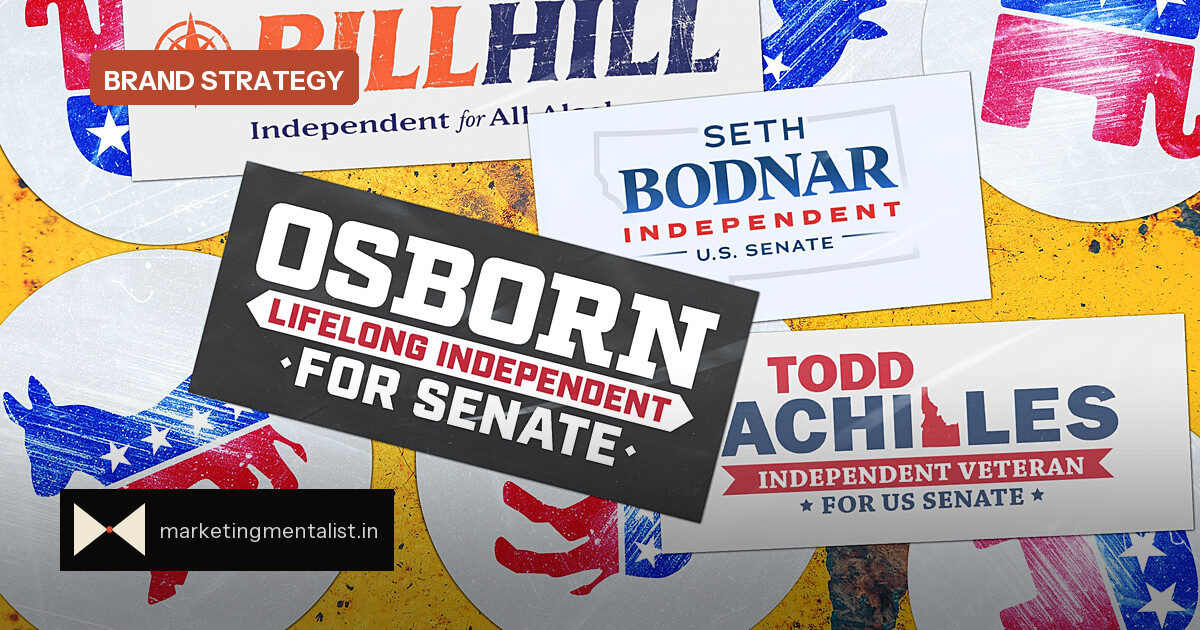
Dan Osborn, a Navy veteran and union leader, ran for a Nebraska Senate seat in 2024 with a red-and-white wordmark: his last name in all capitals, paired with the tagline “Independent for Senate.” He lost by fewer than 7 points to Republican Deb Fischer—still the best performance for an independent in a Nebraska U.S. Senate race in state history.
Now Osborn is running again, this time against Republican Pete Ricketts. Democrats cleared the field, as they did last time, and the campaign says its internal polling has him tied. The logo kept the last-name wordmark but changed the tagline to “Lifelong Independent.” That small shift turns a filing status into a biographical claim.
Idaho candidate Todd Achilles, an Army veteran and former state lawmaker, is using a similar cue: his logo builds an Idaho state map into the first L of his name and carries the banner “Independent Veteran.”
Owning the exit when both party brands feel toxic
Kevin Smith, a political science professor at the University of Nebraska-Lincoln, puts the problem bluntly: “The Democratic Party brand is toxic in large parts of Nebraska.” For a non-Republican in such a state, he adds, being perceived as a true independent “at least gives you a fighting chance.”
This is negative positioning: a brand built around rejecting the usual options rather than outperforming them on features. In a polarised environment, the independent identity functions as an exit—a visible way to refuse both parties without staying home. The word does not describe a platform; it becomes the logo and the promise.
The same instinct appears outside politics: challenger brands often win by being the “un-cola,” the “anti-bank” or the category escape rather than a better incumbent. The label has to be narrow enough to mean something and broad enough to attract disillusioned users from both sides.
What brand managers can borrow
For marketers, the campaign logos are a compact case study in repositioning within a low-trust category.
- Make the differentiator a visual asset—the card itself says “independent,” not just the talking points.
- Anchor the label in biography: “Lifelong Independent” and “Independent Veteran” sound earned, not tactical.
- Keep a recognised element while meaning evolves: Osborn held his wordmark and changed one tagline.
- Sell relief from the usual choice before selling detail—distance is the product.
The risk is credibility. If the biography does not back the label, the positioning collapses into opportunism. Osborn’s “lifelong” framing is a direct defence against that attack.
Source: Fast Company