
20 Years Of Brand Ideas: What Still Holds True
Branding Strategy Insider marks 20 years of brand thinking. Here's what its anniversary essay reveals about positioning, clarity and brand value in the AI era.
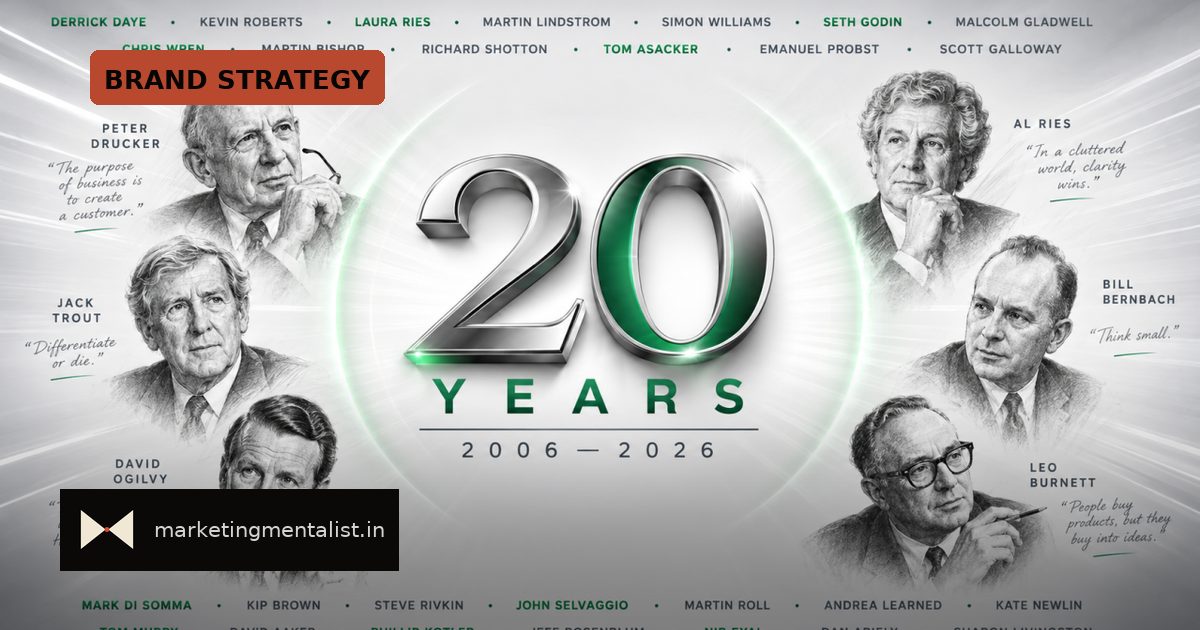
Branding Strategy Insider (BSI) has turned 20. Launched in 2006 — when Facebook was two years old, the iPhone didn’t exist and Twitter had barely started — the publication now reaches tens of thousands of brand and business leaders each month, with more than 60,000 subscribers, according to its anniversary essay.
Anniversary posts are usually forgettable. This one isn’t, because it doubles as a two-decade audit of what actually held up in brand strategy while the media landscape was demolished and rebuilt twice over.
The questions didn’t change. The context did.
BSI’s founder makes a point worth pinning above every marketing desk: the technology transformed completely, but the core questions did not. How do you create something people value? How do you differentiate it? How do you explain why you’re worth choosing? How do you build an organisation that can actually deliver the promise? And how does brand show up in business performance?
If those questions survived the arrival of social media, mobile, the creator economy and generative AI, they will probably survive whatever comes next. That’s a useful filter when your feed is telling you the rules have been rewritten again.
A platform, not a doctrine
The essay’s most interesting argument is a refusal to pick a camp. BSI has published Jack Trout and Al Ries on positioning, David Aaker on brand equity, Byron Sharp on penetration and mental availability, Martina Olbertova on meaning and semiotics, Robert Cialdini on persuasion, Mark Ritson on strategic discipline, Les Binet on short- and long-term effectiveness, plus Seth Godin, Malcolm Gladwell, Philip Kotler, Scott Galloway and dozens more.
These people frequently disagree. That, the piece argues, is the point: brand strategy weakens when it becomes a contest between doctrines, and practitioners need judgement more than they need principles.
We’d go further. Most brand debates online are identity performance — are you a differentiation person or a distinctiveness person? Meanwhile the brief on your desk usually needs both, in different proportions, at different moments. The mature move is diagnostic, not tribal: figure out which problem you actually have before you pick the framework.
The stories behind the famous work
One of BSI’s genuine contributions has been first-person accounts from people who were in the room. Rob Siltanen, Creative Director and managing partner at TBWA\Chiat\Day, wrote his own account of the Apple pitch and the origin of “Think Different” and the “Crazy Ones” script. Jerome Conlon, Nike’s Director of Marketing Insights & Planning during the era of “Just Do It,” started not with the tagline but with the problem — Reebok growing, Nike’s relevance too narrowly defined around serious male athletes.
Larry Light, who contributed roughly 150 articles over four years, described taking over as Global CMO of McDonald’s amid falling relevance and eroding trust, and building Brand Journalism. Tom Murry, CEO of Calvin Klein for 17 years including the 2003 PVH acquisition, wrote that dramatic growth achieved at the expense of the brand would have counted as failure.
Why this matters: brand history compresses messy human process into tidy case studies. A campaign becomes a slogan; a turnaround becomes a chart. The disagreement, risk and stubbornness get edited out — and then juniors learn that great work arrives fully formed.
The leadership questions worth stealing
The essay’s central thesis is that brand strategy and business strategy should be one strategy. It offers a set of questions that belong in the boardroom, not the marketing meeting:
- Where is brand helping — or hurting — growth?
- Does our positioning create meaningful preference?
- Are we making the customer’s decision easier?
- Does our culture let people deliver the promise?
- Are we creating pricing power, or training customers to wait for a discount?
- Is our brand architecture creating clarity or complexity?
That fifth one is the quiet killer. Discount conditioning is the fastest way to convert brand equity into a habit you can’t afford.
AI raises the price of clarity
The closing argument: when anyone can generate infinite content in seconds, content stops being a differentiator and clarity becomes the scarce asset. If AI can competently explain what your company does, leaders have to answer a harder question — why should anyone care?
Trust, meaning, judgement, culture and creativity become more consequential, not less. Two decades in, the conclusion is almost boringly durable: brands are a river, not a pond, and the promise has to survive the organisation before it ever reaches a customer.
Source: Branding Strategy Insider