Apple’s first touchscreen MacBook Pro breaks a decade-old brand rule
Apple's first touchscreen MacBook Pro reverses a decade of saying no. What the shift teaches marketers about brand principles and product identity.
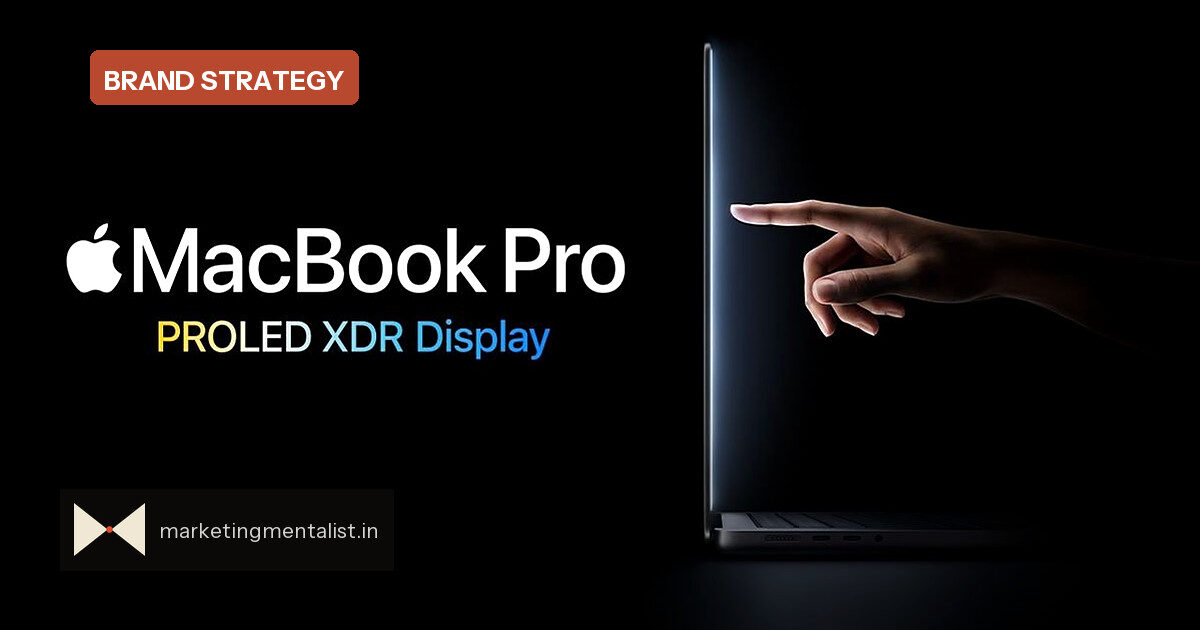
For more than a decade, Apple insisted that a laptop screen was not meant to be touched. On October 28, the company ended that argument with a new MacBook Pro that lets users tap, swipe, pinch and drag directly on the display.
This is more than a hardware update. It is a public reversal of a product philosophy Steve Jobs set in motion in 2010, when he described vertical touchscreens as “ergonomically terrible.” Apple is now asking customers to unlearn the rule.
What Apple actually changed
The new MacBook Pro pairs its ProLED XDR tandem OLED display with touchscreen functionality. It runs on M5 Pro or M5 Max chips and can be configured with up to 128GB of unified memory and 16TB of storage.
A 1-minute-50-second launch film keeps the display at the centre. It teases a different kind of OLED, then walks through anti-glare, reflection protection and real-time pixel correction. Instead of listing specifications, the film shows gestures such as tapping, swiping and pinching, and ends on the line “it all clicks.”
Why the old argument only half worked
Jobs was not entirely wrong. Repeatedly lifting an arm to poke a vertical screen is tiring. But the objection only made sense if touch replaced the keyboard and trackpad. Apple’s new machine does something more careful: it adds touch as an option rather than forcing a swap.
Tim Cook later summed up the resistance in 2012, comparing laptop-tablet convergence to a toaster and a refrigerator. That stance kept the MacBook distinct while rivals such as Microsoft’s Surface Pro and Windows 8 pushed hybrid computing for years. Apple is now borrowing from that playbook without turning the MacBook into an iPad with a keyboard.
The brand lesson
Marketers often confuse a principle with an identity. A principle helps you choose between trade-offs. An identity trap stops you from adapting even when the market has moved.
- Long-held objections often describe bad execution, not the feature itself.
- An additive feature lets customers choose without removing what they already trust.
- Competitive proof reframes old objections faster than internal conviction does.
What to do with your own “nevers”
Audit the rules your brand has repeated for years. Ask whether the objection is to the behaviour itself or to doing it badly. Then ask whether you can add the new behaviour without deleting the familiar one.
Apple did not prove Jobs wrong. It proved that even a Steve Jobs-era rule can expire. The MacBook stays a MacBook, but the screen is no longer off-limits. For brand builders, that is the real launch story.
Source: Afaqs!