Ambuja at 109 MTPA: Strength, Sustainability and Brand
Ambuja Cement is half UltraTech's scale, so it is betting on inherited strength, third-party sustainability proof and premium mix. Here is the brand logic.
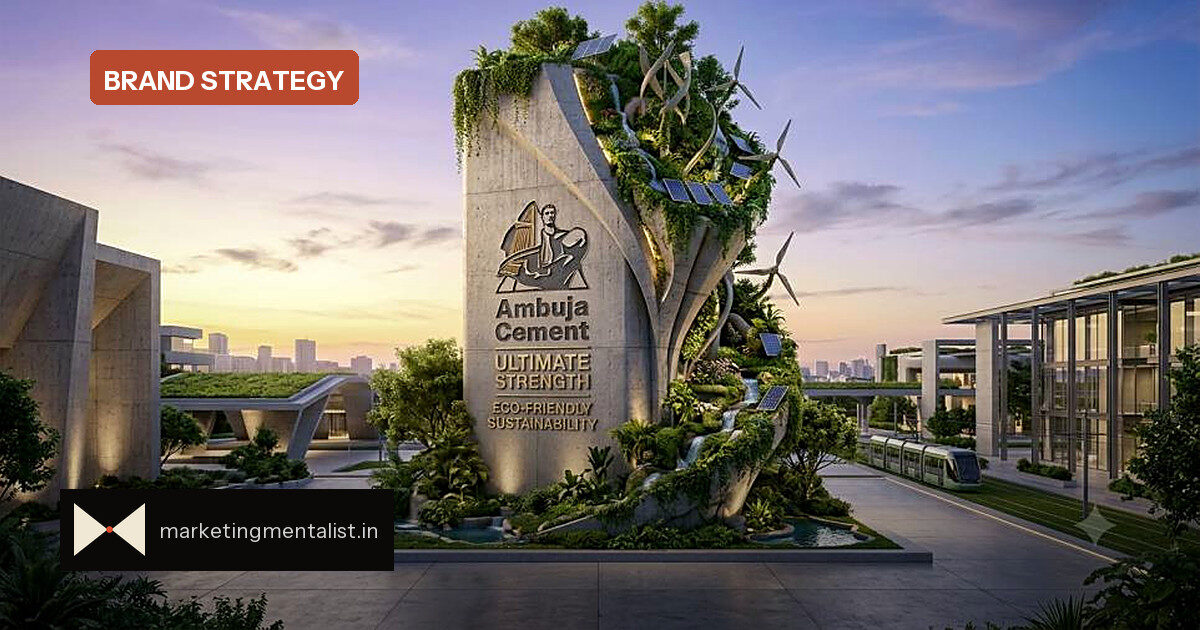
When Ambuja Cement talks about brand, it is not decorating a scale story. It is the scale story’s underdog. The company reported 109 MTPA capacity on 30 June 2026. UltraTech had passed 200 MTPA two months earlier. When the largest rival is nearly twice your size, brand equity stops being a nice-to-have and becomes one of the few levers you can pull.
Strength as a compounding asset
Ambuja’s organising idea is old. “Giant Compressive Strength” dates back at least to the 2015 Great Khali film by Publicis. After the Adani family agreed to acquire Holcim’s stakes in Ambuja and ACC for $10.5 billion in May 2022, the brand did not reinvent. It revived the 2015 film in May 2023, then launched “Mazbooti Ki Misaal” in October 2023. The new film keeps load-bearing strength as the functional promise but moves the emotional wrapper from a wrestler breaking things to a family living safely beneath a giant elephant. That is brand equity preservation: the claim stays constant, the reassurance gets refreshed.
Sustainability’s proof problem
#ChangeTheStory began in 2022 as a vivid single initiative. Geocycle India’s Bubble Barrier removed 2,400 tonnes of plastic from Agra’s Mantola canal, told through a digital film, pledge microsite, rap song and AR filter. More recent corporate communication leads with SBTi-validated net-zero targets to 2050, CII GreenPro, GRIHA and EPD-based certifications, and membership of the Alliance for Industrial Decarbonization. The shift from story to certification matters. In a category where green claims are easy to make and hard to verify, third-party proof is the more durable asset.
There is also a warning inside the disclosure. Mid-2025 coverage cited 11x plastic negativity, while the July 2026 release cites 7.23x. Sustainability metrics need consistent methodology, or the proof can quietly lose comparability.
The commercial test is premium mix
Ambuja’s own framing points to premiumisation. FY2024-25 reporting lists premium products at 26% of trade volume. In Q1 FY27, premium products were 34% of trade sales and trade share was 78%, up 4 percentage points year on year. FY26 brought the highest-ever annual volume of 73.7 million tonnes. Yet Q1 FY27 revenue and profit fell year on year, which is exactly why mix and brand matter: they are the levers that do not require winning the tonne war.
Three lessons for brand builders:
- Keep a functional claim constant and rotate the creative wrapper.
- Shift sustainability proof from stories to independent certification before sceptics ask for it.
- Track premium mix and trade share as brand-health numbers, not just impressions.
Two brands, one platform
The amalgamation of ACC and Orient Cement into Ambuja is described as a unified “One Cement Platform”, but Ambuja and ACC still operate as separate brands. Ambuja owns strength; ACC owns durability, anchored in its 1936 legacy. The trust rankings keep this tension visible: in 2024 ACC ranked No.1 and Ambuja No.2, while in 2025 the company says Ambuja was India’s most trusted cement brand for a fourth straight year. The strategic task is not to pick a winner, but to keep two promises distinct enough to avoid cannibalisation while extracting one platform’s efficiencies.
Source: MarkHub24