Decathlon India: sales up 3%, costs up 12.3%
Decathlon India built a value giant on private label control. FY25's revenue up 3% and costs up 12.3% expose the strain in that model.
Decathlon India has long been the quiet outlier in organised sports retail. It does not buy attention with superstar endorsements or sponsor-heavy launches. It sells only its own brands, controls the shelves, and lets the store do the talking. The latest reported results, however, put a question mark next to the model’s cost side.
What the numbers say
For FY25, Decathlon Sports India’s revenue from operations grew 3% to Rs 4,133 crore, while total expenses rose 12.3% to Rs 4,264.5 crore. That turned a Rs 197 crore profit in FY24 into a net loss of Rs 65 crore. EBITDA stayed positive at Rs 174 crore, and other expenses including store operations and overheads rose 13.7% to Rs 952.5 crore.
The company runs 132 stores in 55 cities and plans to add 10–15 stores a year, targeting 175 stores within five years.
Why private label won in India
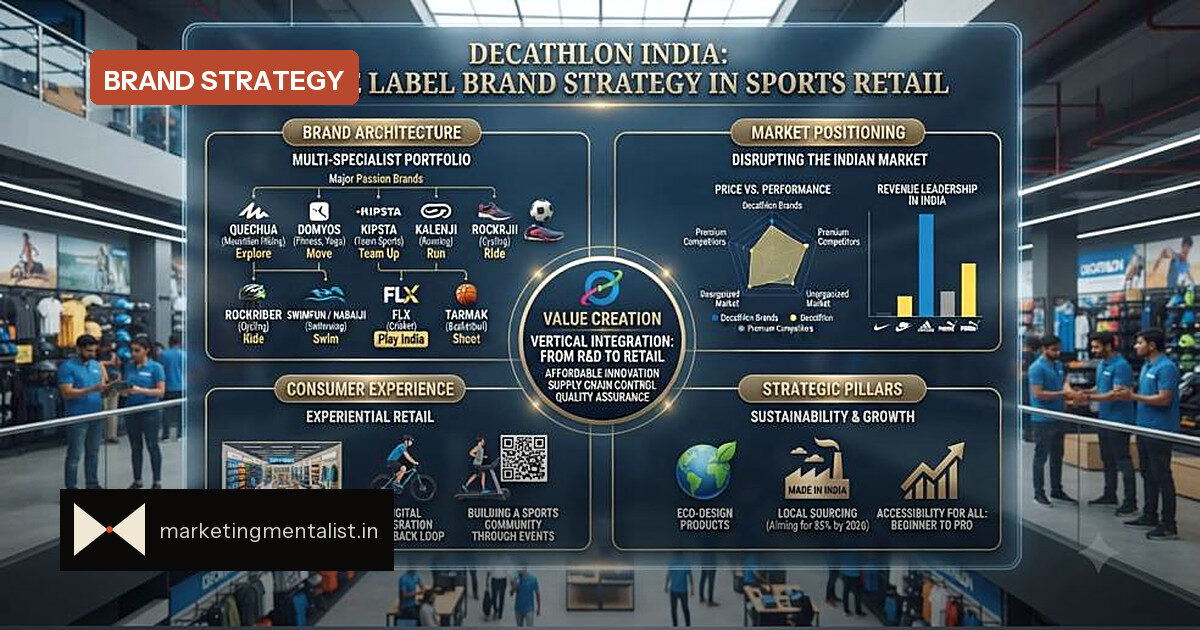
Decathlon was manufacturing in India before it retailed here, producing since the 1990s, opening its first cash-and-carry store in Bengaluru in 2009, and opening to all customers in 2013 after winning full FDI approval. Its advantage is not a clever logo. It is an integrated system: private labels give it control over pricing, design and distribution.
Analysts cited by The Economic Times put its products at 30–40% cheaper than competing goods. Technopak’s Ankur Bisen argued the right term is not “low-priced” but “value fashion”, because the cost base stays lean through simple retail spaces, low rental and marketing costs, and vendor involvement in manufacturing.
- Only own brands across 85 sporting disciplines and more than 100 warehouse-style stores.
- Manufacturing network of 113 facilities, 83 suppliers and seven production offices.
- Target of 90% local production for Indian demand and USD 3 billion India sourcing for global operations by 2030.
This is private label as a system, not a labelling choice. It explains why rivals with lower control found the same price point harder to reach while chasing aspirational pull and volume at once.
The cost wall appears
FY25 reverses the earlier momentum. Expenses grew more than four times as fast as revenue, and no verified public explanation from the company was found beyond the reported expense movements. That makes the margin pressure harder to read.
At the same time, the channel mix is changing. Quick commerce, a 2024 Zepto partnership, its own two-hour delivery in seven major cities, and wholesale through over 3,000 resellers push the brand beyond its low-cost destination stores. That widens reach, especially in tier 3 and 4 cities, but also changes the economics the value model was built on.
What brand builders should watch
The Decathlon case is a reminder that a value position is a cost discipline. The moment distribution and format costs rise, the price gap has to come from somewhere else. The company’s expert sub-brand Kiprun is the main test: it targets serious runners, aims to double the running business over four years, and chases a ₹1,000+ crore running turnover by 2030 while serving over 5 million active runners.
For founders and brand managers, the playbook is not to copy Decathlon’s store size. It is to ask which cost, design and distribution levers you can hold together, and what happens when growth asks you to let one of them go.
Source: MarkHub24