How WorkSafe Victoria framed recovery as identity
A behaviour-change campaign reframes workplace injury recovery as shared identity work, using real stories and three simple verbs.
The ad in one paragraph
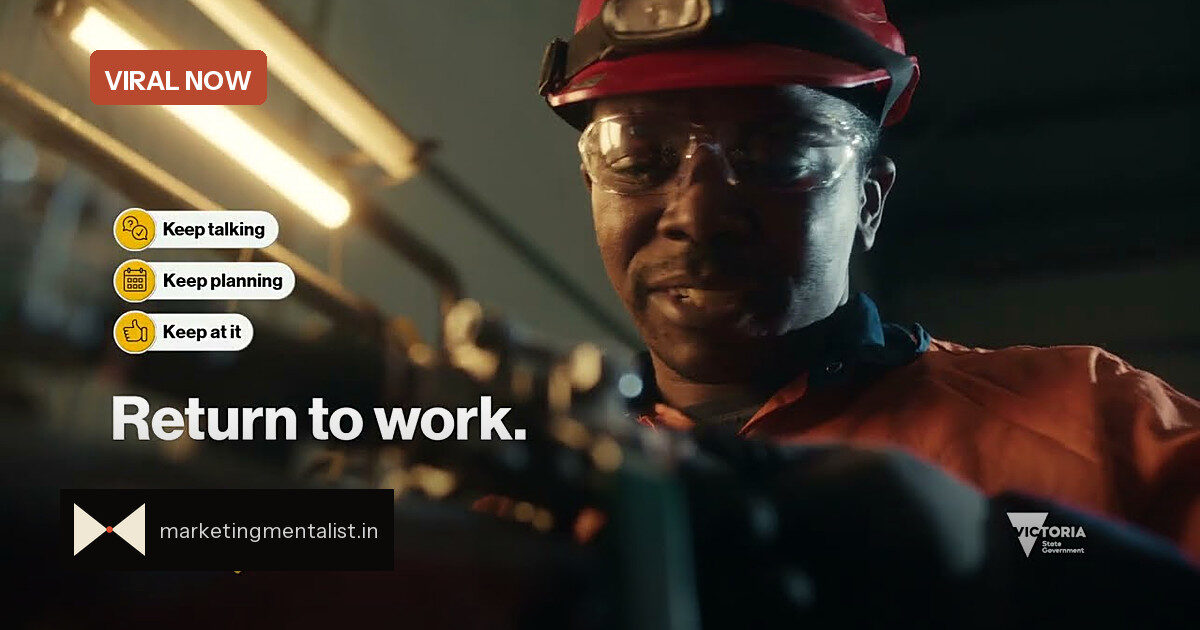
WorkSafe Victoria’s “Back to Work and Back to Life” campaign, created with Shannon Behaviour Change, is made for injured workers and their employers in Victoria. Real people—workers and the employers they returned to—tell their own recovery stories in their own words, organised around three simple behaviours: Keep Talking, Keep Planning and Keep At It. The campaign spans a genuine spread of physical and psychological injuries, and it avoids the usual safety-warning tone in favour of a shared promise: recovery is not a solo mission.
The levers it pulls
Three behavioural principles do most of the work.
- Diffusion of responsibility, and its antidote. WorkSafe’s research found both sides knew return to work mattered but each waited for the other to lead. The campaign names that ambiguity and dissolves it by making collaboration explicit. Instead of “someone should act,” the ad shows both parties acting—together and in sequence.
- Social proof through similarity. Real people, not actors, share their stories. That is social modelling: we are more likely to act when we see people like us doing the same thing. Shannon Behaviour Change planning director Fei Wang puts the cost plainly: “When workers try to overcome their injuries alone at home, recovery slows – and it can contribute to depression, loneliness and a loss of self-worth.”
- Implementation intentions via chunking. “Keep Talking, Keep Planning, Keep At It” turns a complex process into three small, repeatable commitments. Each verb works as a cue: when you feel stuck, talk; when you talk, plan; when you plan, keep going. That lowers cognitive load and gives both sides a next action.
What it does for the brand
WorkSafe Victoria becomes less a claims administrator and more a facilitator of identity recovery. The line “return to work and return to life” reframes the outcome around self-worth, routine and belonging, not just medical clearance. Using real recovery stories borrows credibility and empathy the brand could not manufacture with actors. Giving employers and workers the same three verbs positions WorkSafe as the neutral party that can hold both sides to a shared standard.
What to borrow for your next campaign
If your product depends on two parties waiting for each other, you have a diffusion-of-responsibility problem, not an awareness problem. Name the shared behaviours and make them tiny.
- Turn a process into three verbs your audience can repeat to a colleague.
- Use real customers or users, especially where trust is low and stakes are high.
- Show both sides of a two-sided action so neither feels blamed.
- Frame the outcome as a return to identity—work, life, role—rather than a compliance checkbox.
The campaign’s real lesson is that behaviour change often needs less persuasion and more choreography: someone has to name the next move.
Watch the original: WorkSafe Victoria on YouTube
Source: Campaign Brief