Firefox Bikes and the Limits of Experience-Led Premiumization
Firefox Bikes used experience centres, not mass ads, to build a premium cycling brand. Post-Covid correction shows where retail theatre breaks.
India’s bicycle market grew from an estimated $3 billion before Covid-19 to about $4 billion in 2021. The premium segment remained tiny—roughly $100 million—but it was the only slice where a brand could escape the race to the bottom. Firefox Bikes built its strategy around that insight, turning a legacy distribution business into a premium experience brand.
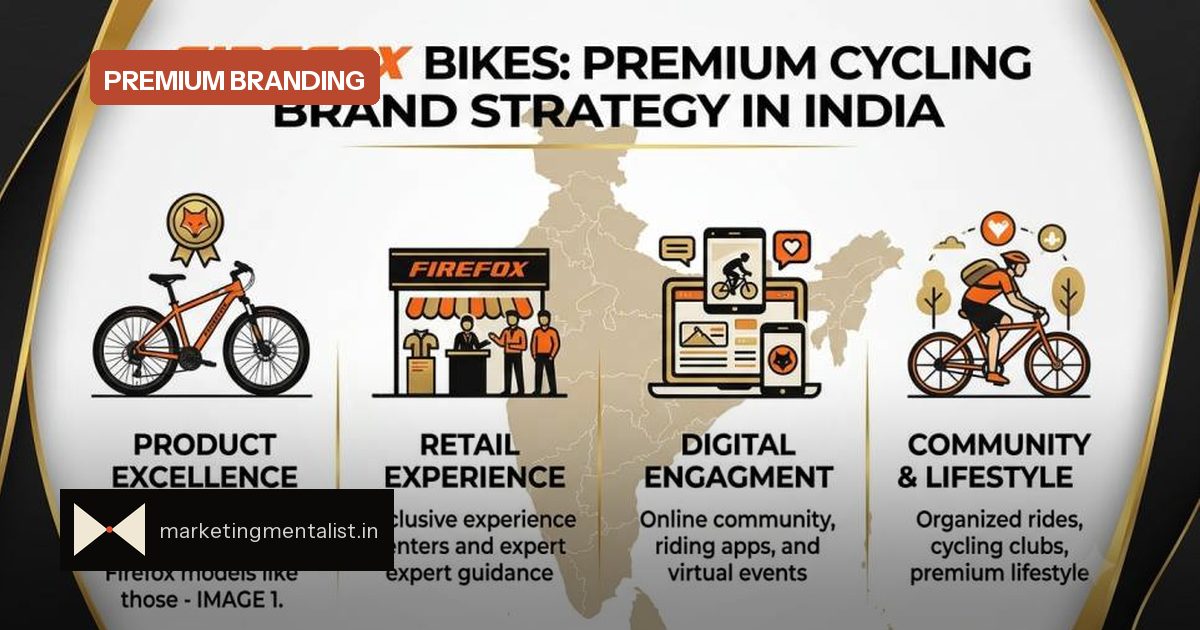
A premium play built on retail theatre
Firefox was founded in 2005 by Shiv Inder Singh and Pradeep Mehrotra. Its early role as exclusive Indian distributor for Trek, and later Gary Fisher and Shimano, gave it something local volume players lacked: international engineering credibility. In September 2015, Hero Cycles—described in industry press as the world’s largest bicycle manufacturer—acquired Firefox to strengthen its premium position.
The strategic shift after 2020 was not a big-budget ad campaign. It was physical. Firefox opened Experience Centres in Mumbai and then Delhi’s Pitampura in November 2021, with VR, gamification and a promise to turn bike buying into a technology-led experience. The company announced plans for 35 more centres across metros and Tier I cities, layered on top of a distribution network of roughly 700 dealers and 18,000–20,000 retail outlets.
The psychology of a premium demand spike
Firefox’s marketing head described the aim as creating “great customer journeys and engagement, starting with discovery.” The consumer insight was that the pandemic had converted cycling from a niche hobby into a visible choice about health, sustainability and personal mobility. That framing helped soften price resistance: the brand’s most popular bands were ₹12,000–₹15,000 and ₹20,000–₹30,000.
CEO Sukanta Das claimed Firefox held close to 25% of India’s premium bicycle segment and grew roughly 100% from 2019 to 2021, while the premium industry grew about 50%. He was careful to note there was no independent syndicated data to verify the share—a telling caveat.
What happens when the tailwind stops
Credit-rating disclosures show the correction. Firefox’s revenue declined 19% to ₹63 crore in FY2024, from ₹78 crore in FY2023. ICRA attributed the pressure to muted post-pandemic demand, excess inventory carried over from the boom, discounting, higher fixed costs and greater borrowing. In the first quarter of FY2023, Firefox sold 18,000 cycles and reported revenue of ₹22.5 crore—solid, but not enough to sustain the fixed-cost base of an expanding experience-retail story.
Brand lessons beneath the numbers
- Experience-led retail creates premium perception, but it does not scale to 18,000-plus traditional outlets quickly.
- Borrowed credibility from Trek, Gary Fisher and Shimano positions a brand; it does not replace a proprietary promise.
- A pandemic-era demand spike is not automatically a permanent category shift—test for durability before locking in real estate.
- In under-measured premium markets, self-reported share claims can shape perception; independent measurement becomes a competitive weapon.
Firefox’s play is a useful reminder that premiumisation is not a one-time positioning statement. It is a sequencing decision: build the brand story in controlled flagship spaces, but keep the economics flexible enough for demand to normalise. The brands that survive a boom-and-correction cycle are those that treat experience as a service layer, not just a store format.
Source: MarkHub24