Godawan’s 15,000-hour craft film shows purpose is a slow signal
Why Godawan's 8-month, 15,000-hour stop-motion film on the Great Indian Bustard is a costly signal of brand purpose—and what marketers can learn.
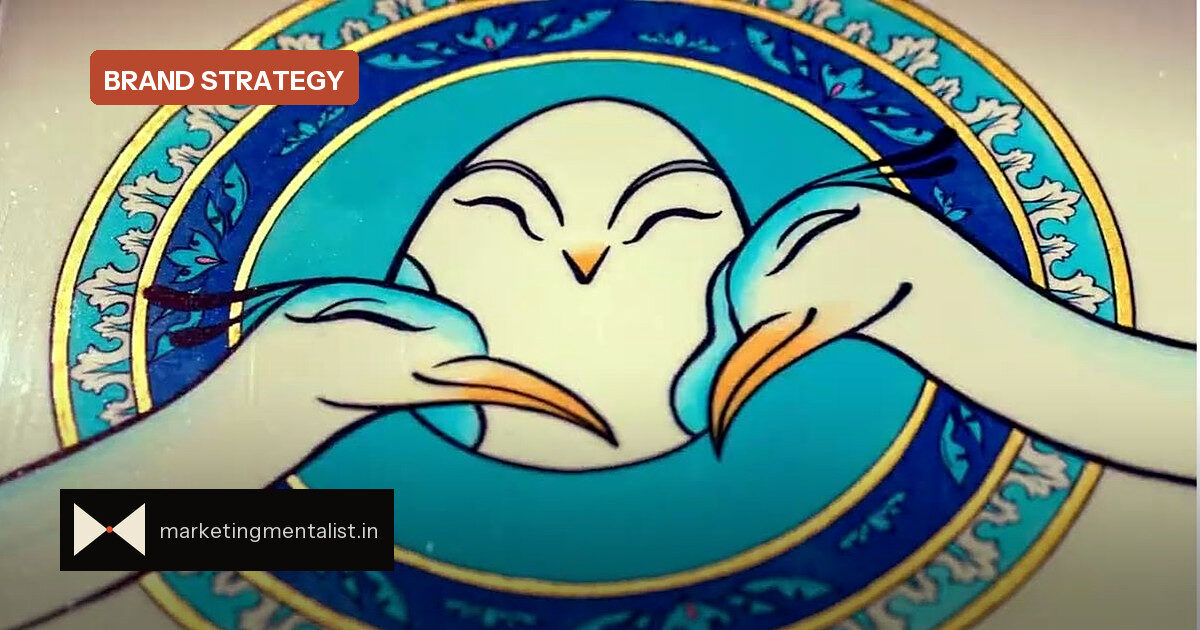
Godawan Estuary Premium Water has turned its long-running conservation story into a handcrafted stop-motion film for World Wildlife Week. Created with Studio Eeksaurus and directed and conceptualised by 22feet and McCann India, the film mixes stop-motion, 2D animation and live action to follow the Great Indian Bustard and the craft traditions of Rajasthan.
The production numbers tell the real story. More than 100 artists and craftspeople built and photographed over 5,200 individual ceramic pieces inspired by Jaipur Blue Pottery. The process took more than eight months and 15,000 hours of work. The music draws on Rajasthani folk forms, including the Ravanahatha and Morchang, with an original score by Resul Pookutty, Taufiq Qureshi and Rajat Dholakia.
Craft is the message
At first glance, this is a conservation film. At second glance, it is a positioning argument. Ruchira Jaitly, chief marketing officer of Diageo India, puts the contrast simply: “At a time when almost anything can be created in seconds, we chose to take the time to make this by hand.”
That choice is doing behavioural work. Since 2022, Godawan has marked the Great Indian Bustard’s recovery: 100 birds in 2023 with Godawan 100, and 173 birds in 2025 with Godawan 173: The Collector’s Edition, alongside the Rajasthan-focused Durbar platform. Earlier this year, the brand projected the conservation story onto Qutub Minar for World Environment Day. The film is not a one-off; it is another costly, difficult proof point in a chain.
This is costly signalling: a signal is most believable when it is expensive or hard to fake. A purpose claim is cheap. Recruiting over 100 artisans, firing 5,200 pieces by hand and spending 15,000 hours is not.
There is a quiet arithmetic here. The Great Indian Bustard’s recovery is measured in dozens of birds—100, then 173. The film’s production is measured in thousands of hours. A brand that spends more than the story strictly requires is sending a very specific message: this cause is not a line on a slide.
Why this matters now
Marketers are being pushed toward AI speed, generative assets and infinite content. That makes human effort scarcer—and more attention-worthy. Godawan’s campaign flips the default. The difficulty is not a production problem; it is the strategy.
McCann India’s chief creative officer Rahul Mathew frames it around shared ownership: telling the Godawan’s story through Jaipur Blue Pottery meant the craft had to be genuine, not decorative. Conservation and craft both demand patience, so the medium mirrors the message.
What to borrow
- Make the effort visible: name the hours, the artisans and the craft, not just the outcome.
- Match the medium to the meaning: a story about patience should be produced patiently.
- Build a chain of proof: one costly activation supports the next instead of starting from zero.
The reminder for brand managers is straightforward. Before claiming care, craft or commitment, ask what visible cost would make that claim expensive to fake. If the answer is “nothing”, audiences will treat it as nothing.
Source: Afaqs!