Daikin India’s Premium Bet: 5 Million ACs by 2030
How Daikin India plans to sell 5 million room ACs by 2030 while building premium through factories, R&D and one brand in eight languages.
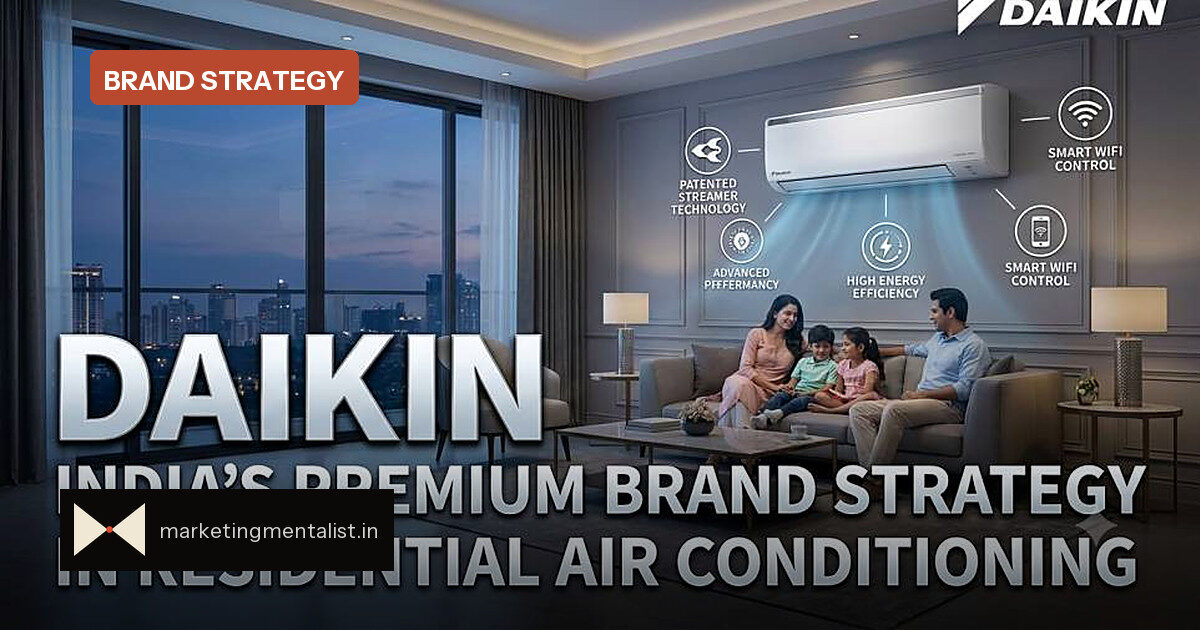
India’s residential air-conditioning market is still mostly empty. Daikin India chief Kanwal Jeet Jawa puts the opportunity directly: about 93% of Indians still don’t own an AC, and he calls that the company’s future market. By 2030, Daikin wants to sell 5 million room ACs—4 million at home and 1 million for export across Africa, the Middle East and South America.
Premium is being built in the factory, not the ad
The most revealing part of this strategy isn’t a campaign; it’s the supply chain. Daikin grew from roughly 30,000 room ACs in 2010 to about 1.2 million in 2023. Its Neemrana plant can make 1.5 million room ACs a year, and once Sri City is fully operational total capacity reaches 3 million room ACs plus 2.8 million compressors. In 2026, Daikin and Taiwan’s Rechi began work on a Rs 547 crore rotary compressor plant with Phase I capacity of 2 million compressors, scalable to 9 million.
That emphasis is deliberate. Jawa argues that Chinese products saturated the Indian room-AC market, and Daikin responded by building its own production and R&D. The result is a scale story as much as a brand story: consolidated operating income crossed Rs 8,178.2 crore in FY2024 provisional, with operating margins of 9.5%, 8.1% and 9.2% in FY2022, FY2023 and FY2024 respectively.
One brand, many languages
Instead of launching a separate value brand for Tier 2 and Tier 3 towns, Daikin kept the master brand and pushed it into eight Indian languages besides English in 2021, under the ‘Innovating For Change’ tagline. Its website labels some inverter splits, such as the FTKM and ATKL series, as a ‘Premium Series’, though no public data splits sales by tier.
This creates the central tension. A 4-million domestic-unit ambition puts Daikin closer to mass-market leader Voltas—which sold over 2 million ACs in FY24—than to a narrow premium niche. Whether premium perception holds at that volume is not answerable from public information.
Brand strength is not the same as pricing power
Here’s the marketer’s lesson. ICRA credits Daikin with good brand recall and VRV leadership, yet also says its ability to pass on large price increases is limited. Revenue grew about 43% in FY2023 and about 20% in FY2024, but margins stayed range-bound. This is the gap between being loved and being able to charge more.
- Premium can be built as proof—engineering, in-house components and R&D—before it becomes price.
- Geographic expansion can happen in the customer’s language without splitting the brand.
- Track pricing power separately from recall, because strong brands don’t automatically get price rights.
For brand managers, the framework is simple: premium is an operating asset, not a label. Daikin’s bet is that owning compressors and local R&D will eventually earn what a price-led campaign cannot. Timely production, backward-integration benefits and parent support will decide whether 5 million units by 2030 builds a premium franchise or just a bigger one.
Source: MarkHub24