MRF’s 87.7 Brand Strength Is Built on Racing, Cricket and Muscle
MRF's 87.7 Brand Strength Index is a trust score. Inside the layers—mascot, cricket, motorsport—that make invisible quality feel real.
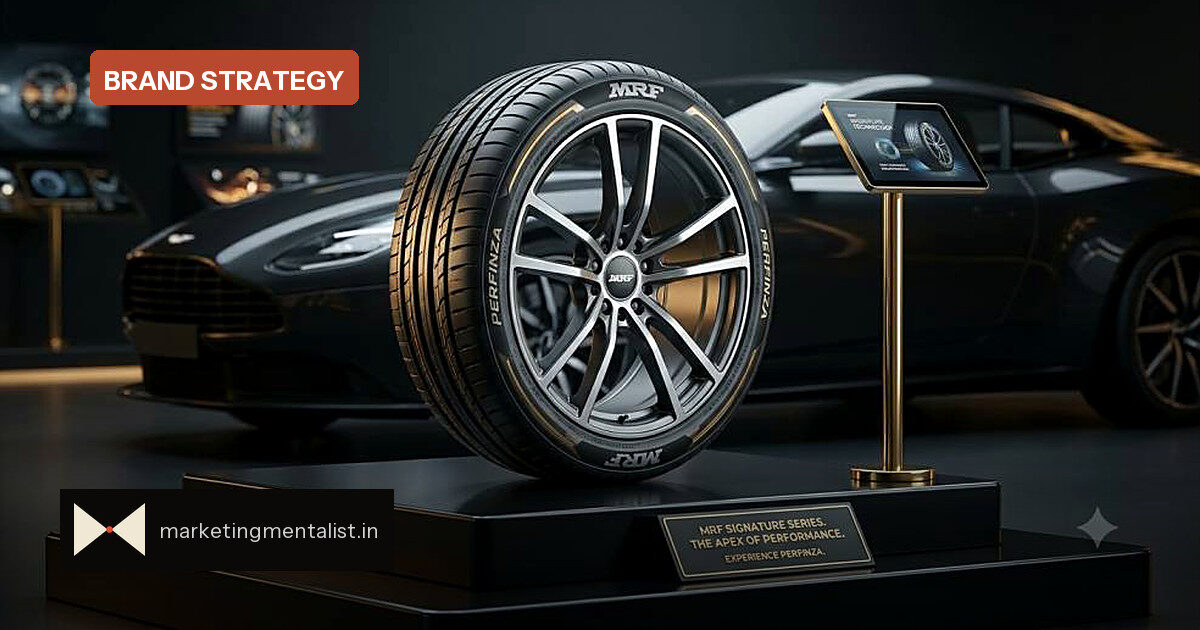
Most buyers never kick the tyres. They glance at a logo, a name and a price, then decide. That is why MRF’s latest brand-strength score deserves attention: 87.7 out of 100, placing it third among tyre brands globally in Brand Finance’s Tyres 25 – 2026 report. Brand Finance also named MRF India’s most valuable and strongest tyre brand.
The invisible product problem
A tyre is safety-critical, but it is one of the last things a buyer inspects. Crisil estimates that replacement demand accounts for roughly half of annual sales, and the top six manufacturers hold about 85 per cent of a sector worth approximately ₹1 lakh crore. In that kind of market, reputation is the product.
MRF Limited, founded in 1946 as Madras Rubber Factory, built its reputation in layers. Early milestones include entering tread rubber in 1952, exporting tyres to the USA in 1967, beginning nylon tyre manufacture in 1973, and supplying tyres for the Maruti 800. The Muscleman logo appeared during the 1964 export push and was credited to long-time marketing executive Philip Eapen, with creative work by Lintas.
A proof stack, not a single campaign
MRF’s premium positioning did not arrive through one launch. At Bharat Mobility Global Expo 2025, the company framed its brand around “Muscle in Motion” and a simple principle:
“Tyres We Race Are the Tyres You Buy.”
The idea: if a tyre survives racing, it can be trusted on an ordinary road.
Four proof points carry that promise:
- Mascot: Muscleman gives a technical product a simple visual metaphor of strength.
- Cricket: the MRF Pace Foundation with Dennis Lillee; bat endorsements from Tendulkar, Lara, Kohli and Gill; and an ICC global partnership, including the 2015 Cricket World Cup.
- Motorsport: first Indian FIA-approved karting tyres, the MRF Challenge series, FIA European Rally Championship team titles in 2022 and 2023, and an official tyre supplier role for the 2025 British Rally Championship.
- Premium product line: Perfinza and Markus sizes for Audi, BMW, Mercedes-Benz, Volvo, Jeep, Hyundai and VW, plus W-rated Steel Brace motorcycle radials.
Why borrowed credibility works
For a low-visibility safety product, buyers lean on trust signals such as endurance, expert use and familiarity. Racing proves the product at the limit, cricket supplies emotional salience, and the specialist range gives premium buyers a concrete next step. None of these tactics works alone; together they make one idea — strength — feel obvious.
The caveat for marketers
MRF’s financials are strong. FY26 consolidated revenue rose to ₹31,149.01 crore from ₹28,153 crore, net profit climbed to ₹2,426.1 crore, and EBITDA margin expanded from 15.97 per cent to 17.15 per cent. But ICRA and Crisil point out that premiumisation is lifting realisations across the entire tyre sector. A brand ranking validates strength; it does not prove which tactic caused the financial result.
The transferable lesson: pick one durable claim, then keep proving it where the buyer already respects the outcome.
Source: MarkHub24