JK Cement’s Paint Play: Trust Transfer as Brand Strategy
JK Cement is using putty and white cement trust to sell paint. A look at premiumisation, trust transfer and the psychology of simplifying choice.
Cement is the least romantic category in Indian marketing. Freight costs, regional oversupply, fuel prices, government capex cycles — almost nothing in the P&L responds to brand love. Which is exactly why JK Cement’s push into “value-added products” is worth studying: it is a branding strategy built to fix a margin problem.
What the news says
According to a detailed case study by MarkHub24, JK Cement has made “premiumisation” an explicit pillar of corporate strategy. In its FY26 annual report, Joint MD and CEO Madhavkrishna Singhania listed strengthening the value-added products portfolio among immediate priorities, with the company aiming to improve product mix, tighten pricing discipline and “narrow the realisation gap with larger industry peers.”
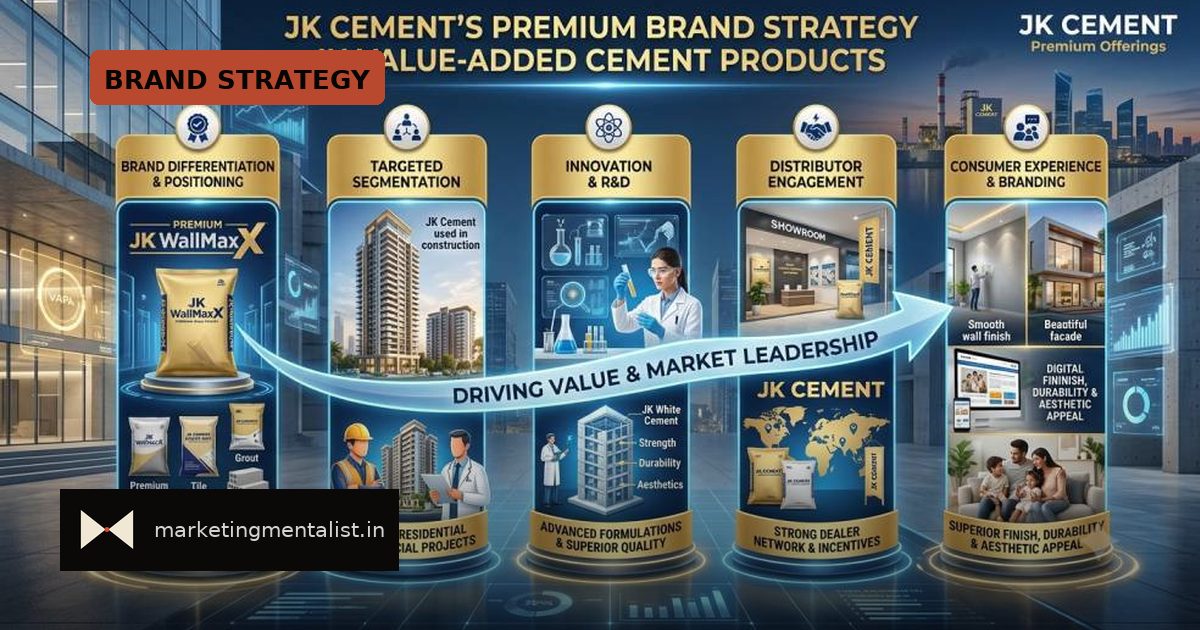
The portfolio in question sits closer to the end consumer than bulk grey cement: white cement, wall putty, tile adhesives, grouts, construction chemicals and now paints. JK Cement set up India’s first indigenous white cement plant at Gotan, Rajasthan, in 1984 — the move that turned it from a commodity supplier into a specialist manufacturer. Its board approved a paints entry in March 2022 with up to ₹600 crore over five years, housed in a separate wholly owned subsidiary. Entry was acquisition-assisted: a 60% stake in Acro Paints for ₹153 crore in January 2023, with the balance bought out by early 2024. JK Maxx Paints Limited reported revenue of ₹264 crore for the year ended March 2025 per Tracxn, with company guidance pointing to ₹500–550 crore in FY27.
The branding move: borrow trust, don’t build it
The most instructive part is the April 2026 campaign, Maxx Karo, Relax Karo — the brand’s first celebrity ambassador engagement, with Akshay Kumar. The TVC’s joke is simple: he answers every question with “JK Maxx,” because every expert he consulted while painting his own home recommended JK Maxx at every step.
Note what the campaign does not do. It does not launch paints as an independent challenger brand against Asian Paints, Berger or Birla Opus. Business Head – White Cement and Paints Nitish Chopra framed the offer as “a complete, end-to-end solution backed by the trusted legacy of JK WallMaxX Putty and JK WhiteMaxX Cement.” That is textbook trust transfer: move accumulated credibility from a low-visibility ingredient brand into a high-visibility consumer category.
The consumer psychology underneath
Chopra’s stated insight is that buyers face too many choices across putty, primer and paint. In behavioural terms, this is choice overload compounded by sequential decisions — each step raises the perceived cost of getting the next one wrong. Painting a home is infrequent, expensive and socially visible, so the buyer’s dominant emotion is not excitement but risk.
The strategic answer is to reduce the number of decisions to one. Hence the shared MaxX naming architecture across WallMaxX, ShieldMaxX, LevelMaxX, WhiteMaxX and JK Maxx Paints, and the corporate framing of a “complete wall solution” from surface preparation to final coat.
What marketers can take from this
- Premiumisation can be defence, not vanity. JK Cement’s own words tie value-added products to a per-tonne realisation gap. Frame your premium tier against a specific economic problem.
- Ingredient credibility is an underused asset. Putty is invisible in the finished home, yet it is trusted by masons and contractors. That trust is transferable upward.
- Sell the sequence, not the SKU. When purchase involves multiple linked choices, bundling into one recommendation reduces anxiety better than any feature claim.
- Match capital to ambition. Grasim’s Birla Opus entered decorative paints with a disclosed ₹10,000 crore across six plants and became the second-largest player by capacity within roughly two years; Asian Paints’ share slipped from 51% to 47% in FY25, per Geojit’s Antu Thomas as cited by Outlook Business. JK Cement’s ₹600 crore, acquisition-led route is a different game entirely — and should be judged on different metrics.
The open question is verification. Forward guidance without segment-level audited profitability tells you the story is working; it doesn’t yet prove the strategy is value-accretive rather than merely revenue-diversifying. For brand teams, the lesson stands regardless: in commodity categories, the fastest route to margin is often the trust you already own.
Source: MarkHub24