Gandhi: India’s Strongest Brand Recall
An analysis of why Gandhi became an unmatched brand without a campaign, and what marketers can learn from living values instead of performing them.
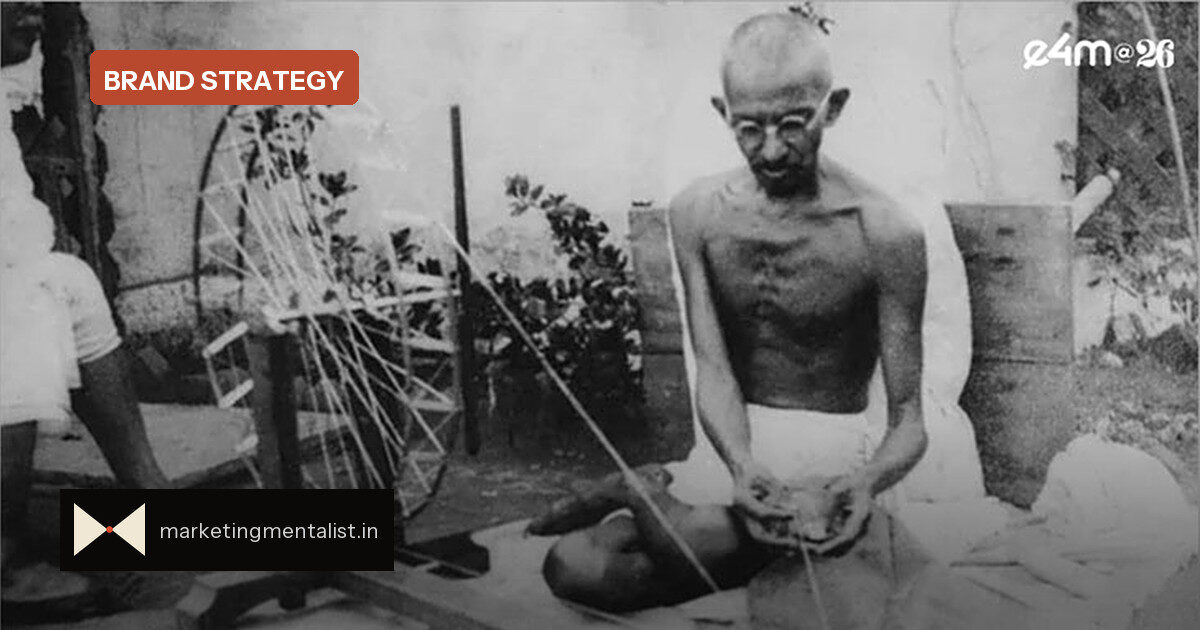
On October 2, as India remembers Mahatma Gandhi, exchange4media carries an unusual marketing argument from Dr Annurag Batra: Gandhi may be the strongest brand of recall the country has produced. He had no advertising campaign, no social media strategy, no logo and no marketing budget. Yet the name still summons truth, non-violence, simplicity, courage, self-reliance and peace.
No campaign, no budget, total recall
Gandhi’s brand strength did not come from communication. It came from the visible consistency between what he believed, what he said and how he lived. His everyday choices became identifiers. The dhoti, khadi, walking stick and round spectacles were never designed as brand assets, but they turned into instant visual cues. As Batra puts it, The message and the messenger were inseparable.
Trust was the distribution engine
Most brands spend heavily to appear authentic. Gandhi had no reason to perform it; he lived it. People followed him because his words carried the weight of visible action. Without television, digital platforms or social media, his ideas travelled across the country because ordinary people carried them. That reverses a familiar assumption: when people believe a message, they become the medium, and reach becomes an outcome rather than an input.
His influence also outlived the freedom struggle, touching leaders such as Martin Luther King Jr. That is the signature of an idea-led brand: it travels across borders and generations.
The lesson for brand builders
Batra’s piece maps neatly onto principles modern marketers treat as strategy:
- Distinctive identity: the person was recognisable before any design system existed.
- Consistent message: one philosophy repeated through action, not copy.
- Memorable symbols: visuals rooted in behaviour, not decoration.
- Clear purpose: the name stood for something larger than one person.
- Emotional connection: people joined a movement, not a campaign.
Modern marketers talk about purpose, authenticity, storytelling and trust. The Gandhi case reminds us these cannot be communicated into existence. A brand promise means something only when audiences see evidence of it. Gandhi’s life was the evidence.
What to borrow from the Gandhi brand
For founders and brand managers, the practical test is simple: if every paid channel disappeared, would people still carry your message? If not, the gap is not in distribution; it is in evidence. Before investing in more visibility, find one visible routine that proves the promise. Let symbols emerge from repeated behaviour. Make the customer the channel, not just the audience.
Gandhi’s legacy shows that a brand becomes durable when actions do the talking long before the advertising begins.
Source: Indian Advertising Media & Marketing News – exchange4media