CEAT’s Brand Evolution: From Rugged Rhino to Smart Mobility
CEAT replaced its rhino and ‘Born Tough’ tagline with a safer, smarter mobility purpose. Here’s what the repositioning teaches brand leaders.
Most tyre brands sell grip. CEAT spent nearly five decades selling toughness. The shift from a charging-rhino identity to “Making Mobility Safer and Smarter. Every Day” is a useful case in how a legacy brand can stretch without snapping.
A legacy built on ruggedness
CEAT traces back to a Turin company founded in 1924, entered India in 1958 with the Tata Group, and became part of RPG Group in 1982. For years, the brand leaned on a rhino mascot and “Born Tough” tagline—a promise built for overloaded trucks and rough roads.
In 2008, CEAT retired both. Then-executive Arnab Banerjee framed the move as a shift from umbrella branding toward category branding, aimed at making the brand “more youthful, dynamic and premium.” The insight: the old identity had become a product claim, not a platform.
The new frame: safer and smarter
India is the world’s fourth-largest tyre market. CEAT holds roughly 17% of the domestic passenger-vehicle tyre segment, behind MRF and Apollo. EVs were still a small slice—around 4% of car sales and 6.5% of two-wheeler sales—but they demand different engineering: silence, instant torque, low rolling resistance.
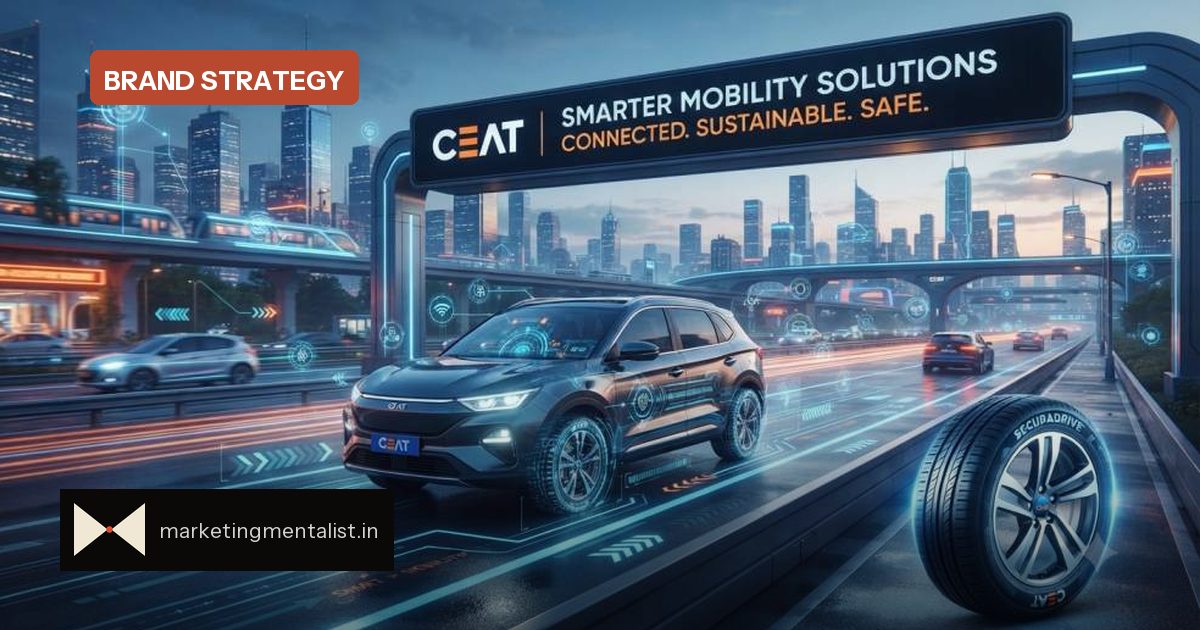
CEAT’s stated purpose is “Making Mobility Safer and Smarter. Every Day.” The execution has two strands. A safety-led story speaks to Indian road conditions and underappreciated tyre risk. A technology and electrification strand shows up in the EnergyDrive range, with CALM acoustic material, EasyFlex cavity design and DuraBlock tread design. CEAT has supplied tyres for the Tata Ace EV and MG Comet and says future mainstream tyres will be “EV-ready by default.”
What brand managers can steal
- Turn a feature into a purpose. “Tough” described the product. “Safer and smarter” describes the customer outcome—and travels across passenger, truck, EV and off-road lines.
- Make the product carry the message. CEAT’s smart-mobility claim is tied to named technologies, not just mood ads. That gives the positioning something verifiable to stand on.
- Renew the creative, not the real estate. The IPL Strategic Timeout board stayed for over a decade, but CEAT layered on QR interactivity, influencers and an exploration theme rather than abandoning a high-visibility asset.
The uncomfortable gap
CEAT’s brand recognition has grown: it entered the world’s top 20 tyre makers and appeared among the top 10 strongest tyre brands in one 2026 ranking. Financials also improved, including strong FY24 operating profit growth. But public reporting does not link campaign spend to those outcomes. Management attributes recent revenue growth to replacement and export segments—not brand campaigns.
That is an honest lesson: most companies separate brand recognition metrics from financial disclosure. If you are building a brand case, track the bridge yourself.
Source: MarkHub24