
Jamai Premium, Shagun Pricing and India’s Buying Code
Bharat Lab and Rediffusion map everyday Indian habits—bargaining, festive buying, kitty parties—into a consumer behaviour playbook brands can test.
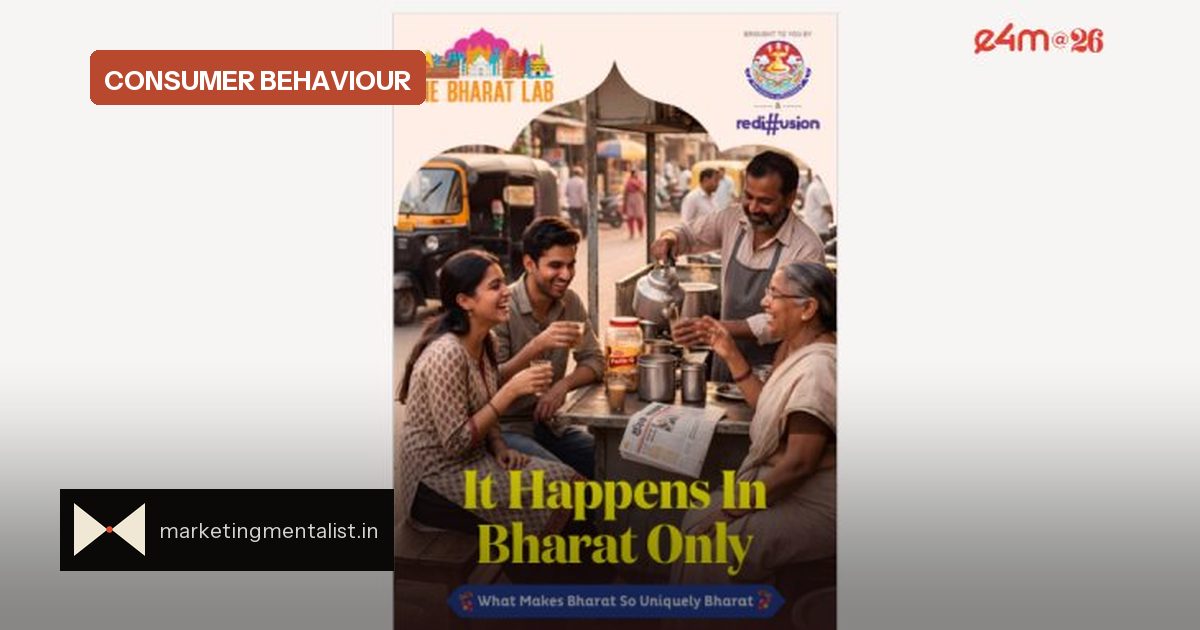
A new observational report from Bharat Lab and Rediffusion argues that Indian consumer behaviour cannot be read through a purely individualistic lens. Titled It Happens in Bharat Only, the study maps everyday habits—bargaining, festive purchases, food rituals and neighbourhood influence—into a sharper picture of why people buy. It is built on conversations across India rather than standard demographic slicing, and it asks marketers to stop treating local behaviour as noise.
Relational buying over individual choice
The report’s central claim is that Indian decisions are often relational. Family, social circles and community act as an invisible decision-making board, especially for high-involvement or first-time purchases. That means a brand’s actual customer may not be the person paying at the counter, but the household or peer group validating the choice.
For strategists, this shifts segmentation. A 34-year-old metro buyer is not a standalone shopper; he may be negotiating with parents, spouse, children and a wider network. Campaigns that only target the individual can miss the real conversation where the decision is actually made.
Everyday quirks as strategy prompts
The report reframes several familiar Indian behaviours into useful marketing concepts:
- Jamai Premium: the tendency to over-serve a son-in-law while taking long-standing family members for granted—a mirror for how brands often over-invest in acquisition and under-serve loyal customers.
- Shagun Pricing: symbolic amounts such as ₹101 or ₹501 show that price endings can carry cultural meaning, not just arithmetic logic.
- Kitty Party Economy: informal women’s groups working as recommendation engines, social proof systems and peer-to-peer financial networks long before WhatsApp and influencers formalised them.
- Tiffin Box Test: a product’s acceptance inside the family or workplace, extending beyond the person who bought it.
- Badaam Effect and Sharma Ji Ka Beta Effect: visible acts of care and family-driven social comparison act as Indian versions of value signalling and FOMO.
- Muhurat Tax: buying around auspicious occasions creates culturally timed demand windows that do not show up on a standard seasonal calendar.
These are not just labels. Each one suggests a testable prompt: how does your pricing end, who actually approves your product, and which community loop carries your word of mouth?
Scarcity’s long shadow
The report also connects bargaining, product longevity and jugaad to an earlier era of limited resources. Even as incomes rise, the instinct to repair, reuse and extract more value remains. Brands that assume rising affluence will erase these habits may misread India. Durability messaging, exchange offers and value engineering can still win trust even in premium categories.
What to do with it
Use this as a cultural listening framework, not a rulebook. Test the quirks that appear in your category. A D2C gifting brand might experiment with shagun-style price endings. A subscription app might measure whether new users get the equivalent of a Jamai Premium while loyal users churn quietly. A consumer electronics marketer might map muhurat windows as seriously as festive sales.
The report itself is observational, not a statistically weighted market study. Treat its concepts as hypotheses to validate with your own research. The bigger lesson is strategic: if a behaviour is widespread and persistent, it is probably not an error waiting to be corrected. It is a code your brand can learn to speak.
Source: Indian Advertising Media & Marketing News – exchange4media