Firefox Bikes’ ₹6,000–₹20,000 Premium Balancing Act
How Hero Cycles kept Firefox distinct, added a value sub-brand, and used experience retail to hold the premium middle without dilution.
The premium middle is now the battlefield
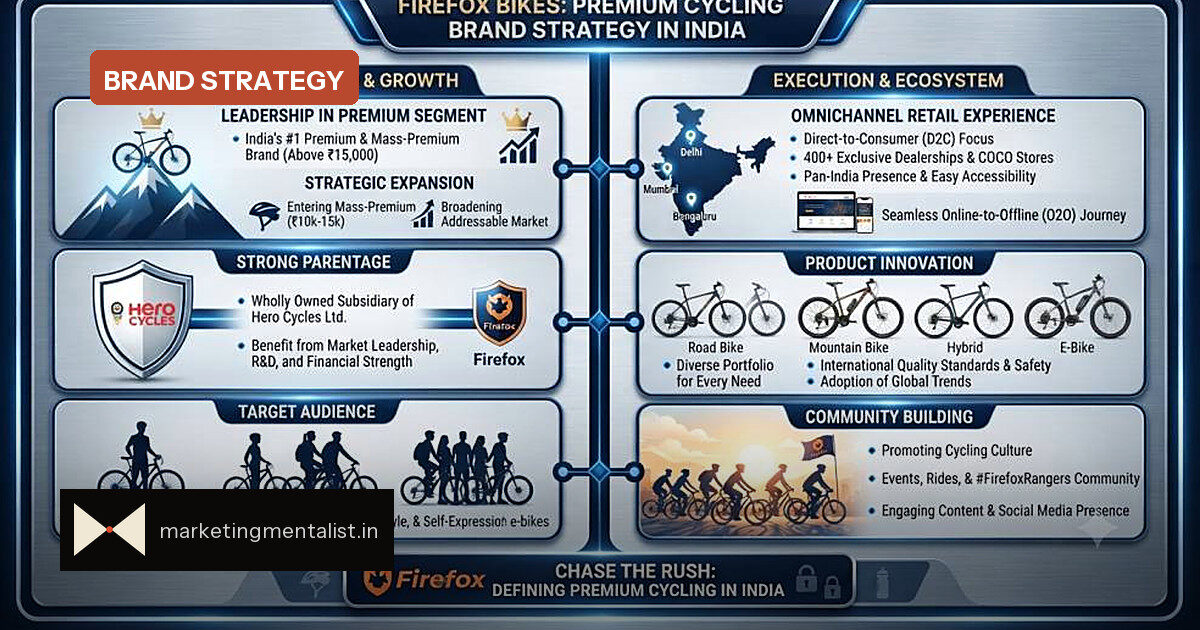
India’s bicycle market was long built for volume. When Hero Cycles acquired Firefox Bikes in 2015, reports said the premium segment had grown at 25% CAGR since the early 2000s and Hero was manufacturing around six million cycles a year. The acquisition was intended to expand Hero’s presence in premium cycles, and the two brands were kept separate from the start.
After 2020, demand tilted toward adult MTBs and hybrids as new riders picked up cycling for fitness and sustainability. By late 2022, CEO Sriram Sundresan said the post-Covid surge had softened as commuters returned to routine, but the quickest-growing opportunity was a “mass premium” band between ₹6,000 and ₹20,000. That middle became the central tension: how do you chase value buyers without looking less premium?
Two brands, not one discount
Firefox’s answer was architectural. In January 2022 it launched Bad Attitude as a separate sub-brand with a similar design language but lower costs. The parent stayed anchored in high performance, adventure and recreation, while Bad Attitude absorbed the mass-premium demand. The CEO spelled out the distinction: Firefox for performance, Bad Attitude for the value-conscious buyer.
The same boundary-keeping appeared in e-cycles, where Firefox limited itself to premium B2C use cases and avoided commuting so it would not collide with Hero’s Lectro range. This is a lesson in brand architecture: a flanker brand can protect the flagship and still capture the price-sensitive segment.
Retail as a positioning tool
Firefox also made the store part of the brand. Its first company-owned, company-operated experience centre opened in Navi Mumbai in 2021, using black-and-orange livery, virtual reality, gamification, service areas and local ride displays. The company said it had invested in Salesforce Cloud for the digital journey and planned to replicate the format in 35 customer experience centres.
For marketers, that is the transferable idea. When a product is easy to compare, the buying experience, community cues and personalization do the differentiating. Firefox added customization—paint shades and graphics on select frames—because its research showed buyers wanted more personalization, and senior leaders described cycling as adventure, recreation, fitness and fun rather than commuting.
What to do about it
- Use a sub-brand, not a price cut, to enter a cheaper tier when the core identity matters.
- Fix clear scope rules so channel or category overlap with a parent brand is designed out.
- Treat owned experience retail as a brand investment with its own metrics, not merely distribution.
- Read management growth claims without public baselines as directional only.
The reported outcomes are thin: a marketing head said the brand grew four times in two years, while the CEO later said it grew 2.5 times during the pandemic. The baselines are not disclosed, so the claims should not be compared. Still, the case holds together as a disciplined premium play under a mass-market owner—sub-brand for value, experience retail for identity, and explicit scope limits for the parent relationship.
Source: MarkHub24