Why Brands Now Use the Back of a Billboard as Creative Media
Star Health and Safi turned billboard backs into brand ideas. What makes it attention or wasted reach? A framework from OOH leaders.
Out-of-home advertising is no longer just a race for the busiest road or the largest hoarding. As the medium gets more crowded, brands are using the physical structure itself as part of the creative idea. Two recent campaigns show how the back of a billboard has stopped being dead space and started carrying the message.
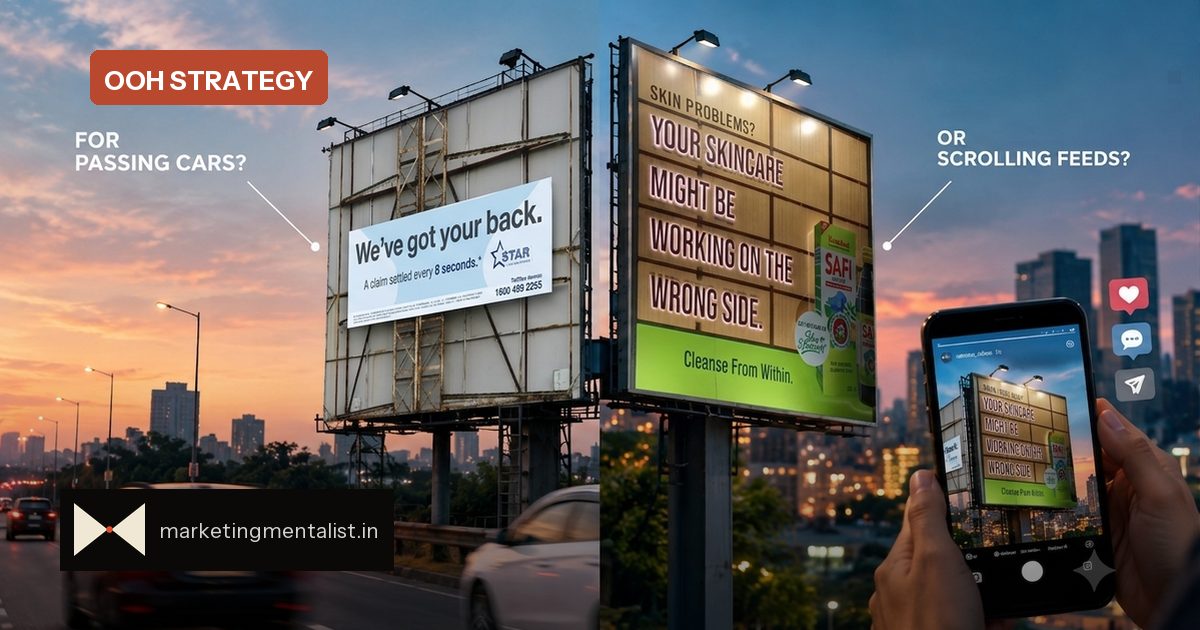
Star Health Insurance used the actual reverse side of billboards in five cities to dramatise its promise, We’ve got your back. Hamdard’s Safi went the other way: in four cities, its boards were front-facing but designed to look reversed, carrying the line, Your skincare might be working on the wrong side.
Same visual, different strategy
The two executions look similar from a photograph, but they rely on different mechanics. Star Health bought the literal back of the board, so the placement itself became proof of the brand statement. Safi borrowed the visual vocabulary of a wrong-side board while keeping the actual audience of a front-facing placement.
We wanted the OOH to behave like the idea, rather than simply carry it, says Uzma Majeed, digital lead at Hamdard Laboratories India. The reversed look was designed to challenge the way commuters expect a billboard to appear and pull a second glance, tying into Safi’s Cleanse From Within positioning.
The reach problem
The catch is visibility. A billboard’s front is usually planned around a known traffic flow. The reverse side may face opposite-direction traffic, a service road or nothing much at all. Rohit Chopra, deputy CEO of Times OOH, notes that the value depends on location, traffic direction, sightlines and environment.
Yuvrraj Agarwaal, chief strategy officer at Laqshya Media Group, is blunter. The reverse side has no audited audience, so there is no reach number to claim.
Judge it as PR and price it as content, not as outdoor reach.
That changes how a marketer should evaluate the execution: the return is earned attention, not a media plan’s reach curve.
When the back makes sense
The question is not whether the reverse side is always good or bad. It is whether the back is the idea. Agarwaal says he would recommend it only when the concept would not work anywhere else and the reverse is central to the message.
Use this test before proposing a reverse-side billboard:
- Is the reverse essential to the idea, or just a visual twist?
- Is there a real audience on the reverse side, or only a camera-ready shot?
- Can the execution be approved for the specific site and structure?
- Are you measuring it as earned media, not as reach?
If any answer is no, a front-facing board or a social-first creative may be a cleaner route.
The social layer
One reason these odd formats are spreading is that physical OOH can live a second life as content. A strange board gets photographed, filmed and shared, turning a local placement into earned media beyond the road. Chopra describes OOH as becoming more connected — the physical asset starts conversation and social amplification.
Agarwaal warns brand managers: build for the share, but not instead of the audience. The back of a billboard is not a new category yet; it is a creative option. It works when the reverse itself carries the message and when a genuine, addressable audience sees it. Otherwise, it is just an ad facing the wrong way.
The back of a billboard is a useful reminder that context is part of the creative. When the medium reflects the promise, a simple placement can earn the second look that ordinary OOH often misses.
Source: Afaqs!