
ixigo’s TARA ad turns holiday crowd-following into sheep
ixigo's new TARA film uses sheep-headed tourists to show how heavily travellers lean on popular choices—and nudges marketers toward preference-led discovery.
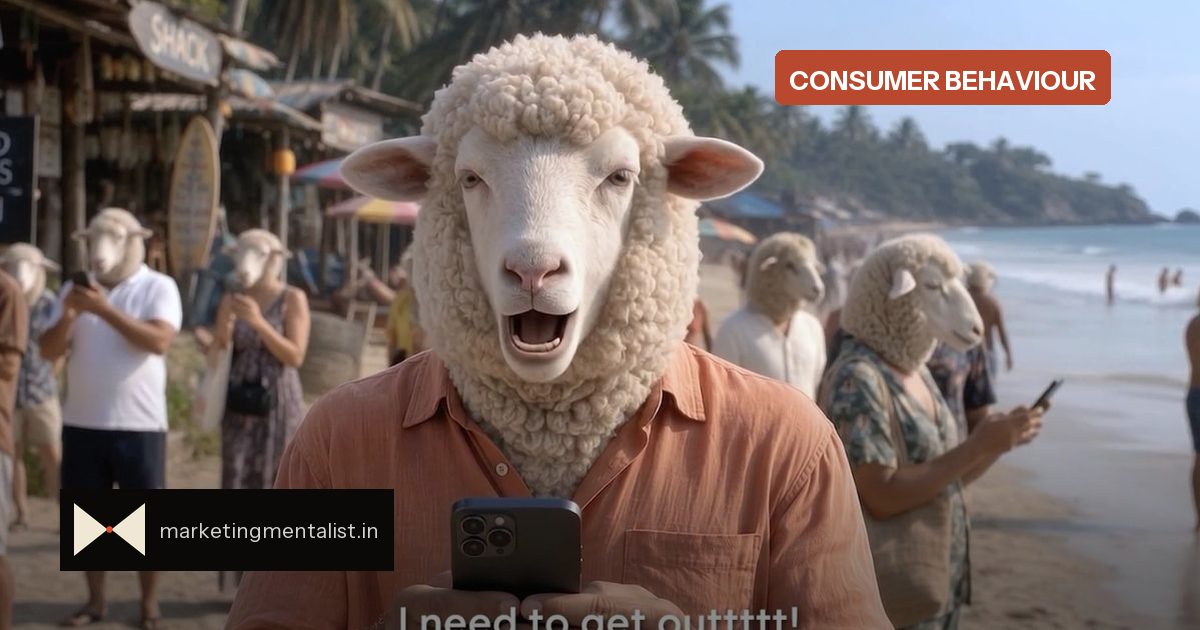
When everyone seems to be holidaying at the same beach, ixigo wants you to notice something absurd: a shoreline packed with sheep-headed tourists. In its new film for TARA, the travel brand’s AI assistant, the crowd is not just metaphorically following the herd—it has literally become one.
The film opens on a crowded beach where every holidaymaker has a sheep’s head, all drawn to the same destination. Packed shorelines and busy beachside cafés reinforce a holiday shaped by popular choices rather than personal ones. Then a single traveller opens the ixigo app and speaks with TARA. He moves to a quieter seaside location, and as he does, his sheep-like appearance gives way to a human face. The closing message: “Don’t follow the herd.”
What the campaign is really showing
This is a neatly packaged demonstration of social proof in action. When a destination looks popular, we often read that popularity as evidence that it is the right choice. But ixigo’s creative team reframes that same signal as a trap: crowded does not automatically mean better, and following the crowd can strip away what you actually wanted from the trip.
The shift is visual, not verbal. The travellers do not become sheep when they make a bad decision; they are already sheep because they never made their own decision. The moment of agency arrives only when TARA asks what the traveller prefers.
Why it matters for brand managers
For marketers, the film is a reminder that personalisation can be positioned as an antidote to social proof. TARA is not shown as a booking tool; it is shown as a preference-discovery tool. The promise is not “cheaper flights” but “a holiday that feels like your own.”
That distinction matters. When an AI assistant helps users express preferences, the brand can move from transactional to conversational. The creative idea is simple, visual and instantly recognisable—exactly what a mass-market travel app needs to explain an abstract AI feature.
What to do with this insight
- Use contrast to make hidden options visible: show the popular choice and the personally relevant choice side by side.
- Position recommendation tools around preferences, not just convenience or price.
- Make the moment of personal agency visible in your creative—show the before and after of choosing for yourself.
Ameya Velankar, group SVP marketing & PR at ixigo, says the sheep are “a humorous reminder of how often we let the crowd shape our choices.” The campaign’s logic is clear: if your product helps people discover alternatives, don’t just tell them—show them what breaking away looks like.
For travel brands and beyond, the lesson is to watch what your category treats as proof. If popularity is the default signal, an alternative voice can become a differentiator.
Source: Afaqs!