Coca-Cola’s Golden World Cup Cans: A Lesson in Fan Ownership
Coca-Cola India turns Spain's FIFA World Cup victory into a limited-edition golden can on Zepto and Blinkit. Here's the psychology.
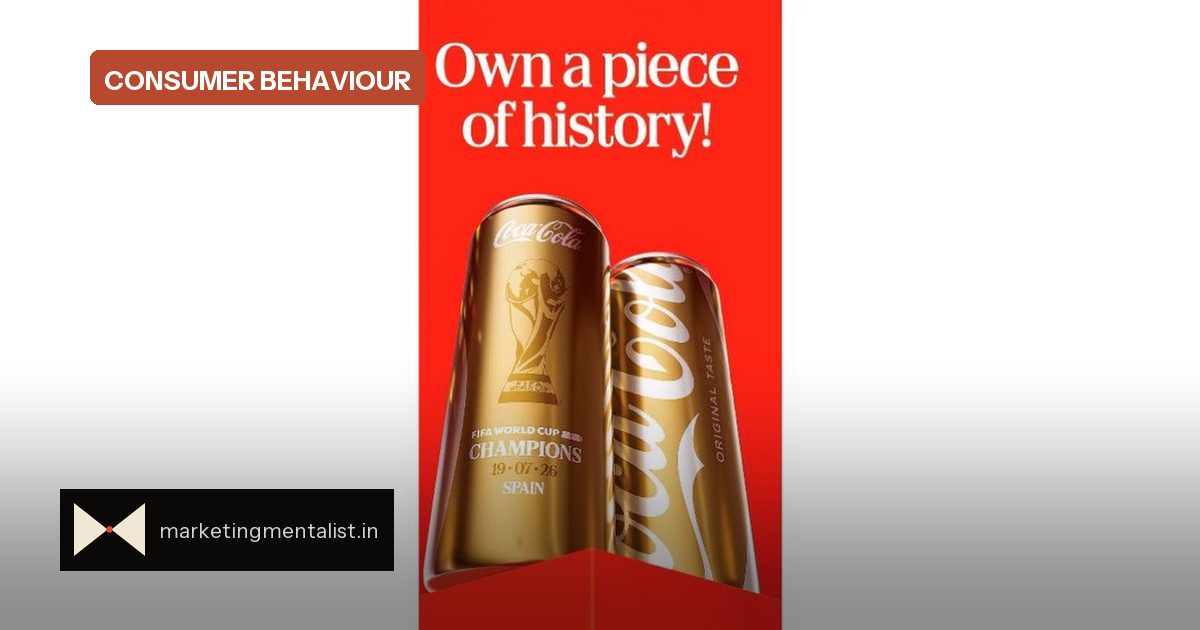
Coca-Cola India is bottling a moment, not just a cola. Close on the heels of Spain’s FIFA World Cup 2026 win, the brand has launched a limited-edition golden can called ‘Own a Piece of History’. The can carries the date of the victory and the FIFA World Cup Trophy, and it is rolling out in Delhi/NCR through quick-commerce platforms Zepto and Blinkit.
Pre-booking went live first on Zepto, while Blinkit also stocks the cans across Delhi/NCR. The distribution choice is deliberate. Quick commerce shrinks the time between an event and the chance to buy a piece of it.
Why a golden can feels like a memory
Nobody can own a match. Fans can, however, own an object that stands in for the win. That is the core move here: Coca-Cola has turned routine packaging into a memory marker. The date matters as much as the trophy because it creates a specific event anchor. A can without a date is just a can; a can with Spain’s victory date becomes a small piece of evidence that you were there, even if you were watching from your living room.
Psychologically, this taps into a few familiar forces. Scarcity raises interest, but only when the scarce object is tied to a meaningful event. Identity expression does the rest. A limited-edition can is an affordable identity badge—it lets a fan participate in the World Cup story without buying premium merchandise.
“We wanted to turn an unforgettable FIFA World Cup celebration into something fans could own,” said Abhishek Gupta, VP, customer development, Coca-Cola INSWA.
Immediacy is part of the product
Coca-Cola has been an official FIFA World Cup partner since 1978, so the brand’s football association is not new. What is interesting is how it is using q-commerce to convert that association into a perishable, in-the-moment purchase. ‘Own a Piece of History’ follows ‘Matchday Hangout’, a watchalong with football enthusiasts and influencers. The golden can extends the same logic beyond content into a physical keepsake.
For marketers, this shortens the path from emotion to transaction. When a team wins, excitement peaks immediately. If a brand waits for a traditional retail cycle, the emotional window cools. Pre-booking on Zepto and availability on Blinkit let Coca-Cola catch fans while the celebration is still fresh.
Here’s what the activation gets right:
- It anchors the collectible to a specific date, not just a generic tournament logo.
- It uses one platform for early access, creating announcement buzz before wider availability.
- It keeps the object affordable, so ownership feels inclusive rather than premium-only.
- It lets the packaging carry the story through two simple symbols: date and trophy.
What brand teams should steal
The biggest lesson is that a limited edition works hardest when it marks a moment people are already talking about. If the same golden can had been released without a victory date, it would be decoration. With the date, it becomes a small ritual object for fans. The second lesson is speed: partnerships with q-commerce platforms make real-time marketing more than a social media phrase.
This does not mean every brand should rush out dated packaging. It means that cultural moments, when they align with a brand’s history, can be converted into tangible, low-cost memorabilia. The product stays the same. The meaning around it changes.
Source: Afaqs!