India’s D2C Growth Goes Under the Lens at e4m Summit 5.0
The e4m D2C Summit 5.0 gathers India's direct-to-consumer leaders to decode consumer behaviour, digital-first strategy and what actually drives durable growth.
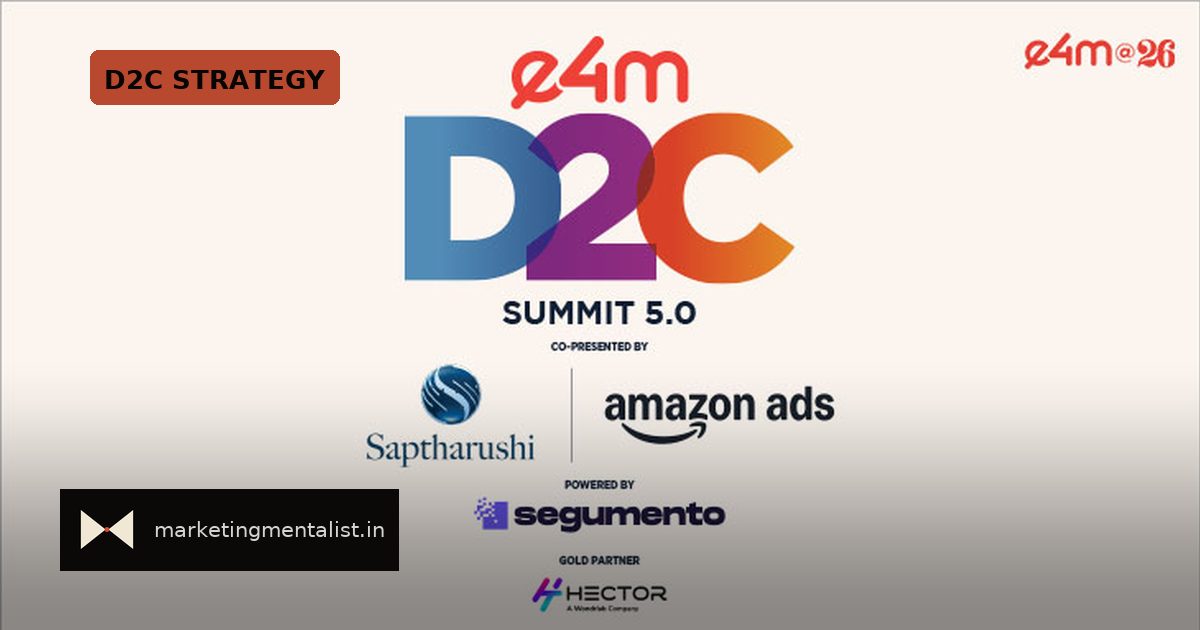
India’s direct-to-consumer sector is about to get a room full of its own decision-makers. The fifth edition of the e4m D2C Summit is set to convene leading voices from the country’s D2C ecosystem to unpack how the category is changing and what brands are doing to build sturdier businesses, deepen customer relationships and grow in a way that lasts.
According to exchange4media, the agenda spans evolving consumer behaviour, digital-first strategies, technology, innovation and brand building, delivered through keynotes, panels and fireside chats. The summit will be followed by the fifth edition of the e4m D2C Awards, which will felicitate brands, marketers and campaigns that have set benchmarks in the D2C space.
Why this conversation matters now
The first wave of Indian D2C was won on distribution arbitrage: cheap digital reach, a Shopify store, a performance marketing engine and a category gap. That arbitrage has thinned. When acquisition costs rise and every category has a dozen near-identical challengers, growth stops being a media problem and becomes a psychology problem.
That is exactly why the framing at this summit — consumer behaviour and brand building sitting alongside tech and digital-first strategy — is the right one. Scaling a D2C brand today means answering three questions that live inside the customer’s head, not inside the ad account:
- Why me? What mental category do I own, and what do I want to be the obvious answer to?
- Why now? What trigger or moment makes buying feel urgent rather than optional?
- Why again? What makes the second purchase feel automatic instead of a fresh decision?
The behavioural gap in most D2C playbooks
Most D2C teams over-invest in question two. Discount codes, urgency timers and retargeting are all “why now” levers. They work — until they are the only thing working. Brands that plateau are usually brands with no answer to “why me” and a weak answer to “why again”.
“Why me” is a positioning and memory problem. Distinctive assets, a clear category cue and a repeated brand promise are what let a consumer retrieve you from memory at the moment of need. “Why again” is a habit problem, and habits are built with cues, defaults and small frictions removed — reorder nudges, subscription defaults, replenishment reminders that arrive when the tube is genuinely running out.
What to take from a summit like this
Industry events are useful less for the on-stage headlines and more for the pattern recognition. If you are attending or following the coverage, listen for the mechanics rather than the metrics:
- Where does the brand say demand came from — created, captured or borrowed from an existing habit?
- What do they do to make repeat purchase the path of least resistance?
- How much of their growth story is media efficiency versus genuine brand preference? Only one of those compounds.
- What have they deliberately chosen not to sell? Focused brands are easier to remember.
The awards angle
The e4m D2C Awards component is worth watching for the same reason. Award case studies are, in effect, a public library of what the ecosystem currently believes works. Read them as hypotheses, not gospel — then test the underlying behavioural principle in your own funnel, at your own price point, with your own customer.
India’s D2C economy has moved past the land-grab phase. The brands that come out of this next stretch in good shape will be the ones that treat consumer psychology as infrastructure, not as a slide in the deck.
Source: Indian Advertising Media & Marketing News – exchange4media