
Predictive AI in Marketing: From Signals to Action, Carefully
Predictive AI can spot consumer intent earlier than ever. The harder question, marketers at CMOs' Charcha argued, is when to act on it and when to stay silent.
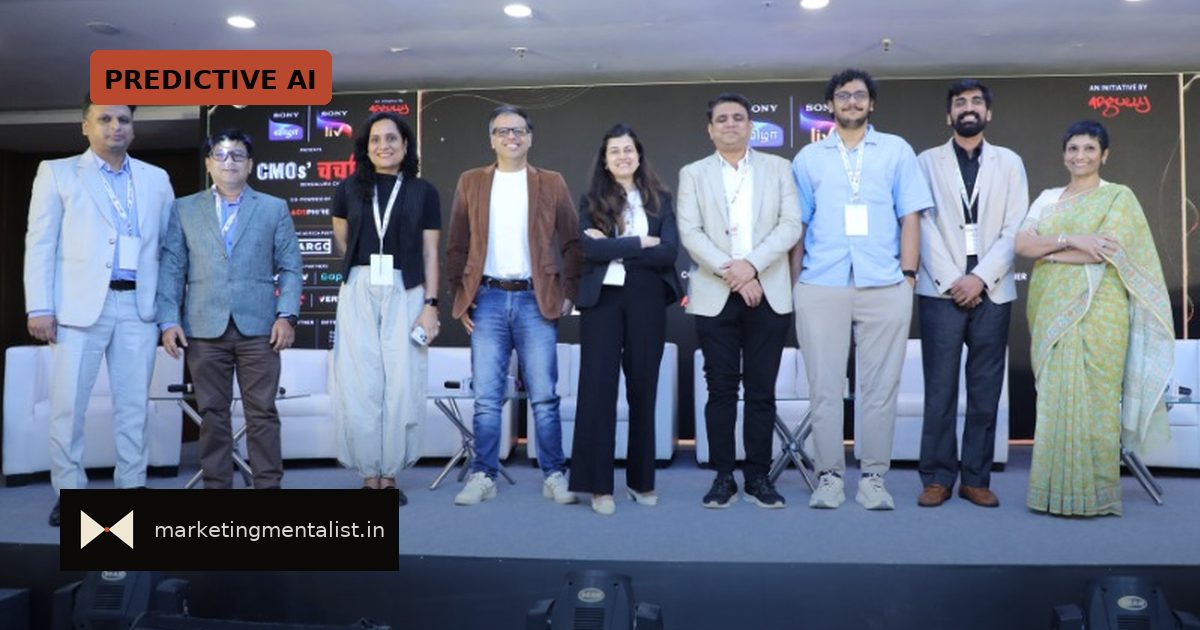
Advertising has always been a prediction business. Every media plan is a bet on what a consumer will want, when they will want it and what will nudge them. What has changed, according to a panel at the Bengaluru chapter of CMOs’ Charcha 2026, is not the ambition but the velocity: AI now reads behavioural signals at a scale no planning team could.
The session, framed around advertising becoming predictive, brought together marketers from insurance, FMCG, healthcare, payments and lending — and the most interesting disagreement was not about capability. It was about restraint.
From intuition to instrumentation
Chairing the discussion, Ganga Ganapathi, International Marketing Leader at Publicis Sapient, pushed back on the idea that marketing was ever purely reactive. Her reframing is the sharpest takeaway of the session: the shift is not reactive to predictive, it is intuition to instrumentation. Marketers always guessed; now they can measure the guess.
That matters because CMOs are under growing pressure to prove commercial impact. Predictive capability is arriving less as a creative toy and more as an accountability tool.
Intent is a continuum, not a switch
Nitin Khanna, VP Marketing at ACKO, made the point that insurance has been a predictive category for decades through actuarial modelling. What AI adds is the ability to treat intent as a spectrum rather than a binary in-market/not-in-market split. Consumers leave what he described as behavioural breadcrumbs about what they may need next, and life stages — not searches — often determine when insurance becomes relevant.
FMCG sits at the opposite end. Suman Pal, Head of Media & Partnerships at Wipro Consumer Care & Lighting, noted that nobody deliberates over soap. Habit, not consideration, drives the category. There, prediction is about anticipating the next purchase using seasonality, weather, geography and channel behaviour. Humidity changing bathing frequency is a genuinely useful signal — and a reminder that context beats demographics.
The infrastructure gap nobody budgets for
Gaurav Modi, VP at Vertoz, flagged the unglamorous truth: brands want conversion prediction, but their data sits in silos across CRMs, websites and apps. A model is only as good as the plumbing beneath it. He also argued for interactive advertising, where engagement itself generates fresh signals.
Abhishek Agarwal, Chief Growth Officer at HOWL Digital, extended this into the activation problem. Many brands build ever-better models without the ecosystem to act on them — fragmented identifiers, disconnected systems, slow decisions. And even with a strong prediction, leaders often override it with instinct. The realistic future, he suggested, is machine intelligence plus human judgement, not one replacing the other.
Prediction is probability, not permission
This was the line of the panel, from Tushir Agarwal, Strategic Advisor at ADSPHIRE: prediction gives you probability, it does not give you permission to bombard someone. Signals like construction activity, income shifts or seasonality can flag a future buyer long before they search — which makes discipline the differentiator.
Several panellists drew that boundary explicitly:
- Healthcare: Smita Murarka of Orange Health Labs said data should build cohorts without reflecting sensitive personal details in the message. Personalisation should feel relevant, not fear-driven.
- Payments: Priyanka Nanavati of PhonePe argued payments data reveals what people actually do, not what they claim — but possessing information is not a reason to display it.
- Lending: Abhishek Rao of Moneyview warned that models can detect financial vulnerability, and commercial incentives to exploit that moment are real. Regulation, he noted, trails technology.
What to do on Monday
Psychologically, the risk is well documented: personalisation works until it crosses into surveillance, at which point relevance flips into reactance and consumers push back harder than if you had said nothing. A simple filter for your team — for every predicted moment, ask whether acting on it makes the customer feel understood or watched. If the honest answer is the second, keep it as a signal and let the prediction stay silent.
Fix identity resolution before you buy another model. Build a written list of signals you will never reference explicitly in creative. And keep a human veto in the loop.
The winners in this cycle will not own the biggest model. They will own the best judgement about when a prediction deserves to become a conversation.
Source: Adgully