India’s top 100 brands lose $63.2 bn as AI rewrites value
India's top 100 brands lost $63.2 bn in brand value in 2026, down 12% while the global top 100 grew 22%. Airtel took No. 1; digital commerce led growth.
The headline number hides a warning
India’s 100 most valuable brands collectively lost 12% of their value in 2026, falling from $523.5 billion to $460.3 billion. The $63.2 billion drop arrived even as India’s economy is projected to grow 7.7%, and it bucked the global trend: the world’s top 100 brands grew 22% in the same period.
The split is revealing. Global growth was led by technology and AI names—Google up 57%, NVIDIA up 60% and ChatGPT up 285%. India’s value engines, by contrast, were under pressure, particularly in B2B and consumer technology.
Airtel rewrites the top of the table
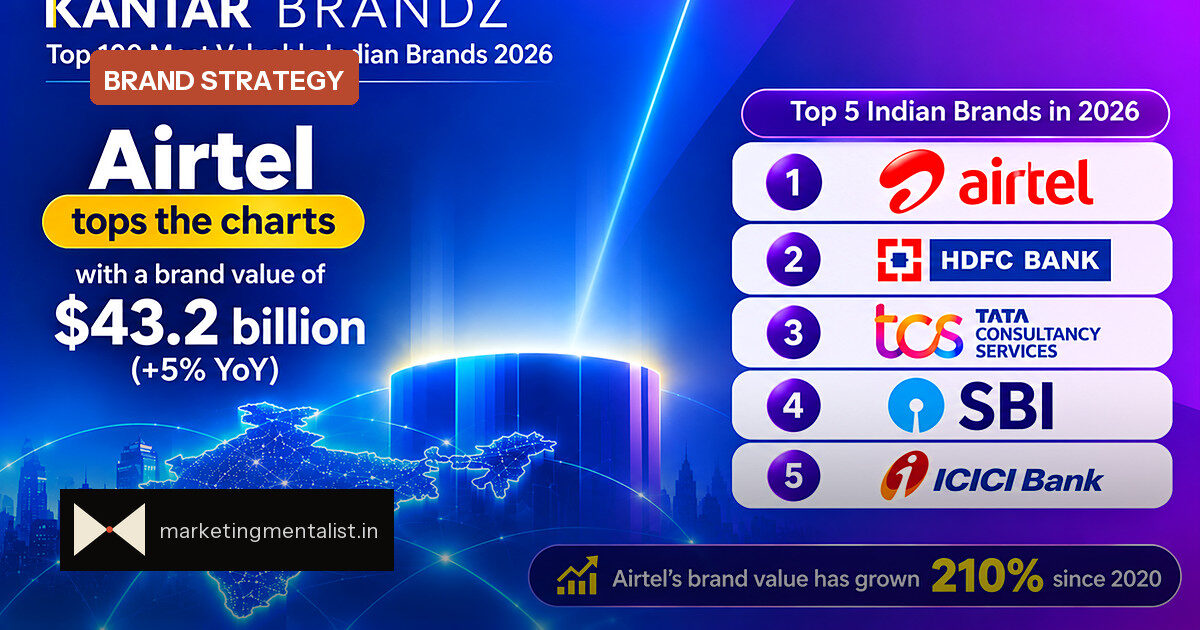
Airtel became India’s most valuable brand for the first time in the ranking’s 13-year history, overtaking HDFC Bank. Its brand value rose 5% to $43.2 billion and is now 210% higher than in 2020. Kantar attributes the gain to sustained brand-equity investment and Airtel’s shift from connectivity into a broader digital ecosystem.
Meanwhile, traditional IT services slid. TCS fell in value, HCL Technologies dropped out of the top 10, and Infosys moved down. Flipkart entered the top 10.
AI is squeezing the old engine
Soumya Mohanty, Kantar’s Managing Director for South Asia, described the pressure on IT services bluntly: tasks that once had to be outsourced can increasingly be automated by AI. Since IT services have long been a backbone of India’s exports, that disruption hits brand value directly. Her prescription: Indian IT players need specialised, higher-value offerings rather than conventional service models.
This is a positioning problem as much as a technology problem. When your core promise can be automated, differentiation collapses.
Where the growth moved
- Meesho rose 64% to $1.9 billion, the top riser, on a mobile-first affordability proposition and 45% order growth.
- Blinkit entered at No. 27 with $4.3 billion, the highest-ranked new entrant, as quick commerce expands beyond grocery.
- Royal Enfield grew 60% to $3.8 billion, building on heritage while expanding products and occasions.
- Financial services remained the largest category at 29% of total value; PhonePe, Paytm, CRED, SBI and Union Bank all gained.
Meaningful difference is slipping
Kantar’s analysis found a structural weakness: Indian brands that improved their meaningful difference in 2026 grew about 7% on average; those whose meaningful difference declined or stayed flat fell 13%. Yet the share of Indian brands scoring above the global average on meaningful difference fell from 11.8% in 2014 to 4.3% in 2025.
Mohanty framed it as underinvestment in long-term brand building beyond advertising—innovation, new occasions, new segments. Indian businesses have often extracted value from the one brand that works, she said, rather than reinvesting in R&D and new markets.
Find new spaces before the market does
The 2026 study identifies finding new spaces as a large gap: it accounts for 24% of brand-value distribution among chief marketing objectives in India, versus 42% globally. Brands that achieve their identified marketing objective have a 1.66 times higher chance of growth.
Examples in the ranking point to the playbook. Nescafé expanded through smaller packs, premiumisation and new occasions. Rapido moved beyond bike taxis into autos, cabs and delivery. Airtel stopped being just a telecom operator. The lesson is not to defend a shrinking category but to find adjacent demand.
As Mohanty put it, India will grow—the question is which brands participate.