Heer by GIVA makes Diwali a self-gifting occasion
Heer by GIVA's Diwali campaign turns festive gifting inward. A behavioural read of the self-gifting pitch and the two new collections.
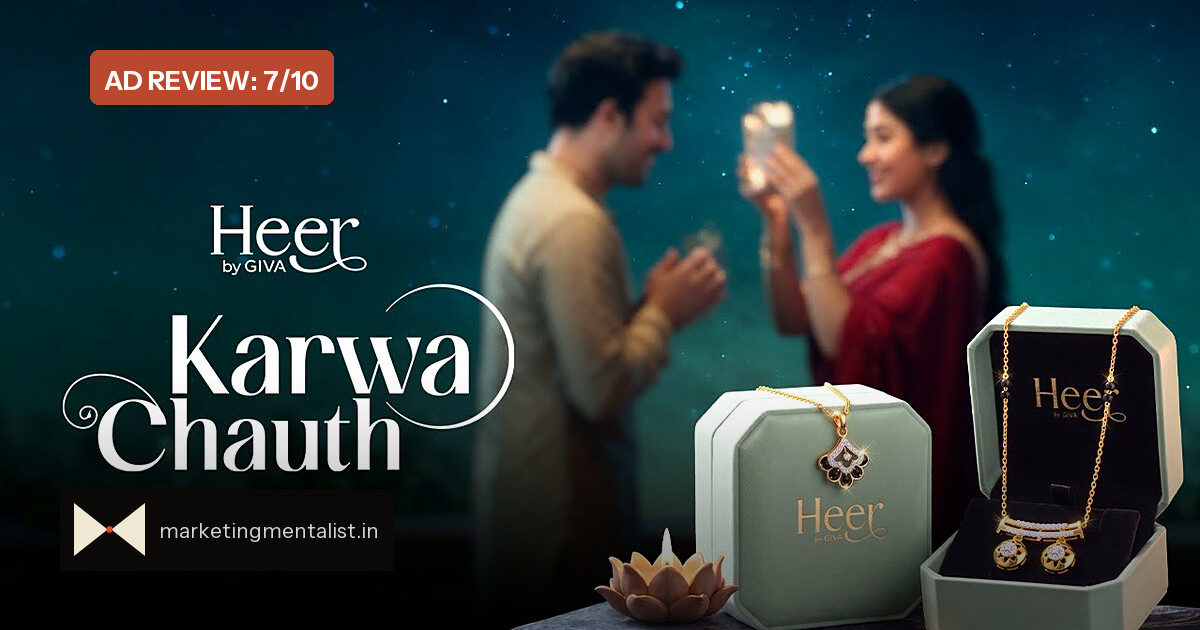
Our score: 7/10 · Heer by GIVA, “Heer by GIVA Diwali self-gifting campaign”
Verdict: A behaviourally sound reframe that makes self-gifting feel deserved, though it reads more like a sharp brief than a memorable film.
What works
- Gives permission through 'thoda apne liye' without discarding the festive ritual.
- Ties jewellery to identity and everyday life, not just milestone moments.
- Backs the emotional promise with two distinct collections and accessible formats.
What misses
- Source describes the strategy, not a cast, craft hook or memorable film moment.
- Self-gifting is familiar territory, so the differentiated proof is thin.
The lesson: Remove guilt and frame self-gifting as identity expression, then anchor it with a product that proves the promise.
The ad
Brand: Heer by GIVA. Agency and director: not named in the source. The Diwali campaign is titled ‘Heer Se Shuru Diwali’ and runs on the concept ‘Sabke liye, aur thoda apne liye’ — for everyone, and a little for yourself. It pushes self-gifting during the festive season, alongside two new collections: Timeless Polki, set in 14KT gold, and Vivid Gemstone, combining coloured stones in 9KT and 14KT gold. The film has drawn 894K views on the brand’s channel.
What works
The self-gifting reframe. Traditional Diwali gifting is other-directed. The line ‘Sabke liye, aur thoda apne liye’ keeps the collective ritual but adds a permission clause. Psychologically, that matters. It reduces the guilt attached to buying for yourself and reframes the purchase as a small, deserved addition rather than an indulgence. This is the ‘treat yourself’ psychology made culturally specific: a woman remains the giver, but is no longer excluded from the list.
Identity over occasion. Chief brand officer Resha Jain’s framing positions jewellery as part of a woman’s journey, not just her milestone moments. That taps a shift in buying behaviour: women choosing pieces for individuality, aspiration and everyday life, not only for festive display.
Product proof. The campaign does not float on emotion alone. Two collections give the idea tangibility: Timeless Polki for a traditional, occasion-led self-gift; Vivid Gemstone for colour-driven daily wear. The wider focus on 9KT gold, lab-grown diamonds and made-to-order jewellery supports the practical, accessible case.
What misses
Strategy outruns the craft. The source describes a clear positioning and product launch, not a cast, narrative, sound or visual hook. For a campaign built on emotion, there is no evidence of how the film dramatises that internal shift. The behavioural promise stays unproven as creative.
Familiar territory. Self-gifting is already a well-worn play in beauty, D2C and jewellery. Without a sharper proof point, the campaign risks sounding like an excellent internal brief rather than a distinctive market move. The line also hedges slightly: women are still buying for everyone first, with only a little for themselves.
The verdict
7/10. The strategy is behaviourally sound and product-backed. It should work as a positioning campaign, but the source does not yet show a standout piece of storytelling. The reframe gives women permission; the film still has to make that permission felt.
The lesson
To trigger self-gifting, remove the guilt and frame the purchase as identity expression. Then anchor the emotional promise with a product range that makes the self-gift concrete. A sharp line opens the door; craft walks through it.
Watch the original: Heer by GIVA on YouTube. Shown for review; the rights stay with the brand.
Source: ETBrandEquity.com