Decathlon India’s Private-Label Stress Test
Decathlon India out-earns global sportswear rivals, yet FY25 shows how fast a private-label price promise can crack when costs rise. Here’s the brand lesson.
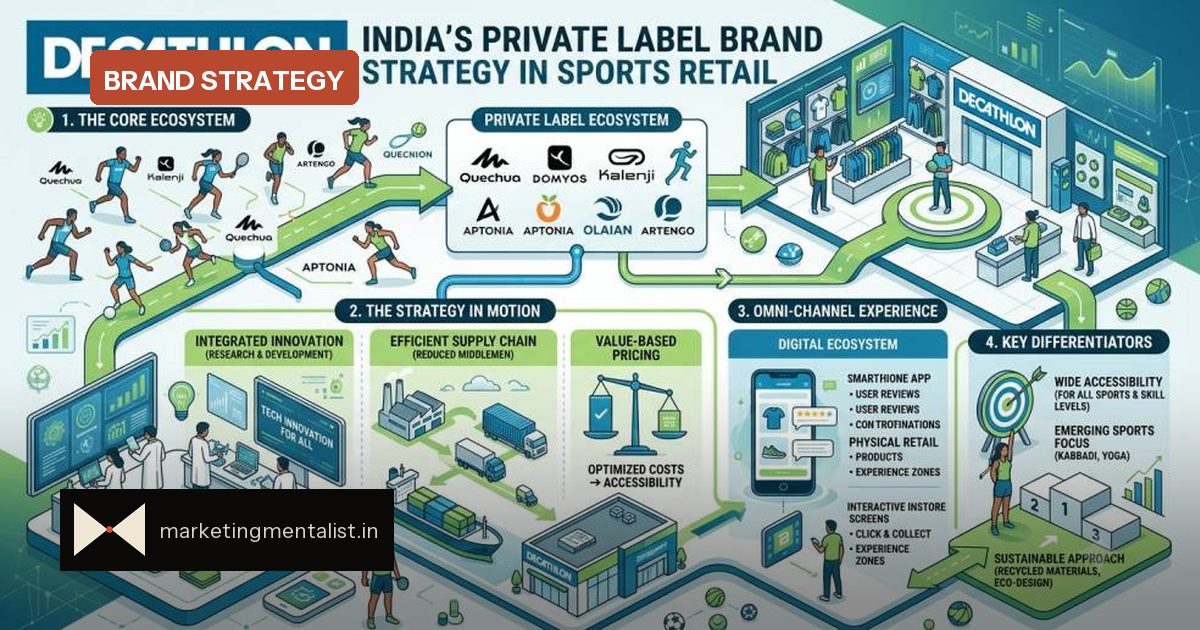
Decathlon’s India business is a useful stress test for private-label brand architecture. In FY25, Decathlon Sports India reported operating revenue of INR 4,133 crore, a 3% rise, while total expenses climbed 12.3% to INR 4,264.5 crore. The result: a net loss of INR 65 crore despite positive EBITDA. For brand managers, the numbers are less interesting than the strategic question hiding inside them—where does private-label equity actually live?
From many passion brands to one master brand
In March 2024, Decathlon reset its global portfolio around a master brand, a new purpose and “Ready to Play?” The structure now has nine category specialists and four expert brands. In India, that architecture is both rational and risky. Rational because most of these labels are sold only inside Decathlon’s own channels; building standalone awareness for a sub-brand customers cannot buy elsewhere would leak equity. The master brand should be the primary carrier of meaning. The risk is that cricket, India’s dominant sport, sits under FLX, which is not part of the named 2024 global architecture.
Participation beats endorsement—if you can afford to be patient
Decathlon’s stated consumer insight is that customers rank health and fun before performance. That is a smart axis for a value-led private label: it sidesteps the endorsement arms race. The May 2026 Sports Utsav event across 125-plus stores and 60 cities, with over 650 events and more than 200,000 participants, turns floor space into trial infrastructure. For founders and brand managers, the framework is simple. If you cannot win on aspiration, compete on participation and make trial easy.
Where the model gets fragile
The FY25 composition reveals a structural vulnerability:
- Material costs rose 8% while revenue grew only 3%.
- Depreciation jumped 74.3% as new city formats and warehouses were built.
- Advertising spend remains roughly 2% of revenue—far below endorsement-led rivals.
A price-led private label has little brand premium to absorb input-cost shocks. That is why Decathlon’s sourcing push matters: India-made cycles moved from about 2% to over 98% in roughly twelve years, and the target is 90% local sourcing by 2030. In this model, sourcing is brand strategy.
What marketers should watch next
Decathlon is now on quick-commerce platforms, where own-label products sit beside rivals without the store environment that normally explains the value. That is a live experiment in whether a brand designed for a curated, explained 4,000 sq m store can survive a 10-minute app shelf. The answer will tell us whether Decathlon’s master-brand relaunch is a genuine brand asset—or a distribution label wearing a new visual system.
Source: MarkHub24