CEAT’s long-game ‘Safer & Smarter’ bet lands 18th in tyre value
CEAT has kept one platform for years while rivals chase cricket sponsorships. Here's what its 18th-place global tyre rank and EV proof teach brand managers.
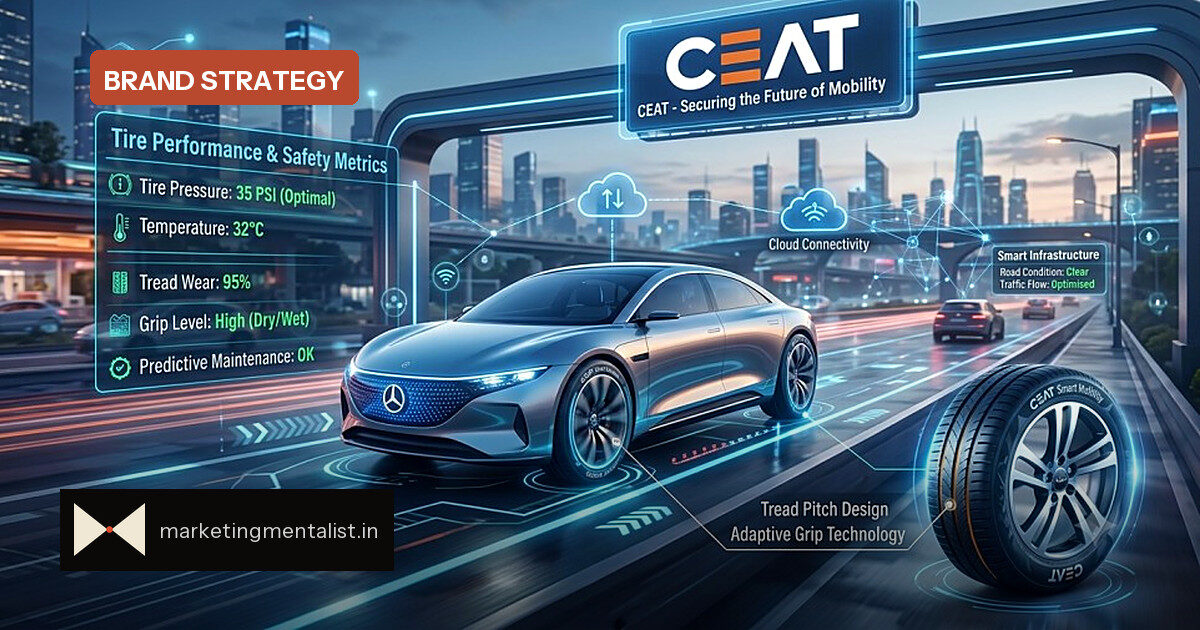
Most drivers do not think about tyres until the moment they need them. That makes CEAT’s marketing problem unusually hard: build a brand when the product is low-involvement, safety-critical and hard to tell apart on the shelf.
A case look at CEAT’s brand work, drawn from company filings, agency descriptions and Brand Finance data, shows how the RPG Group company has tried to solve it with one consistent idea: Making Mobility Safer & Smarter. Every day.
The tension behind the platform
The competitive set includes MRF, JK Tyre and Apollo Tyres. The challenge, as the case frames it, is to make a staid passenger-tyre category feel smart while keeping recall and engagement. That wording matters because it names two jobs at once: participation in a low-involvement purchase and differentiation in a market where compound and tread claims blur together.
One positioning, many executions
The platform predates the flashy campaigns. CEAT’s FY2015-16 annual report already carried the safer-and-smarter line, and a June 2017 investor deck repeated it. By the time Aamir Khan appeared as brand ambassador in September 2020, the idea had been in public use for years. The SecuraDrive films by O&M, followed by three Ogilvy films in 2021, were executions of a long-standing positioning rather than a repositioning.
The 2021 creative insight was simple: if every driver followed the rules, safety would be easy, but real roads are unpredictable, so the tyre has to be dependable. That turns a technical benefit into emotional reassurance.
Where the proof sits
In the public record, “safer” is the rational anchor, tied to braking and control. “Smarter” is the differentiator, backed by three proof points that consumers rarely see directly: compound and tread engineering, EV-specific tyre design, and digitally advanced manufacturing.
CEAT’s EV launches do the heaviest lifting. EnergyDrive for four-wheelers was positioned as a first in India, with acoustic-lowering material, a cavity design to cut rolling resistance and a stiffness technology for tyre life. The company claims a 50% share of India’s two-wheeler EV tyre business. A supply partnership with MG Motor India for the Comet EV followed in 2023.
Manufacturing adds another layer. The Halol plant became a World Economic Forum Lighthouse in January 2023, described as a first for a tyre company worldwide, and the Chennai plant joined the network in January 2025.
Consistency versus visibility
Brand Finance’s Tyres 25 2026 report puts CEAT 18th by value, behind MRF at 11th and Apollo Tyres at 14th. Michelin stays first for the ninth consecutive year at $10.3 billion. Apollo has also bought high-visibility sponsorship as lead sponsor of Team India’s cricket team since September 2025. CEAT’s answer, at least in the public record, is product and purpose consistency, not borrowed attention.
That leaves an open question: does a consistent platform compound in a category where most shoppers do not notice? The financials suggest the business is growing. FY25 consolidated revenue reached ₹13,217.87 crore, up 10.7% from ₹11,943.48 crore in FY24. But Q4 FY25 profit after tax fell 8.36% on raw-material costs, a reminder that brand strategy and business results are not the same graph.
What marketers should watch
- Consistency is CEAT’s strongest documented asset; the platform survives across annual reports, investor decks and campaigns.
- The most verifiable “smart” proof sits upstream in R&D, product design and plants, so the brand still has to translate it for the point of purchase.
- EV tyres give CEAT a natural stage where noise, range and torque make “smart” tangible.
- Competitors are picking different levers: Apollo’s sponsorship-led visibility versus CEAT’s purpose-led product proof.
For brand managers, the lesson is not that consistency always wins. It is that a two-word platform can do two jobs if each word is kept honest: one rational, one differentiating. The risk is that the second word stays an engineering claim instead of a purchase reason.
Source: MarkHub24