Why blank faces make the Lego x Daft Punk collab work
Lego and Daft Punk are collaborating, but the real story is how two faceless icons use projection to build devotion, legacy and fan ownership.
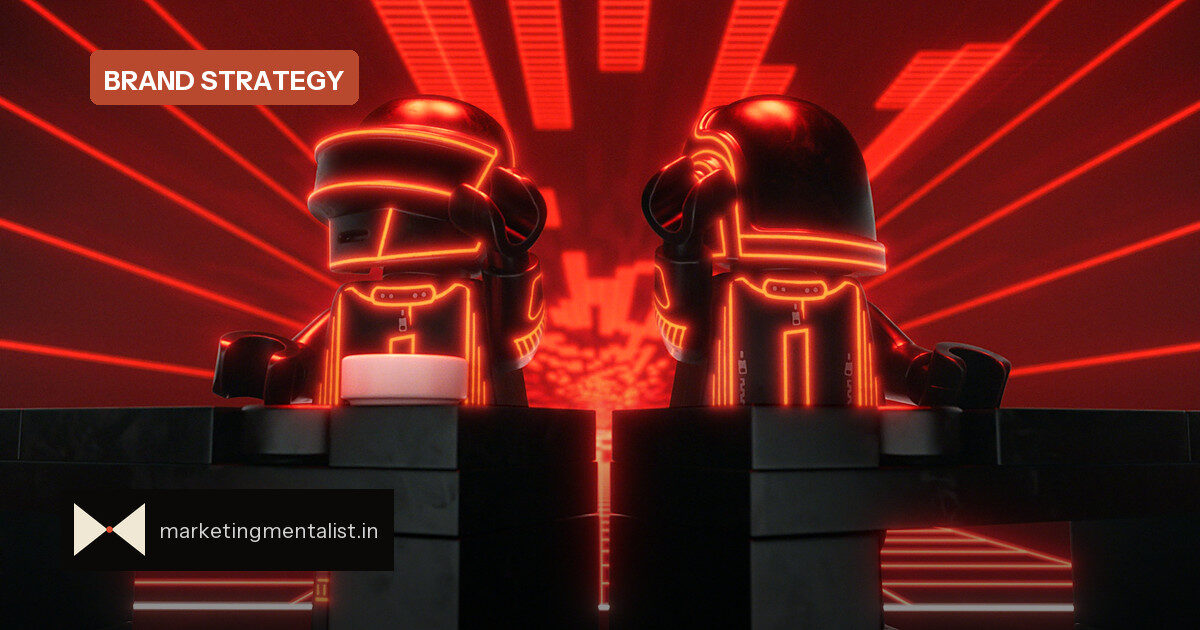
Daft Punk split in 2021, but the French duo’s robot personas are entering the Lego universe through a partnership that spans product, content and brand experiences. The first release re-creates the pyramid stage from the group’s Alive 2007 tour. Lego has not yet shared price, size or a shipping date; creative lead Samuel Liltorp Johnson says the design is still in development with Daft Punk’s team and Patrick Harboun, a father from Luxembourg who submitted the idea through Lego Ideas.
For now, there’s a short film of two robot minifigures chasing a glowing red brick to a DJ console, soundtracked by “Voyager” and “Human After All,” and the promise of more in 2027.
Why this is not just another licensing deal
Lego has leaned on plenty of IP partnerships, but this one fits at a deeper level. Cédric Hervet, Daft Punk’s creative director, says the band had approached Lego years earlier while still active, but the timing wasn’t right. “For me, the end of the band was never the end of the robots,” he says. “A legacy keeps living through the people who take it on.”
That legacy is literally fan-built. The pyramid stage reached production because Lego Ideas voters pushed it forward. Hervet believes this might be the best life the robots could have after the band’s end.
The psychology of the blank face
Here’s the marketing spine. Lego’s first minifigure, introduced in 1978 by designer Jens Nygaard Knudsen, was deliberately minimal: two black dots and a painted smile on a yellow head. Lego later explained that “sex, race and role were not to be part of the figure—they would be formed by the child’s imagination and play.”
The same neutral face could be a cop, a knight or an astronaut, depending on the hat and the story. Daft Punk’s reflective helmets work the same way. With few fixed identity cues, fans project their own memories, moods and meanings. A minifig with a permanently angry face is stuck; a blank one stays open for the audience to finish.
What brand managers can do now
- Keep at least one signature asset deliberately neutral so customers can project onto it.
- Build a vote-based path for fan submissions—not just focus groups—to decide what gets made.
- Treat a retired icon as a living legacy, not a sealed archive.
Lego isn’t just putting helmets on bricks. It is pairing two design languages that already share a core rule: fixed silhouette, open interpretation. That’s the kind of brand fit that survives after the initial novelty fades.
Source: Fast Company