Quaker’s 2026 bet: 12g protein and 33% fibre
Quaker's India journey from heart-health education to a 2026 protein-and-fibre refresh shows why health claims need to be taught, not assumed.
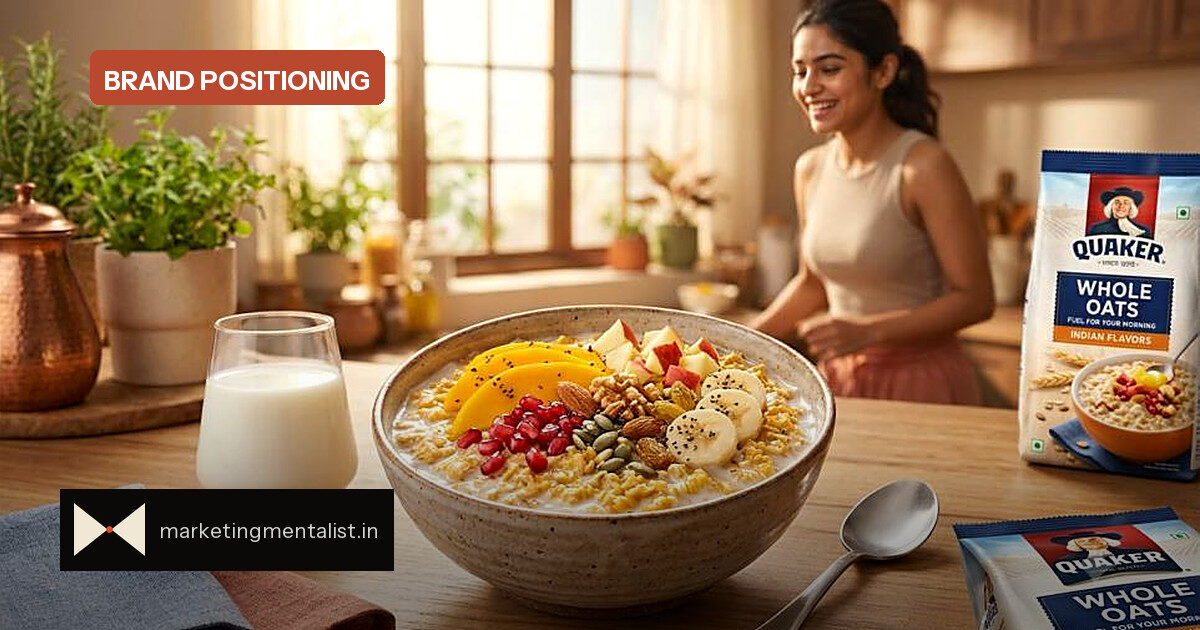
When Quaker launched in India in 2006, oats were not a breakfast category. The brand had to create the reason to buy before it could compete on taste, price or distribution. Its 2026 restage, leading with 12g natural protein and 33% fibre, is the latest move in a 20-year lesson: in a low-penetration category, positioning is something you teach, not something you declare.
A category built on education
Quaker’s 2009 Mission to Make India Heart Healthy was not a conventional ad burst. PepsiCo partnered with The Times of India and Apollo Hospitals, built a risk-assessment portal called goodmorningheart.com, and asked consumers to check their heart age before showing them a bowl of oats. That structure signals the real problem: with no existing oats habit, a health claim needed third-party credibility to land.
The 2009 insight, according to WPP’s case summary, was that Indians thought more about looking healthy than being healthy. Quaker attached oats to a specific, fear-adjacent outcome—cardiovascular risk—via beta glucan and lower LDL cholesterol. Reported results included 160,000 heart test takers, 60,000 mobile app downloads and a 74% sales increase, though the baseline is not stated and the result is agency-reported rather than audited.
Positioning kept moving
The documented shifts show a brand searching for a more ownable axis:
- 2009: heart health and risk education, anchored by credibility partners.
- 2022: a refreshed identity positioning oats as fuel for weight maintenance and cholesterol, aimed at younger buyers.
- 2024: taste plus health, with Kiara Advani and Sidharth Malhotra fronting Instant Oats in Herby Cheese, Magic Masala and Mixed Berries.
- 2026: protein and fibre, answering the cluttered nutrition-claims landscape.
Why heart health was hard to defend
The heart territory was never uncontested. Saffola entered oats in 2010 as the 21st entrant, carrying heart-friendly oil heritage. Trade coverage places PepsiCo at 37% of plain oats and Saffola at 70% of masala oats in one read. Kantar data for December 2022 put Saffola at 42% value share against Quaker’s 34%, while a year earlier Quaker led narrowly at 38% against 37%. Even by January 2024, Nielsen data cited by Exchange4media said only 13% of Indians consume oats regularly.
Quaker did not delete heart health. The 2026 descriptor still mentions beta glucan and cholesterol, but the lead benefit moved to protein and fibre. That is the bridge: keep scientific proof as support while shifting the headline to what current buyers say they shop for.
The takeaway for brand managers
Quaker’s sequence is less a series of random pivots than a response to category maturity. Early on, education was the brand. As rivals crowded in, differentiation moved to format and taste. Now, with protein and fibre ranking high among purchase factors—46% and 32% in Mintel data cited by PepsiCo—Quaker is trying to convert nutrition noise into one product answer.
The lesson: a health benefit is only as defensible as your exclusivity. If a rival already owns heart health, teach a different job. And when you refresh, keep a proof point in the descriptor so the pivot reads as evolution, not amnesia. For brands targeting younger India, taste is not negotiable, and growth may lie beyond breakfast alone.
Source: MarkHub24