What Zuck’s Guinness wince reveals about brand authenticity
A viral clip of Mark Zuckerberg grimacing at a Guinness shows how public consumption has become an authenticity test for founders and CEOs.
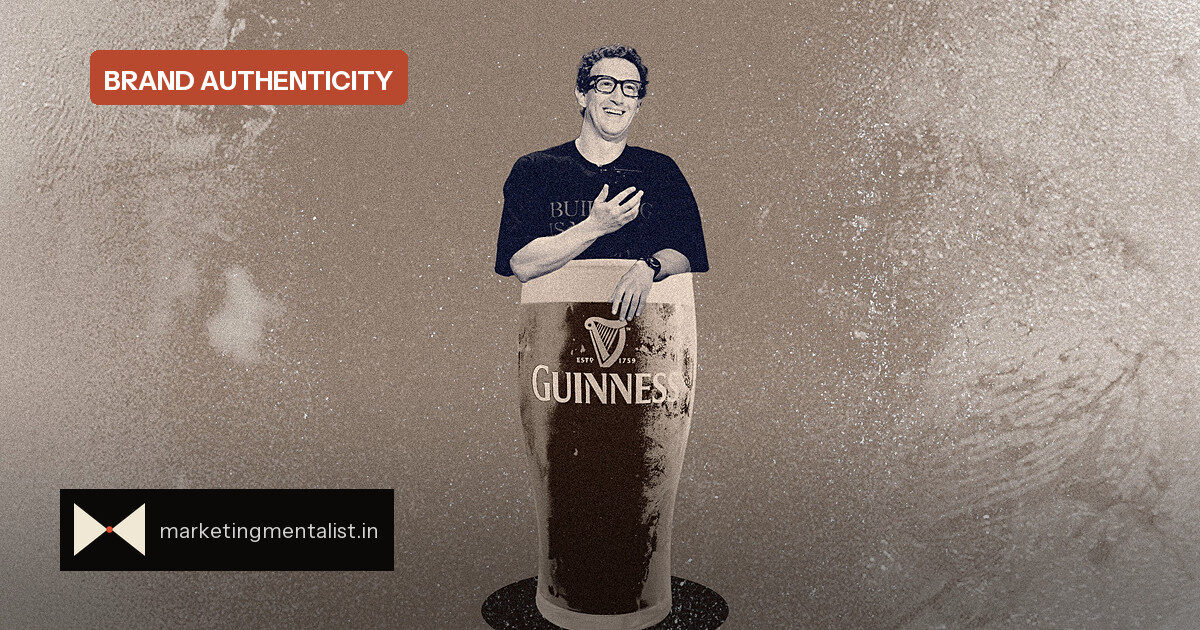
On a podcast built on tech talk over a beer, Mark Zuckerberg took a sip of Guinness. His face froze into something between surprise and regret, and the internet turned the clip into content almost immediately.
The show was The Cheeky Pint, hosted by John Collison, the Stripe cofounder. The format is simple: conversation over a drink. But when one of the world’s richest men visibly recoils at a stout, the moment stops being about beer.
Why a grimace went global
Zuckerberg is hardly the first person to find Guinness an acquired taste. What made the clip travel is who he is. A leader who usually moves through controlled spaces suddenly looked caught off guard. One observer said he looked as if he had “accidentally swallowed the little paper cup of fluoride at the dentist’s office.”
That rare, unscripted moment worked as an authenticity litmus test. Audiences used a second or two of body language to decide whether a billionaire was normal, relatable, or performing.
The CEO food moment is now a genre
There is a pattern. When McDonald’s CEO Chris Kempczinski took a cautious bite of the chain’s Big Arch burger, viewers read it as proof that he did not eat fast food. Burger King and Wendy’s quickly shared their own executives eating burgers with visible enthusiasm, converting consumption into a brand-reputation performance.
Other leaders have learned the genre. Elon Musk drank three beers on The Cheeky Pint and famously smoked on Joe Rogan’s show. NVIDIA chief Jensen Huang eats Beijing street noodles and Korean fried chicken in public, which reads as accessibility rather than awkwardness.
The psychology of the wince
Marketers have long known that consumers make fast, intuitive judgements from tiny signals—what psychologists call thin-slicing. A fraction of a second of facial expression is enough to assign warmth, competence and authenticity. In a controlled CEO appearance, the message is polished; in an accidental wince, the messenger feels real. That feeling—whether earned or just perceived—is what audiences now share and amplify.
For brand managers, the takeaway is broader than Zuckerberg. Founders and executives are the public face of a brand promise. When their off-script moments contradict the polished persona, the gap becomes the story.
What founders and marketers should do
This is not about drinking Guinness. It is about how small, unguarded actions become brand assets or liabilities. Audiences thin-slice a leader’s body language in seconds, and the verdict spreads faster than any polished campaign.
- A public sip, bite or handshake is now content; treat it as a planned brand moment.
- People reward consistency, not perfection. Forced enthusiasm often fails.
- Context matters as much as the reaction: a casual setting can signal approachability or trap a leader in awkwardness.
The safest move is to prepare executives for the camera without scripting every micro-expression. The Zuckerberg clip is a reminder that perceived authenticity now sits at the centre of personal and corporate brand trust.
Source: Fast Company