AI Search Now Decides Which Brands Get Quoted
Answer engines went from 634 million to 904 million monthly visitors in a year. Here's what earns a citation, what's a myth, and why it matters for brands.
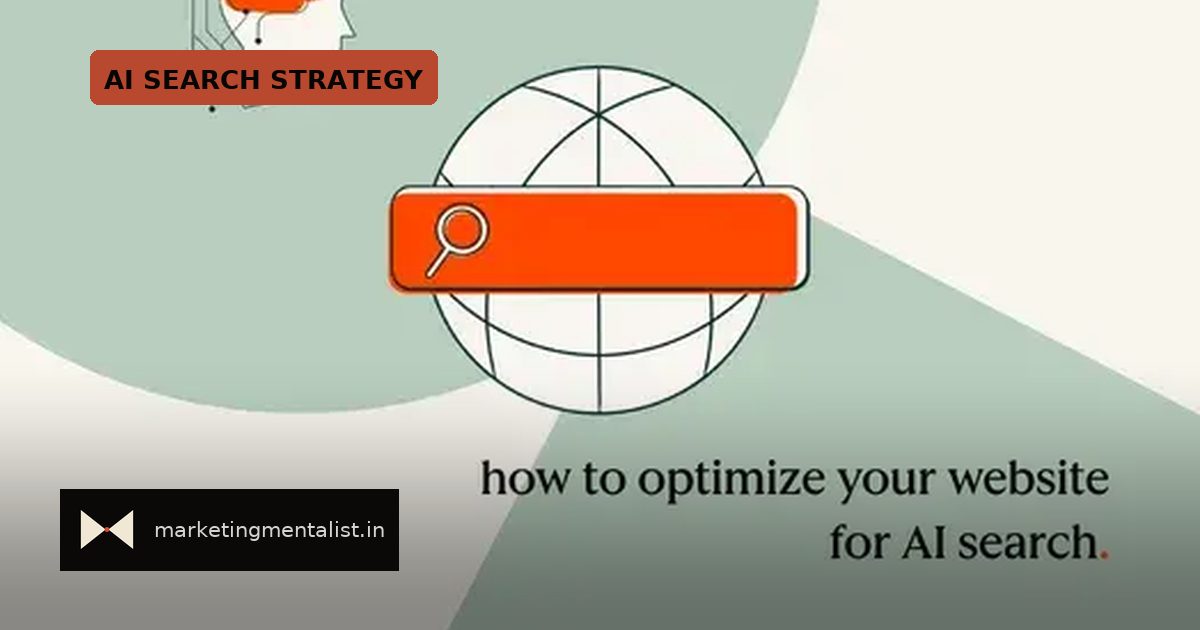
There is a new gatekeeper between your brand and your buyer, and it does not scroll. It summarises. A fresh HubSpot Blog guide on optimising websites for AI search puts a number on how fast this shift is moving: monthly unique visitors to the major answer engines rose from 634 million in Q1 2025 to 904 million in Q1 2026 — a jump of more than 40% in a year, per data from Wix Studio.
For anyone who spent a decade learning how to win a blue link, the important line in that guide is the reassuring one: AEO has not replaced SEO. The same crawling, indexing and quality signals that earn rankings are what open the door to being cited in an AI answer.
Why answer engines only quote what they cannot invent
Here is the psychological core of the whole thing. A model has no reason to cite a page it could have written itself. Commodity content — repackaged common knowledge — is invisible, because the machine already knows it. Non-commodity content, built on original data and firsthand expertise, is the only thing worth borrowing.
The numbers back this up. In SE Ranking’s analysis of 216,524 pages, content that quoted experts averaged 4.1 ChatGPT citations versus 2.4 without. Pages carrying 19 or more data points averaged 5.4, against 2.8 for data-light pages.
Read that as a positioning brief, not a content brief. Scarcity drives citation the same way it drives desire: you get quoted for the thing only you can say.
Answer-first writing is a cognitive format, not a trick
The guide points to CXL’s analysis of AI Overview citations, which found most quoted passages came from the top third of a page, with only about a fifth from the bottom 40%. HubSpot’s own AEO advice is to deliver the main answer inside a section’s first 40 to 60 words.
Question-shaped subheads help too. In Kevin Indig’s study of ChatGPT citations, cited text was twice as likely to contain a question mark, and headings accounted for 78.4% of question-linked citations. A 2026 preprint on structural formatting found lists and tables gave 43% higher extraction accuracy than the same facts in prose.
Humans have always rewarded clarity. Models simply make the reward measurable.
Treat each engine as its own audience
Per Fan Out’s data cited in the guide, Perplexity supplies 59% of off-site citations and draws on roughly 10.8 sources per answer, while ChatGPT stays selective at about 3.3. Perplexity leans on discussion pages such as LinkedIn, G2 and Reddit (17.35% of its citations, per Wix Studio); ChatGPT prefers long-form articles. Only 7.7% of cited URLs show up in more than one engine.
Translation: winning on one engine tells you almost nothing about the next. Plan channel by channel.
Skip the shortcuts
The guide is refreshingly blunt about tactics that do not survive scrutiny:
- llms.txt files. SE Ranking’s November 2025 analysis of nearly 300,000 domains found no correlation with AI citations; Google says it ignores such files.
- Bot-only Markdown pages. Google’s John Mueller advises against them — serving one version to crawlers and another to people is cloaking.
- Special AI markup. Google says none is needed. Schema is hygiene, not a lever.
- Manufactured mentions. A fake-brand experiment by SE Ranking and Search Engine Land saw a fictional brand dominate branded queries within 30 days — but not competitive ones. Google treats manipulating generative responses as spam.
The technical bits that actually gate you
Google is explicit that a page must be indexed and snippet-eligible to appear in AI Overviews or AI Mode. So a stray nosnippet or max-snippet:0 directive quietly locks strong pages out. Speed matters as well: SE Ranking found pages with First Contentful Paint under 0.4 seconds averaged 6.7 ChatGPT citations, roughly three times the 2.1 for pages slower than 1.13 seconds. And because many AI crawlers read only raw HTML, client-side JavaScript content can arrive as a blank page.
The metric that should change your board slide
AI referrals are still tiny — under 1% of visits in Microsoft Clarity’s study of more than 1,200 sites — but sign-up click-through hit 1.66% versus 0.15% for search. WebFX’s analysis of 2.3 billion sessions found generative AI visitors converted around 1.2 times higher than organic search.
Small channel, high intent. That is the profile of a pre-sold visitor: someone who arrived already persuaded by a third party they trust. Which is precisely why being the source the machine quotes is a brand asset, not an SEO chore.
Source: HubSpot Blog