Cremica’s Retail Pivot: From Restaurant Sachets to Shelf Choice
Cremica Foods built two decades of familiarity through restaurant sachets. Now it wants that unnoticed equity to become active retail choice.
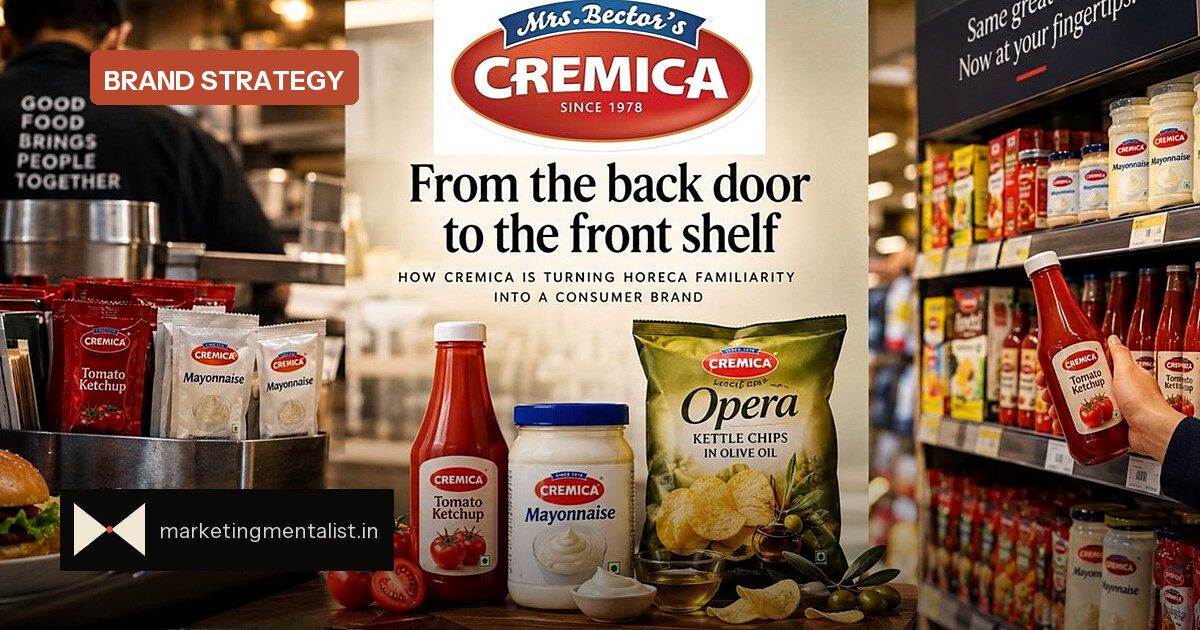
Cremica has spent 20 years becoming a brand people taste without necessarily noticing. Its ketchup and mayonnaise appear in quick-service restaurants, cafés and food-service kitchens, but the brand has historically been quieter on retail shelves. Now Cremica Foods wants to make that hidden familiarity work harder.
The back door to brand building
Akshay Bector, managing director of Cremica Foods, says the company’s HoReCa presence reaches consumers before many brands can pay for their attention. “Today, Cremica portion packs are touching almost 4 to 5 million people every day,” Bector says. The business currently earns roughly 70% of its Rs 320 crore revenue from HoReCa, with about 30% from retail. He expects retail to catch up as the company converts existing brand equity into consumer demand.
Familiarity is not the same as salience
Psychologically, Cremica has strong exposure but weak shelf activation. People have tasted the product for years, yet the brand may not come to mind when they are choosing a ketchup bottle in a supermarket. Marketers call this a gap in mental availability: the likelihood of being thought of in a buying situation. Cremica’s job is less about building awareness and more about moving from “I know this taste” to “I will pick this bottle.”
The HoReCa-to-home flywheel
Cremica is repeating the playbook with Opera, its olive-oil kettle chip range. Relaunched last year after a pandemic pause, Opera has entered accounts including Subway, CSD canteens, Tim Hortons and IndiGo Airlines. The idea is to use restaurant and travel environments as trial tools, then capture that memory later at retail.
Small packs are doing similar work in new markets. With ketchup expanding into Tier-II and Tier-III towns, Cremica has launched Rs 10 variants of mayonnaise and pizza sauce. The brand treats low-priced packs as a way to reduce the risk of trying something new.
Advertising as proof, not a substitute
Cremica has invested in MasterChef, India’s Best Dancer and Ramayan, and it continues to explore cooking shows. But Bector is clear about the hierarchy: “If a business is not delivering a product which is acceptable to the customer, then no advertising or branding can help.” For food brands, media can amplify a product experience; it cannot replace it.
What marketers can borrow
- Let on-premise or B2B placements build repeated exposure before you spend heavily on retail media.
- Use small pack sizes to lower the psychological cost of trial in price-sensitive markets.
- Treat restaurant, café and airline listings as brand-building media, not just distribution wins.
- Keep advertising honest: product acceptability comes before persuasion.
One brand, two businesses
There is a branding wrinkle. The biscuit and liquid condiment businesses split in 2014 and now sit in different family verticals. Cremica Foods has no operational link with the biscuit business, though the name is shared. Bector points to shared family heritage and is not pushing for a sharper visual divide. The condiment brand uses “Love at first taste”; Mrs Bector’s uses “Baked with love, just for you.”
For marketers, the story shows that brand equity can be built before visibility, but it still needs a shelf strategy to convert familiarity into active choice.
Source: Afaqs!