Haier India’s Sport-O-Tainment Bet: Challenger Brand Psychology
Haier India runs no single big campaign. Its Sport-O-Tainment strategy buys year-round attention instead. Here's the psychology behind the challenger play.
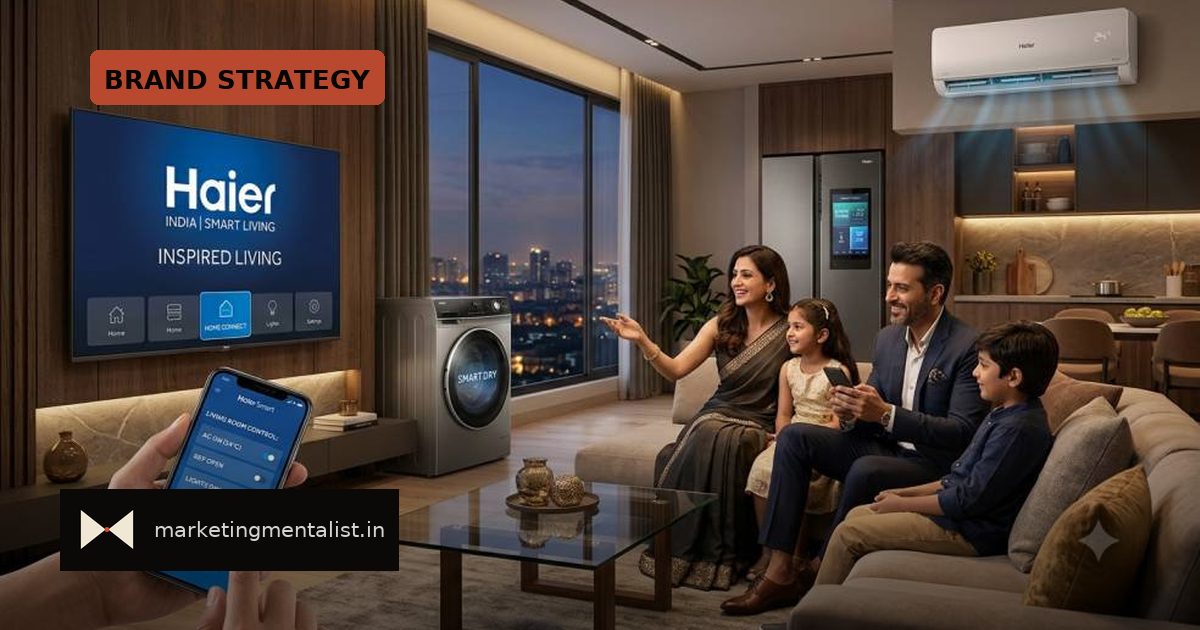
Most appliance brands in India still think in campaigns: a festive film, a Diwali price drop, a celebrity endorsement, repeat. Haier India has quietly done something different. According to a detailed strategy breakdown by MarkHub24, the brand has replaced the one-off campaign model with a continuous, sponsorship-led content pipeline it calls "Sport-O-Tainment" — sport, entertainment and festive culture stitched together under the global "Smart Living" brand pillar.
What the brand is actually doing
Haier India, a wholly owned subsidiary of China’s Haier Group incorporated locally in 2003, positions itself as a challenger against LG, Samsung and Whirlpool. Its documented communication architecture is unusually broad:
- Cricket: Digital streaming sponsor for TATA IPL 2024 on JioCinema, partner for the ICC Men’s Champions Trophy 2025 on JioHotstar, associations with the ICC Men’s T20 World Cup 2024, and Gold Sponsor of the Asia Cup 2025.
- Global sport: Roland-Garros and ATP Tour partnerships (ATP extended to 2028), plus a continued Australian Open association into 2026.
- Football and esports: LaLiga, Liga Portugal, the Morocco football federation, and Liverpool FC and Paris Saint-Germain deals announced at IFA Berlin 2025 — alongside the "Haier G-League" esports property reported at over 8,000 players and a ₹1 million prize pool.
- Entertainment integration: Associate Sponsor of Bigg Boss Hindi Season 20 (premiering September 6, 2026, on JioHotstar), with products — a 630L side-by-side fridge, a 190L single-door fridge, a 100-inch 4K LED TV — embedded into the house itself.
- Festive content: An AI-generated "Do-Do Diwali" video campaign, plus regional work around Ganesh Chaturthi, Onam and Durga Puja.
Underneath it all: a disclosed 2024 media split of 60% digital, 40% traditional, per marketing head Priyanka Sethi.
The psychology: familiarity beats persuasion
Why does a fragmented, always-on sponsorship portfolio work for a challenger? Because in low-involvement, high-consideration categories like appliances, the binding constraint isn’t persuasion — it’s mental availability. Nobody wants a refrigerator until their compressor dies. At that moment, the brands that surface are the ones already stored as familiar and safe.
Two mechanisms are doing the heavy lifting here:
1. The mere-exposure effect. Repeated, low-effort exposure raises liking without requiring an argument. Perimeter boards and in-stadia branding don’t convince anyone of compressor efficiency — they build fluency, and fluency feels like quality.
2. Affect transfer. Haier CEO NS Satish has publicly described cricket as "more than a sport, it’s a national emotion" that mirrors the brand’s values. That’s borrowed emotion. When a challenger has no heritage equity in India, it can rent feeling from properties that already own it — cricket for scale, tennis and European football for premium signalling.
Why the JioHotstar tilt matters
The 60:40 digital lean, paired with a preference for OTT rights-holders over linear TV alone, is a bet about where a 25–40-year-old premium buyer’s attention actually lives. Sethi has described the target as "constantly on the go" and tech-savvy, with influencer and user-generated layers creating what she called a "surround sound effect".
Product placement inside Bigg Boss is the sharpest expression of this. A 100-inch TV in a house you watch for three months isn’t an ad — it’s set dressing that normalises ownership. That’s the peripheral route to persuasion: no claims, no comparison, just repeated contextual association with aspirational living.
The measurement problem — and what to do about it
MarkHub24 is candid that publicly available outcomes are structural rather than campaign-attributed. Haier Group entered the Fortune Global 500 for an eighth consecutive year in 2025 at No. 390, holds Euromonitor’s No. 1 global major appliances position for 16 years, and has been in Kantar BrandZ’s Top 100 for seven. Locally, Haier announced a ₹3,500 crore third manufacturing facility in January 2025 targeting 4 million AC units annually by 2027, and in December 2025 Bharti Enterprises and Warburg Pincus agreed to buy 49% of Haier Appliances India in a deal reported near USD 2 billion.
Correlation, not proof. But there’s a lesson for marketers here: when brand-tracking data is thin, use observable proxies — sponsorship renewals (the ATP extension to 2028 is a renewal, and renewals are revealed preference), category capex, and repeat rights purchases. Brands don’t quietly re-sign properties that aren’t working.
The takeaway for your own brand: if you’re a challenger, don’t buy one big moment. Buy the calendar. Continuous presence in emotionally pre-loaded environments builds the kind of low-effort familiarity that wins at the shelf — long after any single film is forgotten.
Source: MarkHub24