84% of the median Indian website is code, not content
A 2026 benchmark of 951 Indian business websites found 84% of the median response was code and markup. Here's why machine readability matters.
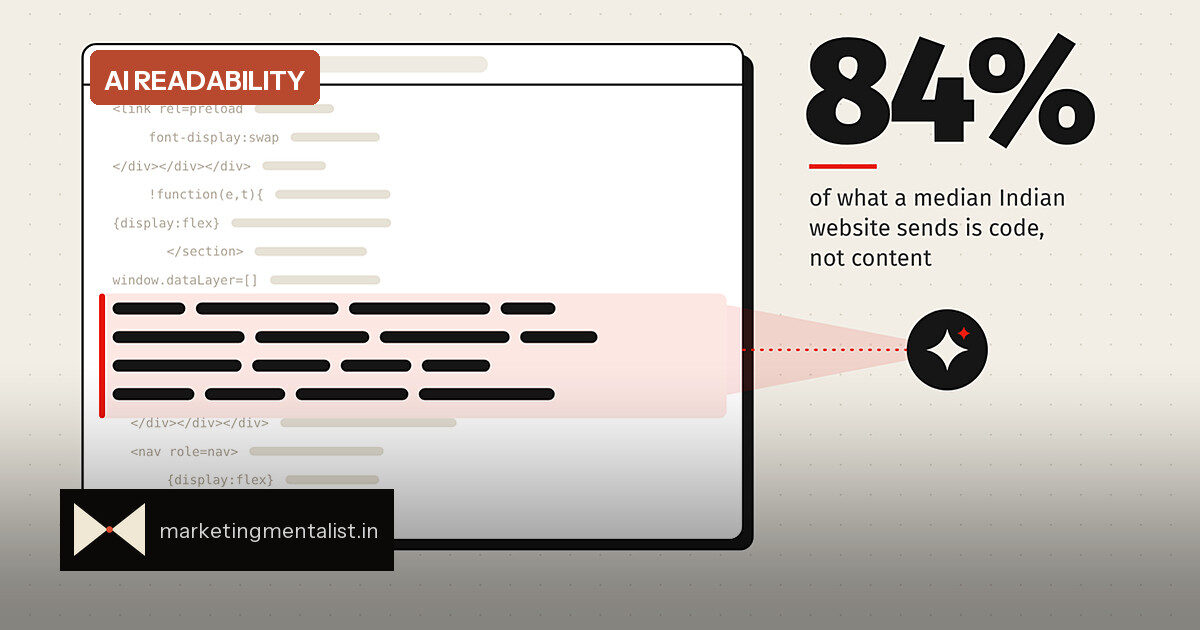
An enterprise site can look polished to a human and still be a rough document to a machine. That gap is now a measurement: the India AI Visibility Benchmark 2026, run by Publive AXP with the Internet and Mobile Association of India, audited 951 Indian mid-market and enterprise websites. For the median site, 84% of the downloaded response was code and markup, not content.
Why should a brand manager care? Because customers are increasingly asking AI assistants to compare products, explain fees and shortlist brands. How easily a machine can retrieve your answer now shapes whether your brand gets to be the answer.
The token economy starts before the answer
Large language models process text in tokens, such as words, word fragments or punctuation. Fewer irrelevant tokens can reduce computing cost and leave more room in a model’s context. But AI search does not necessarily stuff an entire webpage into a model; it crawls, filters and extracts first. That means the friction begins earlier, in what your server hands over.
A page can carry useful information without making it easy for an automated system to find.
What a credit card page hides from a crawler
Imagine a financial services page explaining a card’s benefits. A visitor scrolls, expands the eligibility tab and reads fees. An AI assistant needs the same details. If they appear only after JavaScript runs, behind an accordion or outside the initial server response, some crawlers may never retrieve them.
This is not an argument against JavaScript. Google can render JavaScript, but its own documentation notes that rendering adds complexity and crawler support varies. The practical question is whether your essential claims remain accessible when the experience is stripped away.
Efficiency is not a ranking hack
The benchmark’s 84% figure describes the composition of the response, not a universal ranking rule. There is no published guarantee that a leaner page gets cited more often. Relevance, authority and source selection still matter.
The defensible version is simpler: efficient delivery removes avoidable friction. When content is clear, crawlable and easy to extract, systems that can use it process it more reliably. That’s a foundation, not a substitute for useful information.
Four checks for marketing, tech and SEO teams
- Initial response content. Compare what the server returns with what a browser renders. Key product details should exist before scripts run.
- Useful-information ratio. Look at how much of the response is content versus scripts, markup and navigation. Treat it as a diagnostic, not a ranking factor.
- Crawler access. Verify permissions, redirects, server responses and security settings so relevant crawlers can reach the page.
- Meaning preserved. Confirm that extracted details keep their context, for example a financial product’s eligibility rules staying attached to its conditions.
For a decade, marketers absorbed page speed, mobile performance and Core Web Vitals as commercial priorities. AI readability is likely to follow the same path. The brand that wins may not be the one publishing the most content, but the one putting the least friction between its best content and the machines trying to understand it.