A 10-Year Licence and a Two-Name Brand System
Signify India kept Philips on products while building a separate corporate name. What the dual-brand play teaches marketers about licensed trust and design-led differentiation.
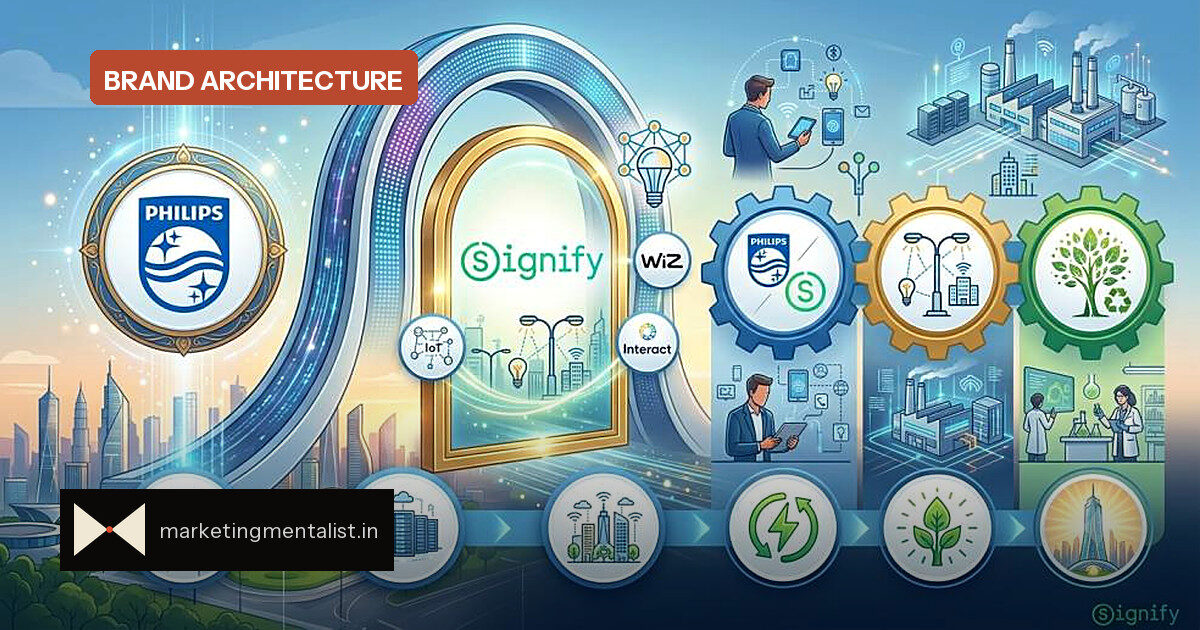
When your most trusted consumer brand belongs to someone else, the marketing challenge is not whether to build equity but where to park it. Signify India has been answering that question since May 2018, when Philips Lighting India Limited became Signify Innovations India Limited while Philips remained on the product box.
The corporate-product split
Philips Lighting separated from Royal Philips in 2016 and listed on Euronext Amsterdam with a trademark licence covering the Philips name, the shield emblem and the “innovation and you” brand line. The initial licence runs for ten years, with two five-year extensions possible if turnover targets and compliance conditions are met. The right to use the Philips company name was far shorter: 18 months after Royal Philips lost control.
That forced a two-name architecture. The Indian entity, incorporated in 2015 and 96.13% held by its foreign parent, was renamed in May 2018. The company described the corporate name as an expression of a connected-lighting strategy and an identity for employees, investors and the professional ecosystem. Philips stayed as the primary brand for lamps, luminaires and other lighting products for consumers and trade, with Interact and Color Kinetics serving connected and architectural segments. EcoLink, launched in India in 2019, has since stretched into ceiling fans.
Why the split matters
This is not a cosmetic renaming. It separates the asset Signify owns — the corporate identity — from the asset it rents: consumer trust in Philips. The corporate launch was deliberately inward: an employee event across India offices, a laser show and a logo reveal on a 3D-printed lamp lit wirelessly from the Netherlands. The product layer kept the trusted name in front of buyers.
For marketers, the lesson sits in brand architecture:
- Match the name to the audience. Corporate story for investors and employees; product brand for consumers and trade partners.
- Never treat a licensed mark as permanent. The clock starts at licensing, not at launch.
- Build a separate reason to believe beyond the borrowed brand, so you can survive a licence ending.
From illumination to design
Signify’s recent campaigns show how a commoditising category can be re-framed. The 2022 Philips HexaStyle TV campaign, a 45-second film by Publicis, targeted people building or renovating homes and focused on shape, not just function. The marketing head’s stated insight was social: envy and backhanded compliments when someone owns something new. Downlights in India had usually been round or square; HexaStyle made a visible design feature the lead.
The 2026 EcoLink BLDC fan campaign with Rashmika Mandanna, tagged #FansReimagined, follows the same logic. Fans were efficient and performant, but design had stayed circular, according to the agency’s co-founder. The campaign positions fans as lifestyle products.
What the numbers show
FY2018-19 results offer context, not proof of rebrand impact. Revenue from operations was ₹35,747 million against ₹35,128 million the year before, growth of 1.8% compared with 5.6% previously. Profit after tax rose to ₹1,975 million. LED’s share of the business grew to 82% from 73%, with LED luminaires up 24.1% and home lighting up 22.8%. Conventional lamps declined 24.7%. The company attributed pressures to low-cost and non-compliant products and reduced government spending, not to the name change.
What to do about it
Before pouring budget into a brand you do not own, run an own-versus-lease audit. Ask where trust really sits, which audience each name serves and when the licence expires. Then build corporate reputation independently and let the product brand do the consumer-facing job. Signify is also pulling cost-side levers, including a 50:50 manufacturing joint venture with Dixon Technologies announced in March 2025, because brand alone cannot carry a price-eroding category.
The open question is how much consumer equity a company should build on a licensed mark ten years out. The structure works today; the dependency is the thing to manage.
Source: MarkHub24