Khata to Cloud: The Kirana Shop’s Quiet Rewiring
A look at how Jio's connected tools are rewiring the kirana: memory becomes searchable, but trust stays local.
Every kirana counter used to hold two forms of currency: cash and memory. The red khata did not simply record dues. It remembered which customer paid before Diwali, whose child had exams, and which family could settle next week. Moving that ledger to a cloud-connected screen is less a tool swap and more a change in how a neighbourhood trusts.
The khata was never only a ledger
A hand-written khata was an early customer memory system. It shaped favours, festivals and the quiet math of who could buy on credit. Behavioural scientists might call it external memory: knowledge held outside the shopkeeper’s head, in ink and paper, so the neighbourhood could run on relationships rather than receipts.
When daily records move to a connected screen, that memory becomes searchable. The shopkeeper no longer has to hold every detail at the counter. The screen can recall repeat purchases, pending dues and festival demand. But the shift only feels natural when the familiar cues stay intact.
What changes for the shop
- Credit becomes visible: a pending amount turns into a line both sides can check, which can reduce awkwardness and misunderstanding.
- Reordering moves from guesswork to pattern: the shop can see what moves in the days before a festival, not just after.
- The counter becomes a multi-role point: payments, recharges, deliveries and catalogue browsing attach to the same visit without a new habit.
What changes for the customer
Regulars still want to be recognised, not processed. A digital kirana works when the cloud assists the shopkeeper’s ‘same as always?’ rather than replaces it. The customer may see less friction, more visible credit and offers that match past behaviour. If the shopkeeper keeps the human cue—voice, flexibility, local knowledge—the screen can deepen continuity instead of breaking it.
This change sits inside a larger Indian shift. In 2016, Jio launched with the Welcome Offer: unlimited 4G data, voice, video and apps (Reliance Industries). The question India asked moved from ‘How much does data cost?’ to ‘What can we do with data?’ (series framing line). At a kirana, that question sounds practical: can the same counter that sells atta also settle a bill, show a new brand and remind a customer to pick up a refill?
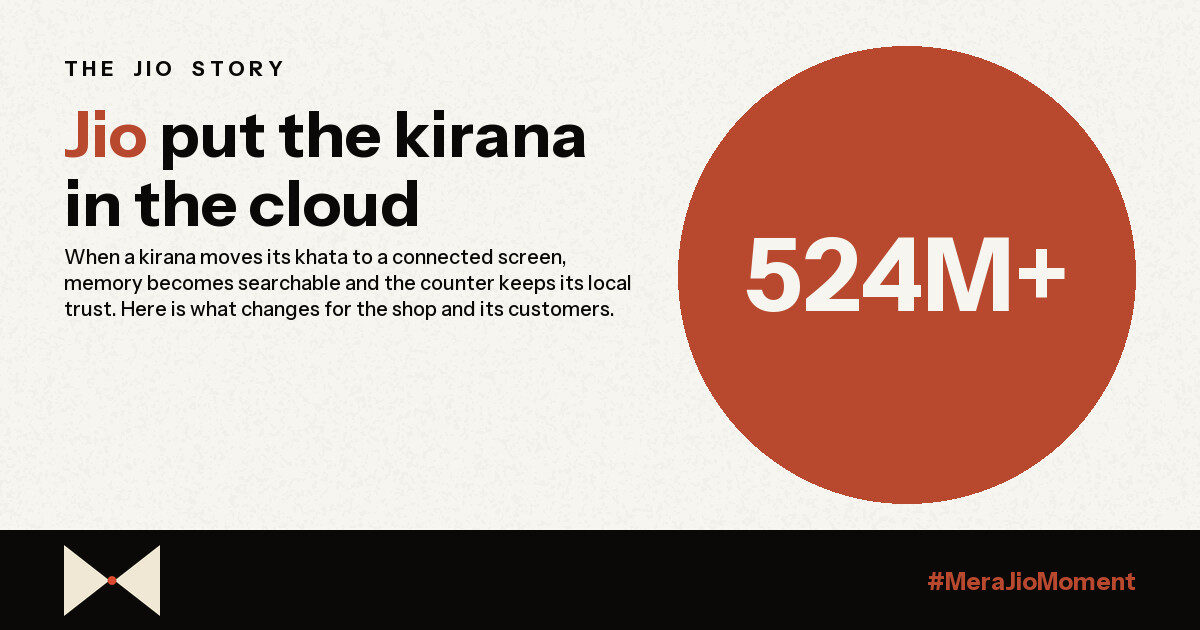
Jio’s ecosystem now spans connectivity, entertainment, commerce, payments, devices, cloud and AI (Reliance Industries 48th AGM, August 2025). Its stated priorities include digitising businesses and bringing digital services home (Reliance Industries 48th AGM, August 2025). That layer is now everyday infrastructure: Jio serves 524 million+ customers (Reliance Jio Infocomm, March 2026; company-reported). For the neighbourhood shop, the tools are no longer the interesting part. The behaviour is.
The shop wins when the familiar stays familiar
Small kiranas do not need to become apps. They need to stay themselves with a better memory. The digital khata is most useful when it reduces effort behind the counter and leaves the relationship out front. The shop remains local; its recall becomes cloud-deep.
That is the real change from khata book to cloud: not a screen on the counter, but a second memory that survives the evening rush, a torn page and a new helper’s first week.