Why Brand Strategy Turned McDonald’s -2.1% Into +6.9%
Why turnarounds stall when CEOs treat brand as separate from operations, and what McDonald's, Nissan, IBM and LEGO did differently.
In January 2003, McDonald’s reported its first quarterly loss: $344 million for the final three months of 2002. The signs were already visible in the stores. Comparable sales were slipping, service was inconsistent, and customers had fewer reasons to choose the chain.
When Jim Cantalupo returned as CEO, he refused to treat this as only a cost problem. His team built a Plan to Win around an ambition customers could understand: to become their “favorite place and way to eat.” People, Products, Place, Price and Promotion stopped competing as separate initiatives and became operating commitments tied to that promise.
Brand decline shows up in the numbers first
Most CEOs will see the symptoms before anyone says “brand problem.” Buyers visit less often, negotiate harder, defect more easily, or demand discounts to overcome a competitor’s pull. Those behaviors erode revenue quality, pricing power, lifetime value and margin.
When cash runs short, leadership cuts expenses, sells assets and reorganizes. But a CEO who cannot tell wasted spending from capabilities customers value may improve this quarter’s numbers while accelerating next year’s decline. Sears entered bankruptcy in 2018 after years of underinvestment in experience, merchandise, service and digital capabilities. Kodak filed for protection in 2012 because its technical edge couldn’t replace the economics of the film business it was losing.
The winners rebuilt the reason to choose
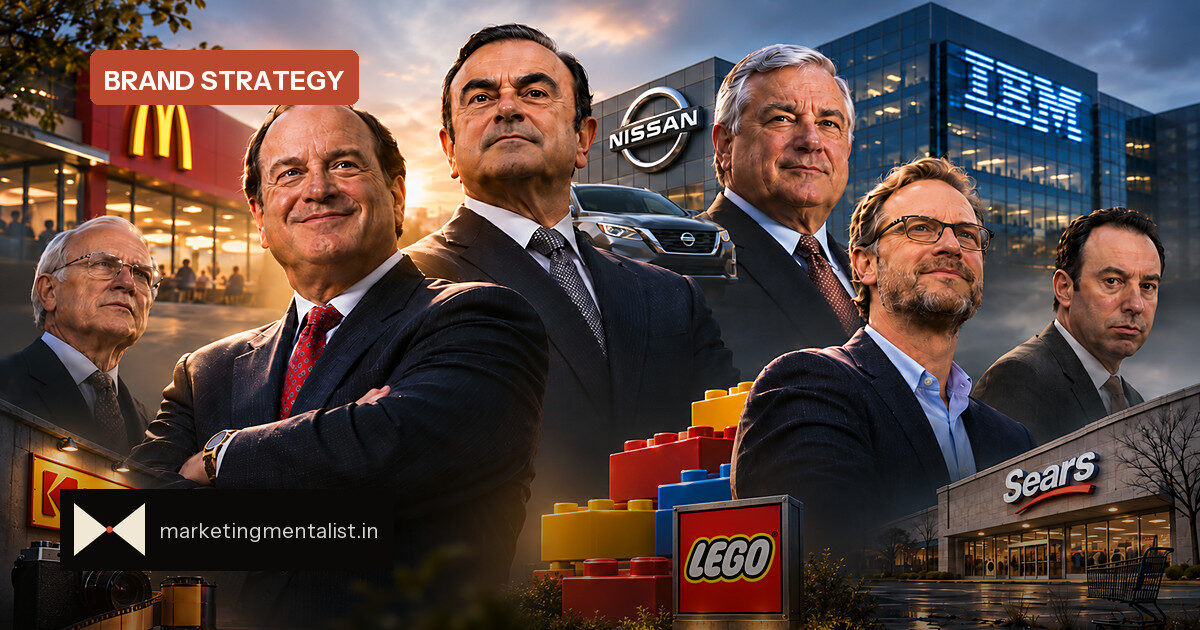
McDonald’s benefited quickly. Global comparable sales moved from a 2.1% decline in 2002 to growth of 2.4% in 2003 and 6.9% in 2004. Nissan’s 1999 crisis was also a brand problem. Carlos Ghosn’s revival plan renewed products and design direction while cutting costs. By fiscal 2001 Nissan had a 7.9% operating margin and roughly ¥432 billion in net automotive debt. IBM was losing $8.1 billion in 1993 when Lou Gerstner kept the company together around integrated technology and services; it returned to profitability in 1994. LEGO, almost undone by complexity, simplified operations and reinvested in its building system, reaching DKK 35.8 billion in revenue in 2015.
Put the whole business on one page
A useful turnaround starts with Purpose and Promise, then translates them into the five action Ps and Performance. The promise must change resource decisions, employee behavior and customer outcomes. If it never changes a decision, the plan is unfinished.
The first 90 days prove the plan
- First 15 days: build a 13-week cash forecast, find where margin and customers are leaking, and talk to former customers, lost prospects and frontline staff.
- By day 30: settle where the business can win and what it will stop; assign an executive to each commitment.
- Days 31–60: make improvements visible to customers. Fix service failures, remove buying friction and protect value without reflexive discounting.
- By day 90: compare retention, purchase frequency, price realization, margin and cash against the opening baseline, then scale what works.
The board should not just ask how cash is being saved. It should ask why customers will choose the company again. Every month that question goes unanswered gives competitors more time to win the loyalty and margin the business is losing.