How Naturals Grew From 125 to 175 Stores on an Ingredient Promise
Naturals scaled from 125 to 175 stores on a no-artificial-ingredients claim, sub-1% ad spend, and a franchise consistency risk.
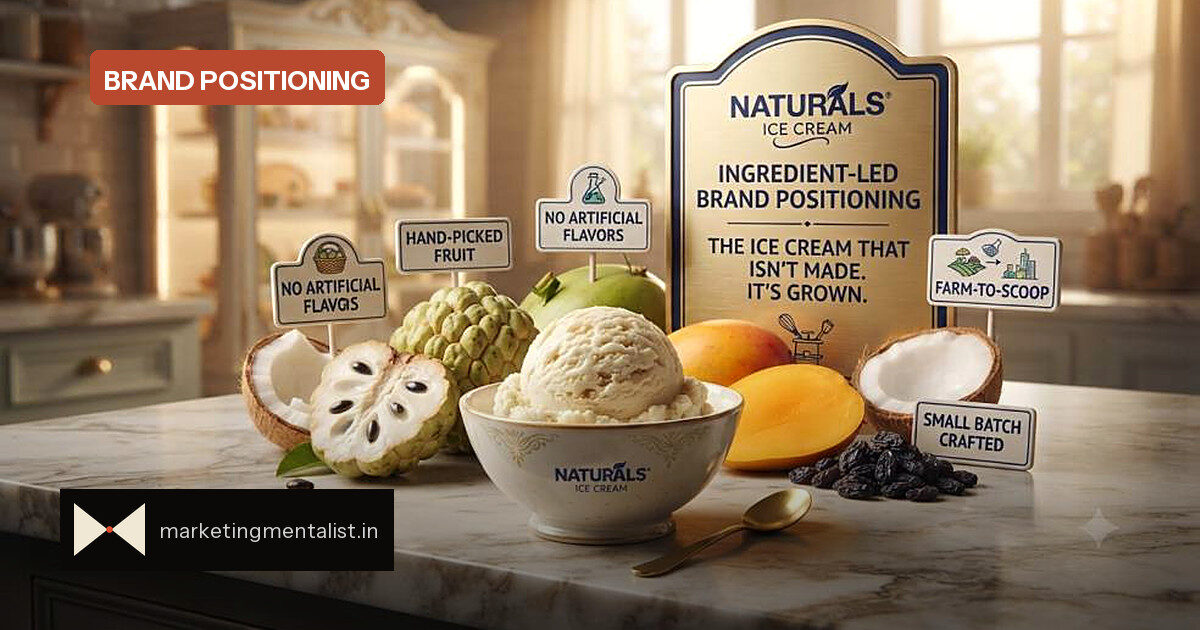
Naturals Ice Cream has built a 175-store brand on what many brands treat as a legal claim, not a marketing strategy: real fruit, real milk and no artificial additives. The interesting part is that the product, not paid media, does the heavy lifting.
The category backdrop is fragmented and consolidating. Public market estimates range from Rs9,000 crore in a 2019 report to Rs30,000 crore in a 2025 trade report, with organised and unorganised players roughly split in the newer figure. Hindustan Unilever has demerged its ice cream business into Kwality Wall’s (India) Ltd, and regional players have been acquired or scaled. In that field, Naturals’ differentiation has to be hard to copy.
The product is the promise
Naturals started in Juhu, Mumbai, in 1984 as a pav bhaji business, with ice cream initially given to draw customers. Founder Raghunandan Srinivas Kamath, whose father was a mango vendor, asked why ice cream couldn’t have real fruit instead of just fruit flavour. That insight became the brand’s positioning.
By 1994 it was known as the ‘Ice Cream of Juhu Scheme’. In 2017 the name changed from ‘Natural’ to ‘Naturals’, and the tagline ‘Taste the Original’ now frames the brand against earlier additive-heavy formulations. The central claim is simple: fresh fruit pulp, milk and sugar, with no artificial flavours, preservatives or stabilisers.
A credence claim, not a taste test
Here’s the marketing problem. A shopper cannot easily verify ‘no artificial flavours’ or ‘no preservatives’ at the counter. That makes the positioning a credence attribute: consumers accept it on trust, based on consistency over time.
The brand’s numbers reinforce a product-led model. Entrepreneur India reports advertising below 1% of sales revenue. Crisil Ratings reports that raw materials exceed 50% of sales for the Kamath group, and operating margins moved between 12.11% and 17.71% across FY22-FY24. Instead of spending to build imagery, the company spends on ingredients.
- The ice cream parlour is both channel and proof point.
- Low ad spend works only while retail consistency and word of mouth hold.
- Input-price swings mean the differentiator carries commodity risk.
Scale is the real test
The store network climbed from 125 outlets in January 2019 to 175 by February 2025, across more than 15 states. Yet Maharashtra still gives 45-50% of group revenue. Reported plans include entering states like Uttar Pradesh and Punjab, launching exotic-fruit, kulfi and mithai-inspired ranges, and reaching Rs500 crore revenue by FY27.
The sharpest tension is the retail mix. Business Standard reported a 2019 plan of one company-owned store for every five franchisee outlets. For a brand that sells ingredient integrity, a franchise-heavy rollout makes every outlet a consistency experiment.
What brand managers can do
For any product-led claim, ask which assets defend it: sourcing, process or accumulated trust. Naturals’ case suggests an ingredient promise can do serious brand work if operations accept the cost and consistency burden. The public revenue data is also a reminder to triangulate: IndiaRetailing reports Rs294.02 crore for FY24, while Crisil reports Rs374.20 crore for the same period.
Treat your supply chain, franchise standards and store experience as marketing investments, not just cost centres. If the product is the campaign, consistency is the creative director.
Source: MarkHub24