
Hyundai India’s 20% Women Executive Target Is Brand Strategy
Hyundai India wants women in 20% of executive roles by 2030, up from 8%. Why this talent target is really an employer branding and trust play.
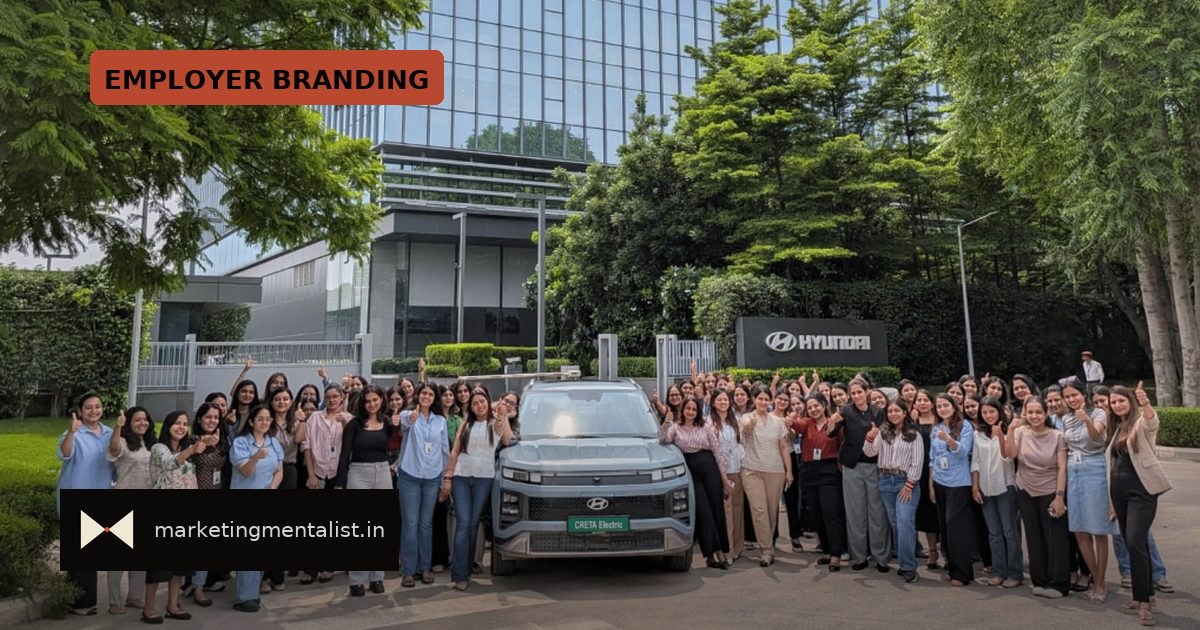
Hyundai Motor India has set a number that HR teams will read as a diversity goal and brand strategists should read as positioning: 20% women in its executive workforce by 2030, up from just over 8% today.
That executive workforce stood at 4,068 employees in FY26. So the arithmetic is brutal but clear — the company has to roughly double representation in four years while simultaneously scaling headcount across manufacturing, engineering, R&D, sales, service and corporate functions.
What Hyundai actually announced
According to Storyboard18, the intake pipeline is already moving faster than the leadership layer. Women made up about 45% of Management Trainees and Engineer Trainees hired in 2026. Women also recorded a 23% promotion or elevation rate in FY26, per the company.
The supporting machinery is fairly specific rather than slogan-led:
- Gender-balanced hiring, wider campus outreach and competency-based assessments.
- Women @ Work 2.0 — maternity and parental support, childcare assistance, workplace flexibility and return-to-work continuity.
- TrailblazHER — mentorship and leadership development for high-potential women.
- Infrastructure — crèches at manufacturing plants, wellness spaces, safety and mobility measures, plus preventive health programmes.
MD and CEO Tarun Garg framed it as widening opportunity and strengthening the talent pipeline, arguing that varied experiences and perspectives make teams stronger and support innovation.
Why it sits next to a ₹45,000 crore bet
Context matters. Hyundai has committed ₹45,000 crore through FY2030 to manufacturing, electrification and future mobility, with 26 new products and variants planned, exports targeted at around 30% of production by 2030, and capacity rising to 10.74 lakh units a year by 2028. Indian operations have already crossed 13.5 million cumulative sales with exports to 150 countries.
Electrification, software-defined vehicles and advanced manufacturing change the skill mix a carmaker needs. When the required talent profile shifts, the cheapest source of new capability is usually a pool you were previously under-recruiting from. Read that way, the 20% target is less charity and more supply-chain logic applied to people.
The branding lesson: claims vs. proof assets
Most employer branding fails because it is adjectival — “inclusive”, “people-first”, “caring”. Adjectives are cheap and therefore ignored. What persuades is costly signalling: commitments that would be expensive or embarrassing to fake.
A crèche inside a manufacturing plant is a costly signal. A public, dated, numeric target is a costly signal, because it invites future scrutiny. A named leadership programme with real mentors is a costly signal. “We value diversity” on a careers page is not.
Use a simple three-part test on your own employer narrative:
- Is it falsifiable? A number with a year attached can be checked. A vibe cannot.
- Does it cost you something? Budget, infrastructure or reputational exposure.
- Can an employee verify it on day 30? If the lived experience contradicts the campaign, the campaign becomes evidence against you.
The gap that will decide the story
Here is the interesting tension. Entry-level intake at 45% and executive representation at 8% describe two different companies existing inside one org chart. The bottleneck for most firms is not attraction; it is retention and the mid-career promotion cliff, usually around caregiving years.
That is why the return-to-work and flexibility pieces matter more to the 2030 number than any campus roadshow. Filling the funnel is a marketing problem. Keeping it full is an operations problem — and consumers, candidates and journalists will eventually judge the brand on the second one.
For brand managers, the takeaway is uncomfortable but useful: a public target converts a soft value into a hard promise. It buys you credibility now and creates an accountability event later. If your organisation is unwilling to accept the second half of that deal, it has not really made a commitment — it has bought an advertisement.
Source: Storyboard18