58% of Marketers Court AI Answers—and Volatility Follows
When AI answers stop naming your brand, is it the engines or your content? Learn to use market benchmarks to diagnose volatility before you react.
The problem: AI answers refuse to sit still
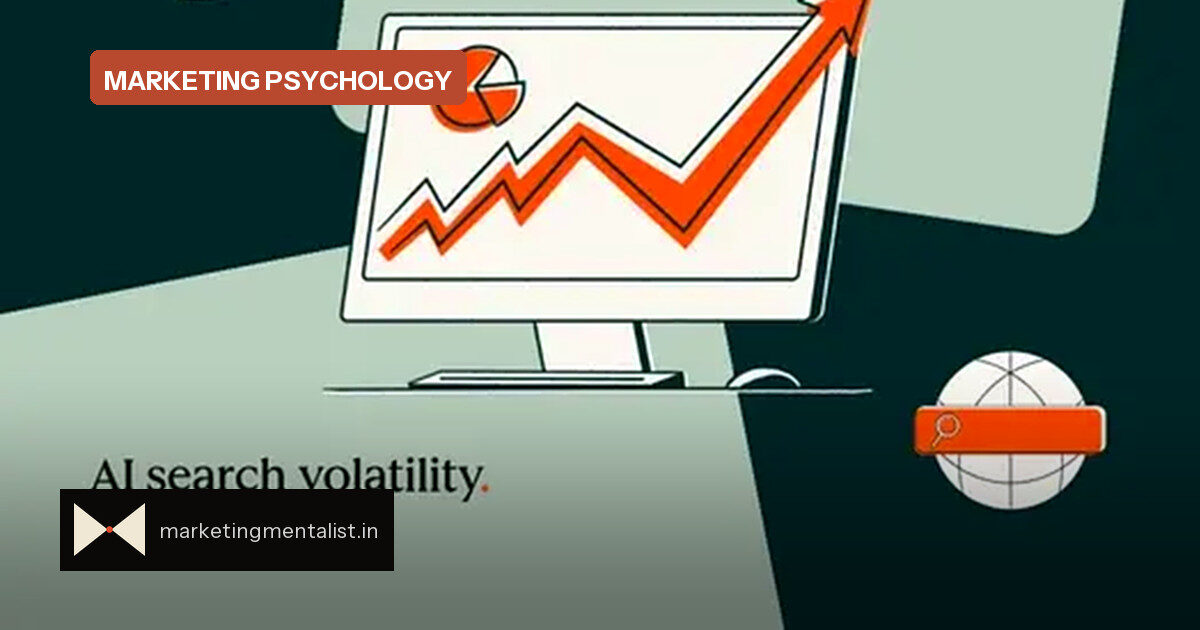
Last quarter, 58% of marketers said their companies were optimizing content specifically for answer engines like ChatGPT, Gemini and Perplexity. That is not a niche experiment; it is the new search battlefield. But unlike Google rankings, an AI answer does not give you a stable position to check. One model update can change which brands an engine names, cites, or sends traffic to.
That volatility is built in. LLMs are non-deterministic: when SparkToro and Gumshoe.ai ran the same recommendation prompts repeatedly in late 2025, ChatGPT and Google’s AI Overviews/AI Mode had less than a 1-in-100 chance of returning the same brand list twice. So a sudden visibility dip can be noise, not a strategy failure.
Read the market before you read your own report
The practical question is what a brand manager does when AI-referred traffic drops. The wrong move is to panic and rewrite everything. The right move is to work out whether the drop is market-wide or brand-specific.
A daily volatility score helps. It tracks four signals—mention rate, citation rate, citation type and AI-referred traffic—across ChatGPT, Gemini and Perplexity, and rates each day on a scale from Calm to Extreme. Pair that score with your own brand-level AEO data.
- Elevated or Extreme, and your metrics dropped: likely a market-wide shift; note what changed before adjusting.
- Calm, but your metrics dropped: investigate your content, visibility or tracking—the problem is likely closer to home.
- Elevated or Extreme, but you held steady: your content is outperforming the market; record what you are doing.
Why rank tracking alone now misleads you
Ranking volatility and AI volatility overlap but are not the same. Pages that rank well in Google are more likely to be cited by answer engines—a correlation, not a guarantee. Yet AI overviews suppress traditional clicks: Pew Research Center’s analysis of March 2025 browsing data found pages with an AI summary led to a traditional-result click in 8% of visits, versus 15% without one. A page can hold its rank and still lose traffic.
That is why traffic alone is a weak KPI. As Ann Handley put it, traffic helps gauge reach, “but it’s misleading when it stands alone for success.”
What to do next
Start with consistency. Use the same prompts (branded and unbranded), the same answer engines, one region and language, and a weekly window. Then compare your brand visibility with the market benchmark. If both slide together, wait. If yours slides while the market stays calm, audit your citation share, content types and channels.
Watch content-type shifts too. In one analysis, blog posts earned the highest citation rate in Google AI Overviews at 42%, while comparison content led ChatGPT at 95%. A format that works on one engine may not move the others. Third-party channels—review sites, UGC, affiliates—often carry more weight in AI citations than owned content, so an owned-only strategy can miss the biggest gap.